Lead Hook
Volkswagen's second-generation T-Roc is already the brand's third best-seller, behind only the Golf and the Tiguan, according to Auto Express. That ranking is the real headline of the publication's new six-month long-term test — not the pretzel drawings. A compact SUV selling at that volume is not a design statement; it is the load-bearing wall of VW's European business. How its trim ladder is priced tells you more about the company's priorities than any designer briefing about character.
Deep Dive
According to Auto Express, the range opens at £31,990 for Life, rises to £32,495 for Match, £36,660 for Style and £39,155 for R-Line. Read those four numbers as a ladder and the shape of the business becomes visible. Life to Match costs £505. Match to Style costs £4,165. Style to R-Line costs £2,495.
That middle rung is the anomaly. Auto Express reports that the Style and R-Line mainly focus on visual upgrades over the rest of the range — the publication's own characterisation, and a single-source claim. If it holds, the £4,165 step from Match to Style is where VW's margin concentrates: the buyer pays a four-figure premium for appearance rather than powertrain, chassis or software content. The long-term test car is a Style. The publication is not living with the £31,990 entry car; it is living with the profit centre.
Then there is the equipment story. Auto Express states that even the base Life gets an eight-inch digital driver's display, a 12.9-inch central touchscreen, wireless Apple CarPlay and Android Auto, LED headlights, a rear-view camera and adaptive cruise control. Those are single-source figures, not independently confirmed. But the pattern matters: VW is front-loading visible, showroom-comparable technology into the cheapest trim. Screen size is a spec-sheet weapon — it is the first thing a buyer sees, and the easiest thing a rival's brochure can be beaten on.
Yet the same cabin exposes the cost constraint. Auto Express reports that VW is backtracking on touch-sensitive buttons, but that the touch sliders below the screen remain, mitigated only by a new rotary volume and driving-profile controller on the centre console, with physical buttons retained on the steering wheel. That is a partial correction, not a reversal. The hardware that most annoyed owners survives where removing it costs money per unit; the hardware that can be swapped cheaply got swapped.
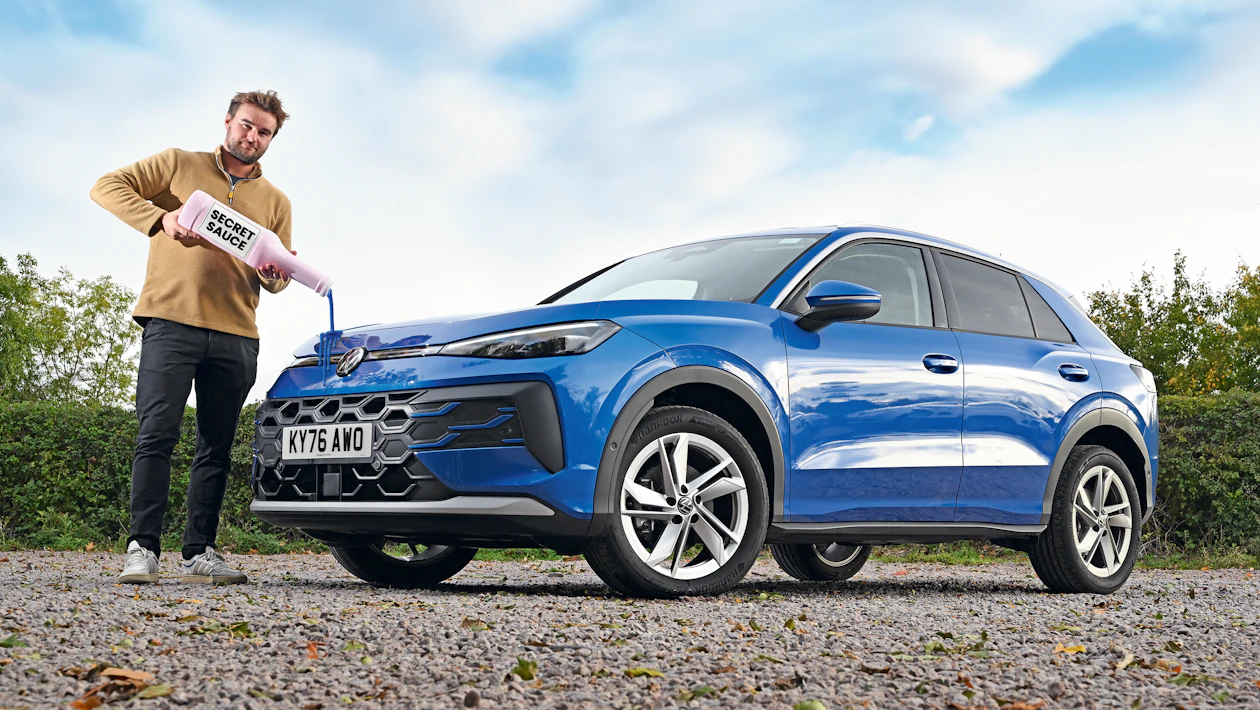
Which reframes the design story entirely. Auto Express says VW design chief Andy Mindt described the car under three principles — Stability, Likeability and Secret Sauce — with the last covering unexpected details: swimmer graphics in the wireless charging pad, pretzel, ice-cream and suitcase drawings in the console, a T-Roc-and-surfboard graphic on the rear window, and weighted wheel caps on R-Line. Those are single-source details. They are also, functionally, low-cost differentiators — exactly what a manufacturer reaches for when the expensive differentiators are unavailable.
The corroborated core is narrower but solid. What Car?'s independent version listing matches the tested car to a T-Roc 1.5 eTSI MHEV Style SUV, five doors, petrol-hybrid, DSG, Euro 6, 150 PS — the same powertrain identity the long-term test describes. Other outlets reviewed the same model: The Telegraph's review headline framed it as economical and good to drive but less fun than before, and DriverReviews built its 2026 assessment around whether it is the best compact SUV to buy. Neither supplies pricing detail.
Audit & Contradictions
The fact-check record for this piece is low-contradiction and high-single-source. No supplied material contradicts the article. But almost everything commercially interesting rests on Auto Express alone.
Specifically unverified: all four prices; the Life and Match equipment lists; the claim that the original T-Roc sold more than two million units and that the new car is VW's third best-seller behind the Golf and Tiguan; every Secret Sauce design detail; the build-quality impressions, including the door thunk and premium-material claims; and the writer's report of covering more than 2,400 miles in the first month. The generation claim — that this is the second-generation car — is also single-source, since the What Car? listing identifies the variant but not the generation.
Two things the piece does not say are as telling as what it does. First, it defers driving impressions to future reports, so this instalment is effectively a build-quality and cabin verdict dressed as a car verdict. Second, the build-quality praise is framed against a baseline of recent VW shortcomings — the source notes some of the brand's recent offerings were found lacking in this area — which is an admission embedded inside a compliment. A same-outlet Auto Express follow-up about build-quality doubts is not independent corroboration of that point, whatever reassurance it appears to offer.
Future Outlook
The competitive read is straightforward. If a 12.9-inch screen and adaptive cruise now anchor a £31,990 compact SUV, rivals priced above that must justify the gap with something a showroom visitor can feel in ten seconds. Visual-only upper trims become harder to defend as screens commoditise across the segment.
For VW, the risk runs the other way. The T-Roc's volume position gives it pricing power, but the trim ladder shows where that power is being spent: on appearance-led upgrades rather than the ergonomic fixes owners actually asked for. If the touch sliders remain a live complaint across a six-month test, the Secret Sauce narrative will read as garnish over a cost decision — and that third-place sales slot will look less like proof of excellence than proof of inertia in a segment where buyers default to the badge they already trust.