Lead Hook
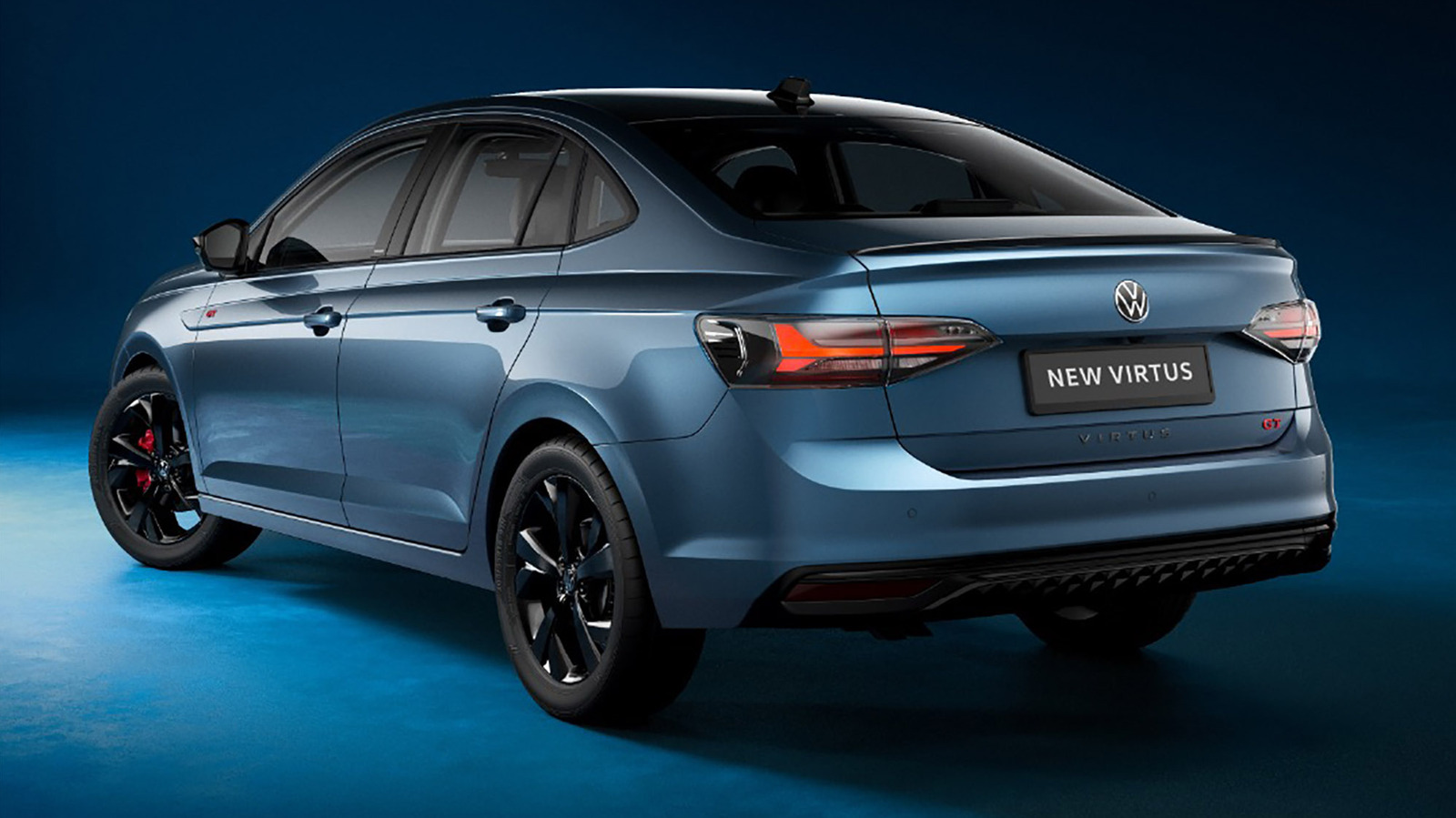
Volkswagen’s smallest sedan is not dead—it is being kept alive where the market still wants it. According to CarScoops, VW has released the first official photos of an updated Virtus ahead of an India market launch expected next month, with detailed trim structure and pricing to follow closer to a launch expected in December 2026. The refresh is incremental: a redesigned lower front-bumper mesh, smaller fog lights, body-colored inserts, new black alloy wheels, a fresh blue paint option, revised taillight graphics, and black rear-diffuser trim. The larger signal is strategic: while VW might be ready to axe the ICE-powered Polo from its European lineup in favor of the electric ID Polo, the sedan remains part of VW’s emerging-market playbook. In India, the company says nearly one Virtus has been sold every 24 minutes since 2022, with high demand for the flagship GT trim and automatic transmissions. That sales claim is single-source and should be treated as company-reported demand rather than independently verified market data.
Deep Dive
The outgoing Virtus measures 179.6 in (4,561 mm) long, which is 5.6 in (141 mm) shorter than the U.S.-spec Jetta, per the source. That size helps explain its absence from North America, where the larger Jetta remains VW’s entry-level sedan. In Europe, the source says the only VW-branded sedan is the fully electric ID.7, while the Passat has transitioned to an estate-only lineup. The updated Virtus, by contrast, is designed primarily for emerging markets and might reach Latin America over the next few years, although with market-specific features. The source presents that possibility as a “might,” not a confirmed rollout.
Under the skin, the update appears to lean on an existing localized platform rather than a new architecture. The Virtus is built on the localized MQB-A0-IN architecture, which also underpins the Skoda Slavia, Skoda Kushaq, and VW Taigun. The source says it remains to be seen whether VW engineers changed the suspension setup. The first photos depict the GT trim, described by the source as the sportiest and most expensive member of the lineup, with red brake calipers contrasting the new blue shade. The exterior changes are modest enough that the car remains instantly recognizable; the profile is largely unchanged.
Powertrain details are not official. VW did not share specifications, but the source expects the updated sedan to retain the turbocharged 1.5-liter TSI four-cylinder engine rated at 148 hp (110 kW / 150 PS), mated to a seven-speed DSG dual-clutch automatic. Another expected option is the entry-level turbocharged 1.0-liter TSI three-cylinder producing 113 hp (85 kW / 115 PS), paired either with a six-speed manual or a new eight-speed torque-converter automatic. Because these are expectations rather than confirmed specifications, they should be treated as likely carryover or incremental updates, not announced facts. The same caution applies to interior technology: judging from the interior of the recently facelifted Slavia, the Virtus will likely get the same 10.1-inch infotainment display with AI-infused software and a larger 10.25-inch digital instrument cluster with new graphics. The current Virtus already includes ventilated seats, wireless charging, and six airbags; the update might add features such as rear massaging seats and a 360-degree camera.
Audit & Contradictions
The announcement, as reported, leaves several questions unanswered. It does not confirm final trim structure, pricing, suspension changes, or whether the expected powertrains and interior tech will actually appear. The source says detailed trim structure and pricing will be announced closer to launch. Outgoing pricing is given as ₹1,070,900 (about $11,300) to ₹1,919,900 (about $20,300) for the limited-production Virtus Anniversary Edition; these are single-source figures from the same report. The claim that the update mirrors the recently facelifted Skoda Slavia is also single-source, as is the history that the Virtus was originally introduced in late 2017, looking like a stretched Polo sedan, and arrived in India in 2022 with a comprehensive facelift.
On corroboration, the evidence is thin. CarDekho’s headline supports that a 2026 Volkswagen Virtus update or spied model exists, but it does not corroborate specifications, pricing, dimensions, or launch timing. The matching CarScoops headline appears to be the same source rather than independent confirmation. CarExpert and Consumer Reports items in the provided feed are unrelated. No contradictions were identified in the provided material; the contradiction level is low. The fact-check summary states the report is internally consistent, with most detailed claims single-source.
Future Outlook
The refresh points to a segmented product strategy: electrification and consolidation in Europe, ICE retention and incremental updates in price-sensitive markets. By mirroring the Slavia facelift and reusing the MQB-A0-IN platform, VW can spread development costs across multiple models and brands while keeping a sedan in a segment where competition is strong. The risk is that modest styling and equipment changes may not be enough to defend share if rivals refresh more aggressively. For buyers outside India and, possibly, Latin America, the updated Virtus remains forbidden fruit: North America keeps the Jetta, and Europe’s VW sedan role has shifted to the electric ID.7. If the Latin America possibility materializes, it would extend the life of an ICE sedan in another emerging market, but the source presents that only as a might, not a plan.