Lead Hook
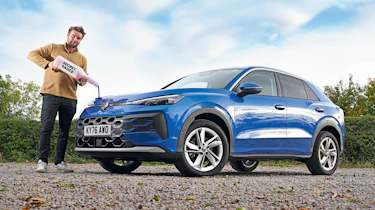
Search for the Volkswagen T-Roc eTSI 150 Style long-term test and Auto Express serves you a picture gallery. The headline promises motoring journalism's most useful format — months of accumulated evidence about what a car is genuinely like to live with — and the page delivers photographs, a photographer's credit and a block of commercial small print. Per Auto Express, the images come from "our latest VW T-Roc eTSI 150 Style long-term test," shot by the outlet's senior photographer, Pete Gibson. What the page does not carry is a single figure on economy, price paid, reliability or a final verdict. That gap is the real story: the long-term test's most searchable artefact is now its gallery, and the evidence can trail behind the imagery.
Deep Dive
The car itself is not in doubt. What Car? lists the exact variant as the "Volkswagen T-Roc 1.5 eTSI MHEV Style SUV 5dr Petrol Hybrid DSG Euro 6 (s/s) (150 ps)" — an independent specification page that corroborates the identity Auto Express encodes in its headline and URL. Read that string closely and you find the entire technical payload of the primary source compressed into a model designation: 1.5 eTSI, MHEV, Style trim, five doors, petrol-hybrid, DSG, Euro 6, 150 PS.
It is also, for a buyer, a genuinely confusing label set. Three separate descriptors — "eTSI," "MHEV" and "Petrol Hybrid" — stack up on the same car, and nothing in the gallery explains what any of them commit the owner to. The designation does not, on its face, tell a shopper whether the car can run on electricity alone, how large the battery is, or what the hybrid hardware costs at resale. Those are exactly the questions a long-term test exists to answer. Broadly, the industry has shifted toward electrified badges that blur the line between mild assistance and plug-in capability; this page, in isolation, adds no clarity to that fog.
What the page does contain, in volume, is commercial apparatus. Auto Express discloses that its "Find A Car" service is managed by Carwow Ltd, part of the Carwow Group, and sets out that Carwow Ltd and Carwow Leasey Limited are credit brokers rather than lenders, with Financial Conduct Authority firm reference numbers listed on the page. The only numerals of substance on the entire gallery sit inside that disclosure: an illustration built on personal contract hire, a nine-month upfront fee, a 48-month term and 8,000 miles annually, inclusive of VAT and excluding fees. Those are template financing terms, not test findings. The page's copyright line credits Carwow Studio Limited, 2026.
The gallery also carries two editorial teasers rendered as site furniture: one promoting Mercedes "Display in Glass" technology that puts screens on the outside of cars, another declaring that the new Dacia Sandero Hybrid takes the "UK's cheapest hybrid" crown. Neither is developed, sourced or dated within the page. They are navigation, not reportage — and a reader arriving from search has no way to tell the difference without clicking away.
The economics behind this shape of page are not mysterious, and they are industry-wide rather than unique to this outlet. Photography is comparatively cheap to publish and rich in search and social surface area; a running-cost log requires months of fuel receipts, servicing invoices and a settled verdict. When a fleet vehicle is returned or a slot closes, the pictures remain publishable long after the data has stopped arriving.
Audit & Contradictions
The fact-check audit for this material records contradiction level Low, with no contradictions identified among the provided documents. That is the correct verdict, and it should not be mistaken for a clean bill of health. The audit is low-contradiction because the page barely asserts anything checkable.
Four claims are single-source and must be hedged accordingly. First, that this specific car sits on Auto Express's long-term fleet — asserted only by the outlet's own headline and URL, with no independent confirmation. Second, the Pete Gibson credit, which is a publication-internal attribution no outside outlet can verify. Third, the framing word "latest," which implies a series of instalments whose findings are not present here. Fourth, any evaluative implication carried by the phrase "long-term test" — running costs, reliability, liveability — for which the supplied page body contains no supporting figures.
Absent entirely: price, fuel economy, performance data beyond the 150 PS badge, CO2, insurance grouping, servicing costs, warranty terms or a conclusion. Auto Express's wider T-Roc coverage is real and current — its own build-quality feature and R-Line review appear in Google News listings, alongside a What Car? 2026 review and a DriverReviews 2026 assessment — but those listings confirm activity, not the contents of this gallery.
The practical hazard is editorial, not factual. Republished without care, a photo caption becomes a verdict by implication, and a mild-hybrid badge becomes an efficiency claim. Anyone drawing conclusions from this page is drawing them from typography.
Future Outlook
Two pressures now converge on this format. Commercially, finance-broking disclosure is expanding on publisher motoring pages, which means the most rigorously worded numbers on a car page may soon be the APR illustration rather than the fuel log. Editorially, rivals are already competing on structured specification pages — What Car?'s version listings exist precisely because buyers want the label decoded, not photographed.
For Volkswagen, the mild-hybrid naming stack is a marketing asset and a comprehension liability at once; the clearer the industry makes the MHEV boundary, the less a three-acronym badge can do unpaid work. For competitors, the opening is evidentiary: a long-term test with receipts published beside the pictures is a durable differentiator that a gallery cannot copy. For readers and for the outlets that serve them, the test is simple — if the accompanying article text exists, publish it linked and dated; if it does not, the gallery should not be dressed as a result.