Lead Hook
Stellantis' SEMA headline is deliberately theatrical: a 1967 Plymouth GTX that appeared two years ago with an electric powertrain now returns with a supercharged Hemi, framed by Stellantis American brands boss Tim Kuniskis as an apology to the person who sold the company the car. According to CarScoops, the new build is rated at 885 hp (897 PS) and up to 787 lb-ft (1,067 Nm), versus a feeble 335 hp (340 PS) for the earlier EV setup. That is the number that will travel. The more important journalistic question is what the announcement does not establish: beyond title-level Google News corroboration, the independent record does not verify the performance, dimensional, historical, or crate-count claims attached to the story.
Deep Dive
The source describes the GTX as arriving for 1967 as Plymouth's rival to the Pontiac GTO, and says the base engine was a 440 cu in (7.2-liter) Super Commando V8 producing 375 gross hp (380 PS) and 480 lb-ft (651 Nm), with the optional 426 cu in (7.0-liter) Hemi rated at 425 hp (431 PS) and 490 lb-ft (664 Nm). It also cites a November 1966 Car and Driver test in which a 440-equipped car with skinny bias-ply tires and a three-speed automatic reached 60 mph in 6.0 seconds. These are historical claims attributed to the source; independent outlets in the provided corroboration do not verify them.
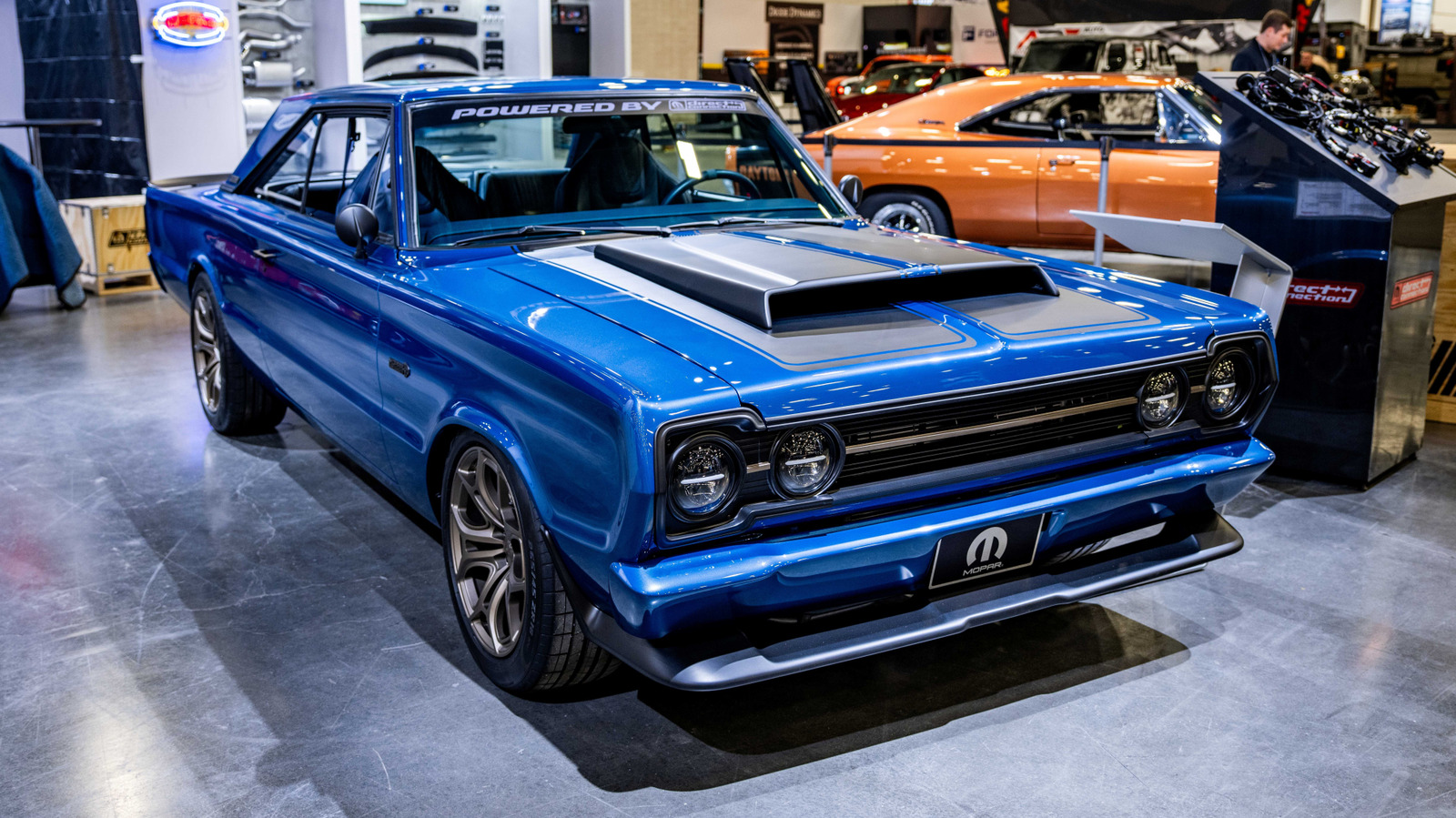
For the SEMA car, the source says it is finished in Frostbite Blue metallic and rides on 18-inch BTG Vintage Bronze forged magnesium wheels, just as it did at SEMA two years ago, but now has twin silver racing stripes and a hood scoop. Air into that scoop feeds a Hellcrate Redeye 6.2-liter supercharged Hemi crate engine package, one of the powertrain options Stellantis announced at this year's event. The source attributes 885 hp and up to 787 lb-ft in high-octane mode to that package, with rear-wheel drive through a TorqueFlite 8HP90 eight-speed automatic transmission. The phrase "high octane mode" is not defined in the source, and no fuel specification, price, availability, or emissions information is provided.
The crate-engine pitch is broader than one show car. Kuniskis is quoted as saying: "Our philosophy is simple: one part, one solution," and "If you're going to build something serious, you shouldn't have to guess whether all the pieces are going to work together." According to the source, Stellantis has bundled modern Hemi crate engines with a matching engine controller to create turnkey solutions for shops and DIYers. The enumerated packages are a 345 cu in (5.7-liter) unit rated at 385 hp (390 PS) and 417 lb-ft (565 Nm); a 392 cu in (6.4-liter) version rated at 485 hp (492 PS) and 475 lb-ft (644 Nm); and a 376 cu in (6.2-liter) Hellephant Super Stock rated at 1,025 hp (1,039 PS) and 945 lb-ft (1,281 Nm). The source calls the Hellephant "king of the crates," which is editorial language rather than a technical classification.
Audit & Contradictions
The most concrete problem in the record is numerical inconsistency: the source says the restomod would have its work cut out against "one of the six Stellantis crate V8s," yet it details only three crate packages—the 345, 392, and Hellephant Super Stock. That leaves three packages unenumerated in the provided material. A reader cannot tell from the source whether those omitted packages are additional displacements, tuning levels, or simply a counting error. This is a Medium-level contradiction in the fact-check audit, not a trivial wording issue, because it affects how complete the product story is.
Single-source status applies to almost every technical and historical figure here: the 885 hp/787 lb-ft Hellcrate Redeye output; the 335 hp EV output; Frostbite Blue paint and 18-inch BTG Vintage Bronze forged magnesium wheels; the original 440 and 426 Hemi ratings; the 6.0-second 0-60 claim; the crate outputs; and Kuniskis's quotes. The provided corroboration is limited to title-level Google News entries, including headlines matching "Mopar's EV-Swapped GTX SEMA Car Finally Gets The Hellcat It Deserves" and "Mopar's Plymouth GTX Electromod Saves The Planet By Killing The V8." Those listings support that Mopar showed an EV-swapped 1967 Plymouth GTX at SEMA 2024 and that a Hellcat/Hellcrate-swapped version is now being covered. They do not independently verify horsepower, torque, engine, transmission, wheel, paint, historical, or 0-60 claims. Google News listings also carried CarScoops and inkl headlines, but no independent technical verification is present in the provided material.
The "less than impressed" seller is also single-source. The source says the guy who sold Stellantis the car was less than impressed by the EV conversion, and Kuniskis says, "We heard him, so this year we fixed it," and "We put a supercharged Hemi back under the hood, and I have a feeling he's going to like this version a whole lot better." Those quotes are verbatim in the provided material, but the underlying anecdote is not corroborated by an independent outlet. Likewise, the source does not state the seller's identity, the terms of the sale, the cost of either conversion, or whether the EV version was retired, displayed, or repurposed.
Future Outlook
The announcement is best read as a product-strategy signal rather than a simple nostalgia play. Kuniskis's turnkey framing suggests Stellantis wants to reduce friction for builders who might otherwise source and calibrate components separately. If that bundled-controller approach is executed as described, it could make high-output V8 swaps more accessible to shops and DIYers; if not, the marketing claim will be tested by integration problems the source does not address. The broader tension is between an EV showcase that the source says was rated at 335 hp and a V8 replacement rated at 885 hp, with the latter presented as the crowd-pleasing correction. Whether that reflects durable enthusiast demand, a one-off SEMA narrative, or a hedge against electrification uncertainty is not answered by the provided material. What is clear is that the most shareable number—885 hp versus 335 hp—rests on a single source, and the crate lineup count does not reconcile with the packages actually described.