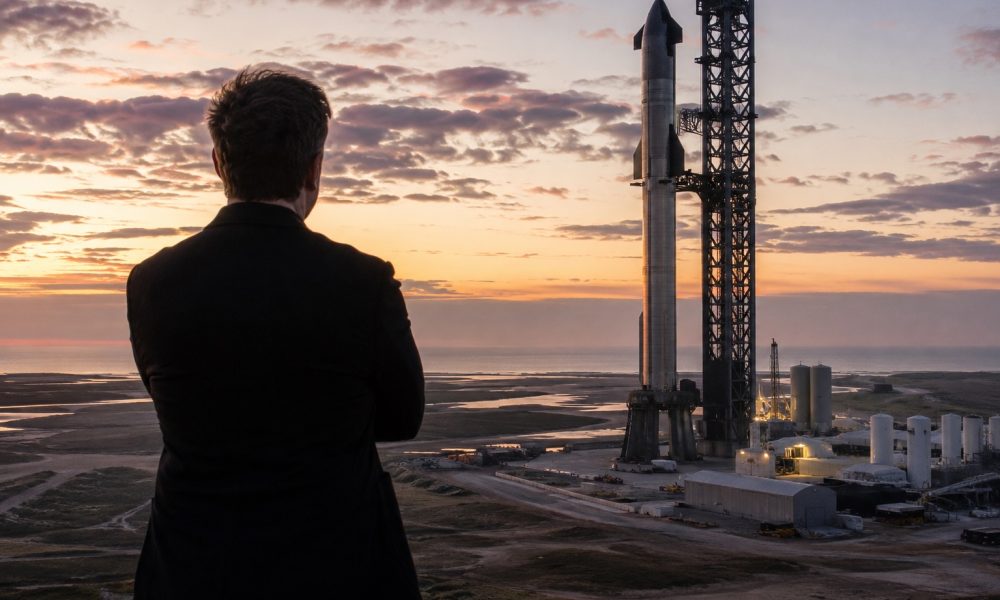
Lead Hook
The countdown to Friday, November 13 has an unusual provenance: for the first time, the launch date for Starship Flight 15 came directly from a SpaceX executive, rather than from Federal Aviation Administration air traffic planning slides. SpaceX Vice President of Launch Kiko Dontchev shared the target on stage at the UP.Summit on Thursday, according to Ars Technica's Eric Berger, who was in attendance — a detail Teslarati reports that matters more than it looks. When the date itself is the announcement, the substance lives elsewhere: in the launch license that has not yet appeared, and in a maneuver that would put the company on the edge of a first in spaceflight history.
The mission, per Teslarati, is set up as the first attempt to catch the Starship ship itself with the launch tower — the same chopsticks maneuver SpaceX has already executed three times with the Super Heavy booster. What makes Friday the 13th newsworthy is not another booster catch. It is the attempt to bring an upper stage back from orbital velocity and set it down on the pad it left from.
Deep Dive
The hardware story (in the version Teslarati relays) reads like a checklist nearly complete. Teslarati, citing testing coverage from NASASpaceflight, reports that Booster 22 fired all 33 of its Raptor engines for a full-duration static fire at Pad 2 on October 25. Ship 42 followed with a single-engine burn simulating a deorbit maneuver on October 26, then a 60-second firing of all six engines the next day. That single-engine deorbit burn is a telling detail: a ship catch is only meaningful if the vehicle can actually come home from orbit, and a deorbit simulation is the rehearsal for the return leg itself. Ship 42, per the same reporting, had already rehearsed the catch in September, when the Pad 2 arms lifted it into position and crews connected the quick disconnect arm while the vehicle hung from the tower.
The trajectory change is the quiet revolution here. According to Teslarati, every Starship flight so far has ended over open ocean; bringing the ship home means a reentry path that heads toward land. That single sentence is where most of the regulatory anxiety will concentrate, and readers should hold the two halves of the story together for that reason. SpaceX President Gwynne Shotwell said in October that, after "significant constructive engagement with the FAA," she expects the license to cover a return to the launch site and a tower catch for both stages — but Teslarati notes the FAA's Starship page did not yet list a Flight 15 license at the time of publication.
Expectations are hedged even inside SpaceX. On the company's third quarter earnings call — ten days after Musk said at Giga Texas on October 10 that the flight would "probably launch a little bit before Thanksgiving" — Musk confirmed Flight 15 would try to catch both stages, and put the odds of a successful ship catch at "more likely than not."
"more likely than not."
Attribution matters with that line: it is Teslarati's account of the earnings call, not an independent transcript in the provided material. Even the framing Teslarati gives the attempt is Musk's own: he has called a successful ship catch "the first time that there's been full recovery of an orbital class rocket," and — per the same report — has already named the step after it, a Flight 16 in which both the booster and the ship fly again.
Audit & Contradictions
Here is what the announcement does not say. The date is the only claim with independent legs: the fact-check audit confirms The Independent explicitly reports the Friday, November 13 target, and an Ars Technica report is consistent with a launch the following week, with its headline noting SpaceX has declared Starship ready for orbit. The Bing-syndicated item in the material is a duplicate of the same Teslarati article and does not count as corroboration. Everything else is single-source: the Flight 15 designation, the first ship-catch framing, the booster and ship test specifics, the claim that Flight 14 on September 28 was the first Starship to reach orbit and deployed 26 Starlink V3 satellites before splashing down despite an early engine shutdown Musk blamed on engine-computer software, the prior booster catches on Flights 5, 7 and 8, the FAA page status, Shotwell's license expectation, and the December static-fire plan for Ship 43. The audit found no contradictions among these claims, rating the contradiction level Low — but readers should treat the operational details as the company's narrative, relayed through specialist outlets, until the FAA docket says otherwise. NASAASpaceflight's reporting aside, no regulatory document in the provided material confirms a license covering land-overflight reentry exists at all.
Future Outlook
The real story of Flight 15 is that the hardware, as reported, is done — and the regulator still holds the last card. Until the FAA's Starship page lists the license, the November 13 date is a promise, not a permit, and the precedent it would set — orbital-class upper stages returning toward populated land paths — will shape how every launch operator, of any nationality, negotiates reentry corridors for the next decade. If the estimate of the ship-catch odds proves optimistic and the catch errs toward rough seas or a tower miss, SpaceX has already telegraphed the next act: a Flight 16 where both stages fly again. The industry's reusable-rocket race has officially moved from "can it land" to "can it come home."