Lead Hook
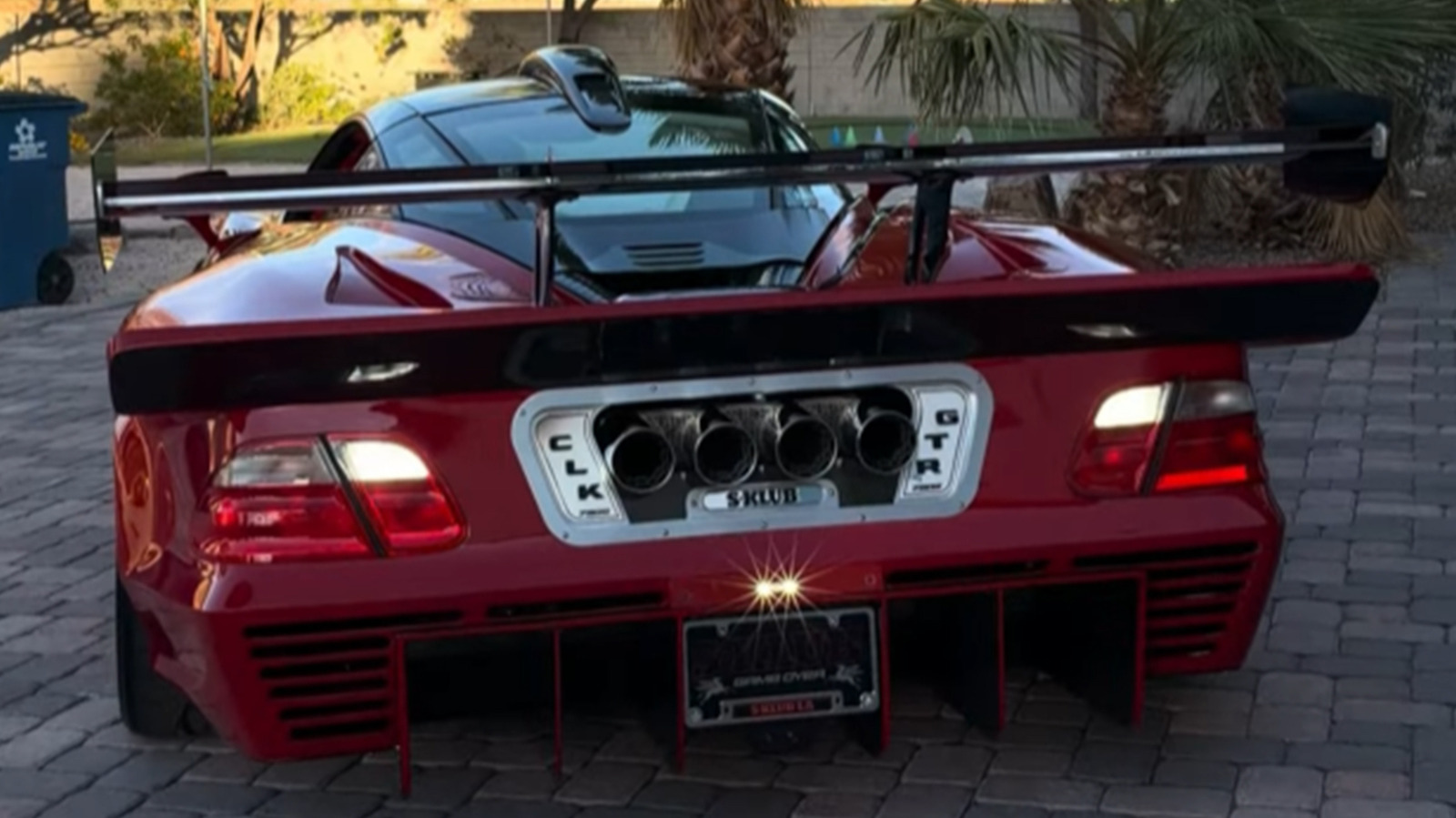
The headline is irresistible: an American firm has turned a McLaren 750S into a Mercedes-Benz CLK GTR lookalike for this year’s SEMA Show. CarScoops reports that S Klub LA, which it says previously unveiled a dramatic speedster version of the Mercedes-Benz SLR McLaren, is behind the build. Yet the same account makes clear that the car is not a ground-up recreation. It is a heavily re-skinned 750S whose McLaren identity remains visible from the windshield back, and whose most provocative economic claim—that real CLK GTR models are worth “in excess of $10 million”—is presented without supporting evidence. The announcement’s real value lies less in proving a replica can fool the eye than in showing where modern coachbuilding stops when donor architecture, cost, and fidelity collide.
Deep Dive
Per CarScoops, “it appears almost all exterior panels from the donor 750S have been replaced.” The front receives quad headlights in the Mercedes style, a sleek black grille, a low-slung bumper, a black chin spoiler, wide front fenders, and aero-disc inspired white wheels. From a distance, the source says, the proportions and design cues give it “just as much road presence” as the original. That is the sales pitch: a car that can borrow the silhouette and theater of a hyper-rare machine without requiring access to one.
The deeper mechanics are less seamless. According to the same source, from the windshield back the McLaren underpinnings become apparent. The roof looks identical to a regular 750S, and the car appears to retain original McLaren door skins. Those doors are “far more flowing, and much larger” than an original CLK GTR’s doors, and are “somewhat at odds with the rest of the design.” The rear quarter panels also look like those of the 750S, though with flared fenders for a widebody effect. In other words, the build’s hardest compromises sit exactly where a true replica would need to be most convincing: in the cabin glass line, door geometry, and rear haunches that define a car’s identity.
The rear is where S Klub LA appears to have done the most original work. CarScoops reports a new tail with CLK-inspired taillights, a large lip spoiler, and a fixed carbon fiber rear wing, plus a “wild carbon diffuser.” The tuner did not replicate the original exhaust layout; instead, it retained the 750S’s four central quad exhausts, now with chrome tailpipes. That choice is telling. It preserves the donor car’s functional packaging and likely avoids re-engineering the rear structure, while still delivering a dramatic rear view. The source does not say whether performance, cooling, or emissions characteristics changed, and it provides no cost, build time, or client details.
Inside, the 750S’s original cabin layout has been retained because, per the source, “trying to build an interior to mimic the CLK GTR would be extremely laborious and expensive.” Custom touches include new red leather across the driver’s seat, steering wheel, dashboard, and door panel, while the passenger side is finished in plush quilted white leather. Again, the announcement leaves out the economic question it invites: if the interior is retained for labor and cost reasons, how much of the project is visual theater versus comprehensive transformation? The source offers no answer, and no independent outlet corroborates the automotive claims.
The source also frames the project morally and economically: “As real CLK GTR models are worth in excess of $10 million, we’d argue modifying a McLaren to look like a CLK GTR is much better than trying to modify and upgrade an original.” That is an editorial judgment, not a verified market statement. The fact-check audit accompanying the material flags the “in excess of $10 million” figure as unverified. No valuation methodology, no transaction evidence, and no donor-car cost are provided. The claim may be directionally plausible to enthusiasts, but in an investigative sense it remains an assertion attached to a single article.
Audit & Contradictions
The audit record is blunt: no independent outlet corroborates the automotive claims. The only related item is the same CarScoops story surfaced through Google News; the other listed items are unrelated. Therefore, every substantive claim in this piece remains single-source, including the conversion itself, the prior SLR McLaren speedster project, the retained McLaren elements, the interior treatment, and the unverified valuation figure. There are no contradictions identified, and the contradiction level is low. That does not make the report false; it means the evidentiary base is thin and the reader should treat descriptive details as reported, not independently confirmed.
What the announcement does not say is as important as what it does. There is no independent verification of the build’s authenticity, no statement about who commissioned it, no price, no performance data, no durability or safety information, and no discussion of intellectual-property or trademark considerations around replicating a Mercedes-Benz design on a McLaren donor. The source’s “sacrilege” framing is cultural commentary, not evidence. The fact that the car “almost looks like a real one” from afar is also a carefully limited claim: it is about appearance at distance, not about passing expert inspection or preserving originality.
Future Outlook
If this approach spreads, the aftermarket may increasingly treat ultra-expensive halo cars as visual targets rather than engineering benchmarks. The S Klub LA build suggests a business logic: use a modern, relatively accessible supercar as a donor, then spend on bodywork and trim to approximate a machine that is effectively unattainable. But the same build shows the ceiling of that logic. When rooflines, doors, and quarter panels remain donor-derived, the result is a tribute with visible seams—compelling in photographs, less convincing up close, and potentially complicated for valuation, insurance, and resale.
For competitors, the lesson is that extreme visual transformation can generate attention without requiring a ground-up chassis. For buyers, the lesson is to separate spectacle from substance: a dramatic exterior does not by itself establish performance, authenticity, or value. For regulators and market observers, the more interesting question is whether future “tribute” builds will be marketed with increasingly bold economic comparisons, such as the unverified “in excess of $10 million” figure here, without the documentation that would make those comparisons defensible. Until independent sources or the tuner itself provide cost, provenance, and performance data, this remains a striking single-source story about design ambition and its limits.