Lead Hook
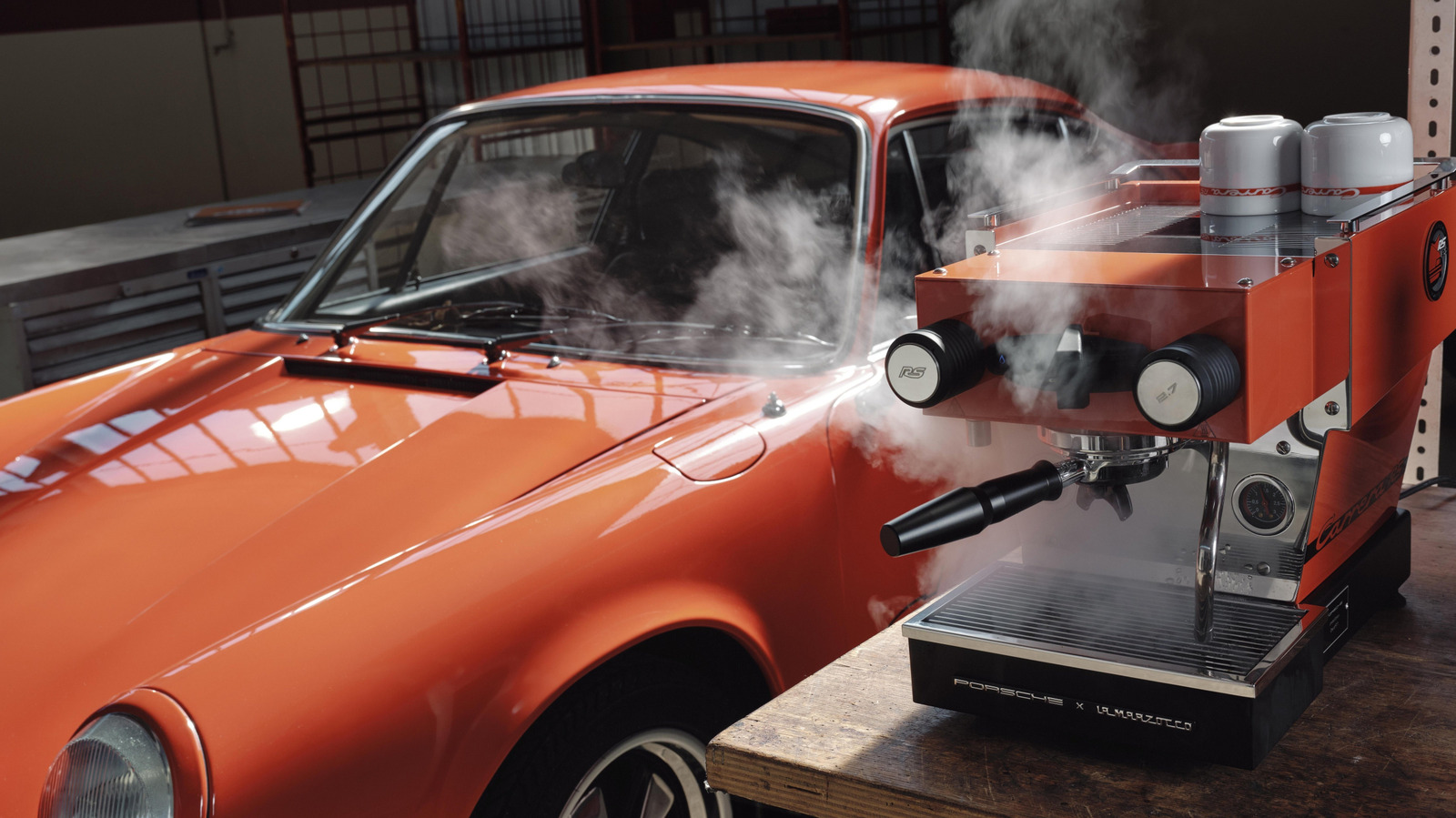
Porsche's newest product is not a car, and the interesting part is not the ducktail spoiler. It is the price. The La Marzocco Linea Micra special edition will set buyers back $7,911 before tax, CarScoops reports — a number lifted straight off the car it imitates. That is the tell. This is not a kitchen appliance priced against other kitchen appliances. It is a heritage asset priced against a 1972 homologation special, and the espresso is almost incidental to the exercise.
CarScoops is candid about the awkwardness, asking whether any of the design work explains why the machine is “evidently worth” the figure and answering, in effect, probably not. That admission is more revealing than the press material.
Deep Dive
Strip away the livery and the hardware is a known quantity. The machine is built on La Marzocco's Linea Micra platform, according to CarScoops, and carries a convertible three-in-one portafilter for single-spout, double-spout and bottomless setups, a two-litre water tank, an insulated steam wand, LED lighting, and app-based control of temperature and brew scheduling. Luxe/Outlook India, reporting the same collection independently, confirms each of those specifications, along with the ducktail-inspired cup rail and the analogue manometers with red and green indicators.
The tribute details are likewise corroborated rather than merely claimed: Carrera RS lettering with the historic Porsche logo, laser-engraved RS and 2.7 markings on the black handles, a magnetic RS 2.7 badge, and a side plaque reading “One of 911.” Luxe/Outlook India describes the same list. The historical frame is the best-documented part of the story — the 911 Carrera RS 2.7 was presented in 1972 as a 500-unit homologation model, was the first 911 to carry the Carrera name and side lettering, and earned its ducktail nickname from the shape of its rear spoiler, per the same outlet.
What the corroboration does not cover is the arithmetic of scarcity. CarScoops reports that production is capped at 911 examples per paint colour, that American buyers can choose only white-and-green or tangerine-and-black, and that Germany gets an additional white-and-blue run of 150 units. That is three scarcity tiers stacked on one product: a model-number cap, a regional cap and a colour cap. None of those figures appears in the independent coverage in this file, which lists all three colourways without regional limits or unit counts.
The grinder follows the same logic. Modelled on La Marzocco's Pico and finished in matching colours, it is priced at $2,125 before tax, per CarScoops, bringing the combined set to $10,036 before tax and shipping. The arithmetic is internally consistent — the two figures sum exactly — but internal consistency is not corroboration. CarScoops also reports that the brands' earlier espresso machine, priced at $7,000, sold out in eight hours. If accurate, that is the commercial justification for the entire exercise: scarcity converts a durable-goods purchase into a timed event.
Audit & Contradictions
The fact-check rating here is Low, and that should be stated plainly: nothing in the corroborating material conflicts with CarScoops. The disagreement is about emphasis, not fact.
But the single-source exposure is unusually concentrated in the numbers. Every dollar figure in the story — $7,911 for the machine, $2,125 for the grinder, $10,036 for the set, $135 for a coffee aroma tin, $69 for barista napkins, $105 for a matching two-pack of espresso cups and saucers, roughly $35 for other cup designs — traces to CarScoops alone. So does the claim that each colourway is limited to 911 units; the corroborating text is truncated mid-sentence at the relevant point, so that figure is not fully confirmed even there. So does the Germany-only, 150-unit white-and-blue variant. So does the grinder's specification sheet: three memory settings, stepless grind adjustment, manual grinding, a magnetically adjustable portafilter and a self-closing hopper. So does the eight-hour sell-out of the previous machine.
Readers should treat those as company claims relayed by one outlet, not as settled fact. The prediction that the new machines will sell out equally fast is explicitly the writer's speculation and should be read as such. Matching headlines from Interesting Engineering, Yahoo and Luxurylaunches confirm the collection exists; none of them confirms a price.
There is also a quieter omission. Neither account discloses who manufactures the hardware, what the base Linea Micra costs without the livery, or how the $7,911 figure was derived. The number's resemblance to the car's model name is never explained as anything other than coincidence.
Future Outlook
The template is now visible, and it is portable. An automaker with a deep heritage catalogue owns paint codes, typefaces, badge geometry and race history — assets that cost nothing to license and depreciate only if the brand does. A specialist manufacturer owns the engineering. The car company supplies provenance; the partner supplies the boiler. Capital exposure is close to nil, and the margin sits in the story rather than the steel.
Expect more of it, and expect the caps to get tighter. The 911-unit ceiling is doing real work: small enough to sell through, large enough to be worth tooling, memorable enough to function as marketing copy on its own. A 150-unit regional variant is the same trick at smaller scale, aimed at collectors who treat appliance purchases as allocation events.
The risk is dilution. Scarcity only prices when it is credible, and a brand that releases a limited edition every season trains its buyers to wait. The test is whether these runs actually clear, and whether Porsche or La Marzocco ever publishes the sell-through. Neither has, so far, in the material available here.