Lead Hook
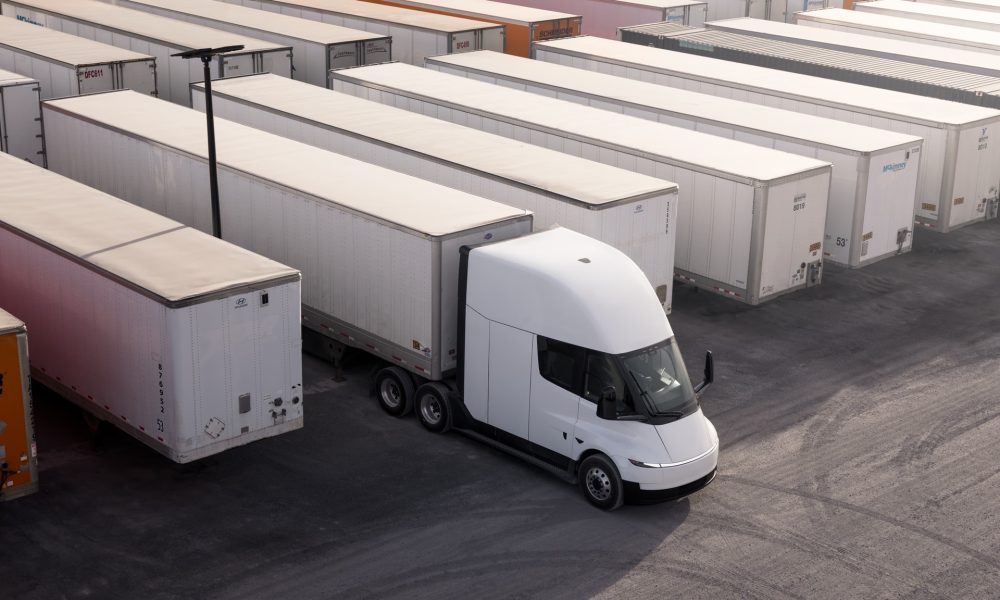
A 500-unit order from Swedish freight company Einride AB is being celebrated as the Tesla Semi's largest order to date — and it is, by a significant margin. But beneath the headline lies a more complicated story about production ramp timelines, phased delivery schedules, and the gap between order placement and actual deployment.
According to Teslarati, Einride announced the order following its second-quarter earnings call on August 18, 2026. The trucks will be deployed on Einride's Saga AI fleet intelligence platform, serving major clients including Amazon across logistics routes in five U.S. states. The electrek.co news outlet independently corroborated the order size, the Saga AI platform detail, and the deployment scope, confirming this as the largest Tesla Semi order to date.
What the announcement does not address is whether Tesla's Sparks, Nevada production facility can actually deliver 500 units on a phased two-year schedule — and what happens to the autonomous-driving features that were originally supposed to define this truck.
Deep Dive
The operational details of the Einride order reveal a carefully structured deployment rather than a single bulk delivery. Per Teslarati, the deployment will be carried out in several phases over the next two years, with Einride receiving its first Semi units in September. Production is ramping at Tesla's dedicated Semi facility in Sparks, Nevada — a detail independently confirmed by electrek.co's coverage.
The Saga AI platform is central to understanding why this order matters beyond unit count. According to the Teslarati report, Saga AI enables scaled adoption of electric trucks for freight use by allowing shippers to integrate electric capacity without the operational burden or capital risks of managing a fleet. This means Einride is not simply buying trucks — it is building a platform on which other companies' freight moves. The 500 Semis will serve large companies including Amazon, extending Einride's electric freight network across California, New Jersey, Texas, Illinois, and Georgia.
The geographic spread is notable. These five states represent distinct regulatory environments, climate conditions, and charging infrastructure maturity levels. California leads on EV freight policy, but Texas, Illinois, and Georgia each have different incentive structures and grid considerations. Deploying a single truck platform across all five simultaneously is an operational test that goes far beyond what Tesla's earlier pilot programs demonstrated.
Those pilot programs matter here. The Teslarati report notes that Frito-Lay and PepsiCo have worked with Tesla for several years to refine the Semi's efficiency and operational components, work that even catalyzed design changes unveiled earlier this year. This design-change claim appears only in the Teslarati article and has not been independently confirmed by other outlets covering the story.
Einride CEO Roozbeh Charli framed the order as evidence of operational maturity:
This deployment is yet another proof point that we can execute at the scale our customers demand. Working closely with Tesla to bring next-generation Semis into active operations quickly and at scale is a testament to the strength of that partnership, and how quickly this technology is maturing from promise to daily operations.
Tesla's Director of the Semi Program, Dan Priestley, emphasized the economic case, noting that EV heavy trucks provide lower costs per mile through fuel savings, reduced maintenance, and better uptime versus diesel, with savings increasing further when deploying at scale.
Audit & Contradictions
The fact-check audit for this story found a low contradiction level, with the core claims independently corroborated across multiple sources. The 500-unit order figure, the Saga AI deployment, the September first-delivery timeline, the Sparks Nevada production facility, and the existing Frito-Lay and PepsiCo client relationships were all confirmed by electrek.co's independent reporting.
One claim remains single-source: the Teslarati article's statement that Tesla made design changes to the Semi earlier this year, unveiled in response to feedback from pilot programs. No other outlet covering the Einride order has independently confirmed these design changes, and the article does not specify what those changes entailed. Readers should treat this as unverified.
What the announcement conspicuously omits is any discussion of Tesla's autonomous-driving timeline for the Semi. According to electrek.co's reporting on Tesla's Q2 2026 earnings call, Musk said Tesla expects self-driving working on the Semi
probably around the end of this year or early next year.However, in the same answer, he stated that Semi autonomy is
taking a bit of a backseat for the next six months or so.as Tesla focuses on high-volume vehicles including the Model 3, Model Y, and Cybercab. Musk also framed driverless trucks as a benefit to truckers, saying
making it easier on truck drivers to have a self-driving Semi is going to dramatically improve safety and comfort for truck drivers that use the Tesla Semi.
The electrek report notes that Musk has made roughly 10 self-driving and robotaxi deadline predictions since 2013, and every single one that has come due has been missed. That historical context is absent from the Einride order announcement, which presents the Semi as a maturing technology without acknowledging the autonomy gap between promise and delivery.
Future Outlook
The Einride order signals that the Tesla Semi is transitioning from pilot-program novelty to fleet-scale procurement — but the two-year phased deployment timeline is itself an admission that production capacity remains constrained. If Tesla could build 500 Semis faster, the schedule would presumably be shorter.
For competitors in the electric Class 8 space, the order validates the market but also demonstrates the platform approach that may differentiate Einride from traditional fleet operators. The Saga AI model — where a freight intelligence company owns the trucks and offers capacity to shippers — could become a template if the deployment succeeds across its five-state footprint.
The unanswered question is autonomy. If Tesla delivers the 500 Semis over two years without self-driving capability, Einride is buying an efficient electric truck. If autonomy arrives within that window, the economics change fundamentally. But based on the historical track record documented by electrek, the Semi's self-driving timeline should be treated with significant skepticism — and any Einride deployment plan that assumes autonomous capability within the two-year window is building on an untested foundation.