Lead Hook
A 12V battery charger that costs roughly ten times more than basic alternatives sits in an awkward place in the automotive accessories market. Basic chargers are available for under £20, yet CTEK's new CS One Gen 2 commands a significant premium. The question is not whether it charges batteries—it does—but whether the layer of connectivity, diagnostics, and automation it adds justifies positioning a consumer charger as a premium smart device rather than a utilitarian tool.
According to Auto Express, the CS One Gen 2 is "one of the very best chargers you can buy, but you'll pay for the privilege." The Scotsman, which also reviewed the product, corroborates the core technical claims and highlights its app control and diagnostics. Both outlets agree on the fundamental value proposition: automatic detection, button-free operation, and smartphone integration. Where they diverge is on whether that value proposition clears the bar set by its price.
Deep Dive
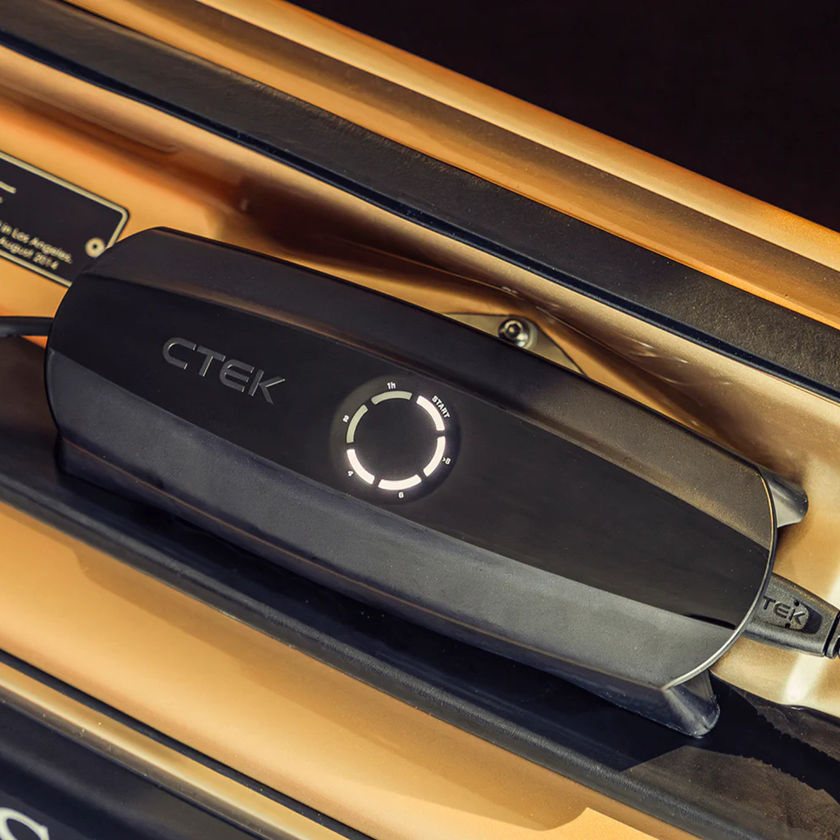
The CS One Gen 2's architecture is built around removing user decisions. According to Auto Express, the charger automatically senses battery chemistry, size, and condition without requiring manual settings. The Scotsman confirms this, describing a "connect & forget" system with no modes or buttons—a design that distinguishes it from CTEK's own best-selling MXS 5.0, which The Scotsman notes remains the "ubiquitous" benchmark.
One feature the Auto Express review highlights is automatic polarity detection. Auto Express reports that instead of the usual black and red leads for the negative and positive terminals, the CS One Gen 2 "senses which way to send the power," which it describes as particularly useful for batteries without clear markings, such as those on classic cars. This is a single-source claim and should be treated as the publication's own assessment rather than independently verified.
The connectivity layer is where the Gen 2 separates itself from its predecessor. According to both Auto Express and The Scotsman, the charger links to a smartphone via Wi-Fi or Bluetooth through a bespoke app. The Scotsman reports that this enables remote monitoring of charging status, which it describes as "surprisingly useful if your car lives outside or tucked away in a garage." The app also maintains charging history and logs, and sends push notifications when charging completes.
Two modes still require manual selection through the app. Auto Express reports a WAKE UP mode for apparently dead batteries and a RECOND phase that uses "special charging patterns" to restore cells. The Scotsman also indicates that the app unlocks extra modes, providing a degree of independent corroboration for the existence of additional functions.
On pricing, Auto Express notes that while basic chargers cost less than £20, the CS One Gen 2 commands roughly ten times that figure. The Scotsman's review does not provide a specific RRP in the available excerpt, but both publications frame the product as a premium offering.
Auto Express reports testing the charger on three batteries of different sizes and types, claiming they were restored to 100 percent "in a few hours" with app updates throughout. This is a single-source claim; The Scotsman's review does not replicate this specific test protocol or report identical results.
Audit & Contradictions
The fact-check audit flags the contradiction level between sources as Low. No direct contradictions exist between the Auto Express and The Scotsman reviews on technical specifications, feature descriptions, or the overall value proposition. The areas of divergence are matters of emphasis and subjective assessment, not factual dispute.
Single-source claims that require hedging include the polarity-detection feature, the three-battery test methodology and results, and the characterization of the product as "one of the very best chargers you can buy." Each of these appears only in Auto Express and should be attributed accordingly.
What the announcement and reviews collectively leave out is competitive context. Neither Auto Express nor The Scotsman benchmarks the CS One Gen 2 against comparably priced smart chargers from other manufacturers. The Scotsman references CTEK's own MXS 5.0 as a cheaper alternative but does not position the Gen 2 against competing app-connected chargers at similar price points. This absence makes it difficult for a buyer to assess whether CTEK's premium reflects genuine technical superiority or brand positioning.
Additionally, neither review addresses long-term reliability, warranty terms, or software support commitments. An app-dependent charger raises questions about firmware updates, app compatibility over time, and what happens if CTEK discontinues software support. These are standard concerns for connected devices but go unmentioned in both reviews.
Future Outlook
The CS One Gen 2 reflects a broader shift in automotive accessories toward app-connected, diagnostic-capable products. The broader implication is that battery care is being recast not as a periodic maintenance task but as a continuous, monitored process. For owners of electric vehicles, classics, and seasonal vehicles, the ability to track battery health remotely aligns with expectations set by connected car platforms. The Scotsman notes this alignment explicitly, observing that the app integration "aligns with how connected cars have become."
For competitors, the CS One Gen 2 raises the question of whether app connectivity and diagnostics will become table-stakes in the premium charger segment. The risk for CTEK is that cheaper competitors replicate the connectivity layer without matching the diagnostic depth, compressing margins in the process.
What remains untested across both reviews is whether the average buyer—maintaining a single daily driver rather than a collection of vehicles—will perceive sufficient value in remote monitoring and automatic detection to justify a tenfold premium over a basic charger. The CS One Gen 2 is a technically impressive product. Whether it is a commercially transformative one will depend on how quickly the market adopts similar features.