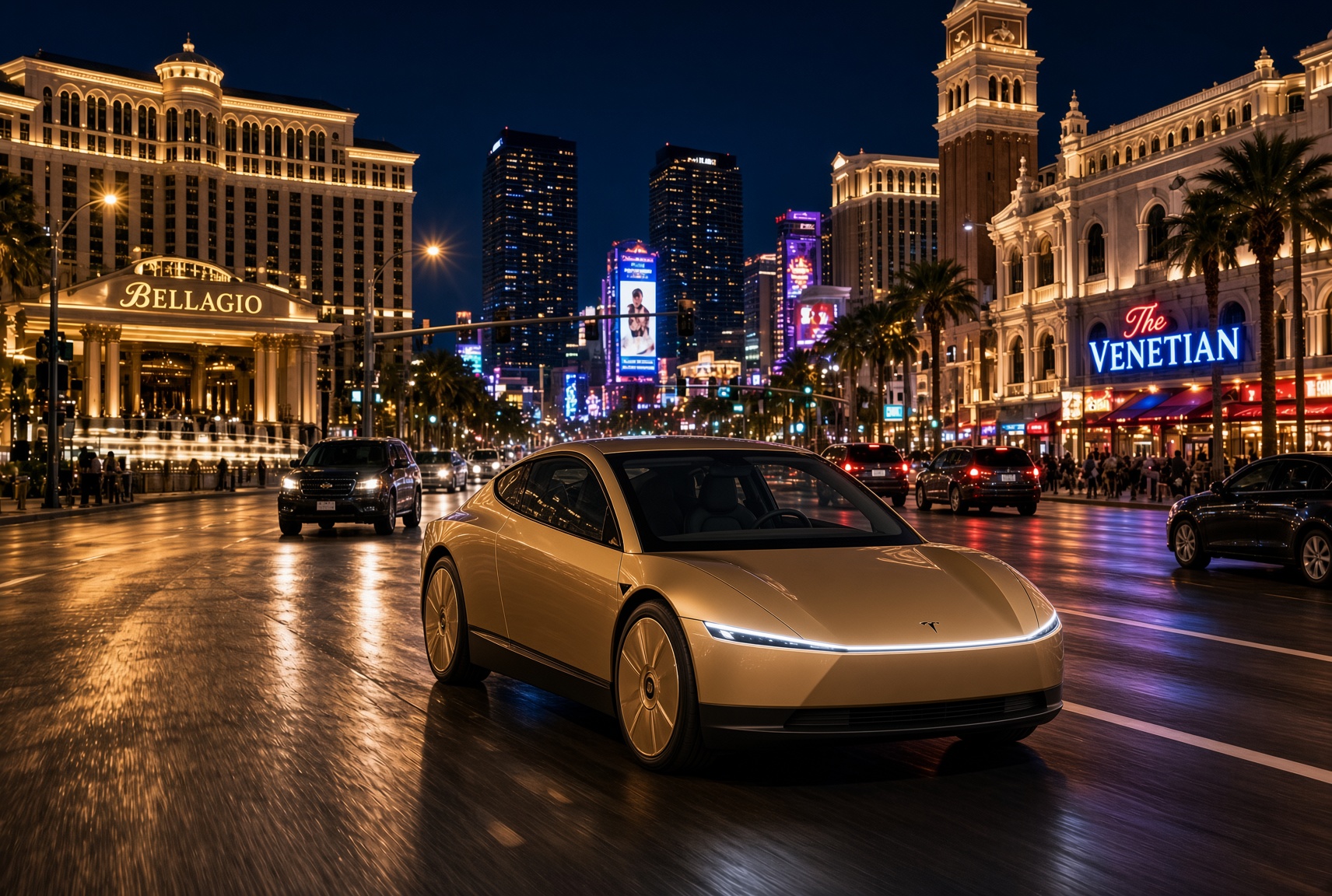
Lead Hook
When Nevada’s Transportation Authority (NTA) finally granted Tesla a robotaxi permit, the headline‑making number was ten – the maximum fleet size the state will allow to operate on the Las Vegas Strip. That figure is a stark contrast to the 5,000‑vehicle fleet Tesla asked for, and it signals more than a bureaucratic footnote. It exposes the regulatory friction, safety expectations, and engineering timelines that could throttle Tesla’s long‑promised autonomous ride‑hailing business across the United States.
Deep Dive
According to Teslarati, the NTA issued an “AVNC Permit 002” (Docket 26‑05015) that authorises Tesla Robotaxi, LLC to run fully autonomous vehicles, but only within a narrowly defined geofence that hugs the Las Vegas Strip corridor. The permit caps the fleet at ten cars and imposes a suite of operational limits:
- Rides may only occur on roads where posted speed limits do not exceed 45 mph.
- Pick‑ups are prohibited within a quarter‑mile of Harry Reid International Airport unless a separate authorization is obtained.
- Each vehicle must display visible “Robotaxi” markings and must notify riders before every trip that no driver is behind the wheel.
- The order explicitly calls for “appropriate human supervision,” a phrase that mirrors Tesla’s own safety‑driver protocol used in parts of Austin since January.
- Any accident, system failure, or stranded vehicle must be reported to the NTA within five business days.
These restrictions are not found in any other outlet and therefore must be treated as single‑source information. They paint a picture of a regulator that is willing to let Tesla test the waters, but only under conditions that keep a human safety net in place and limit exposure to high‑speed corridors.
"appropriate human supervision"
— wording from the Nevada interim order, as reported by Teslarati.
The permit’s modest size is also contextualized by the market landscape. Amazon‑owned Zoox has been operating a robotaxi service in Nevada since last year, with roughly 100 vehicles and about 350,000 rides logged on the Strip. Those figures, cited only by Teslarati, illustrate the operational head‑start Zoox enjoys and may explain why the NTA chose a ten‑car starting point for Tesla rather than the 5,000‑vehicle request Tesla filed in June alongside plans for a maintenance hub in southwest Las Vegas.
From a technical standpoint, Tesla has signaled that it will not meaningfully scale its fleet until its next software iteration, FSD v15, ships. Teslarati reports that the company expects that version to arrive in late 2026 or early 2027. If that timeline holds, the ten‑car cap is a procedural hurdle rather than an immediate capacity constraint; however, the permit’s language leaves open the question of whether Tesla can begin passenger service before the upgrade lands.
Regulatory scholars note that Nevada’s incremental permitting model – granting a small pilot fleet and then allowing scaling contingent on safety performance – mirrors approaches taken in other states. This method forces companies to prove real‑world safety metrics before they can unlock the economies of scale that justify massive capital outlays for autonomous vehicle (AV) fleets.
Financial analysts have warned that Tesla’s robotaxi ambition hinges on rapid, large‑scale deployment to achieve unit‑economics that can compete with traditional ride‑hail services. A ten‑car pilot limits revenue potential and may delay the data collection needed to refine FSD v15, potentially extending the path to profitability.
Audit & Contradictions
The core facts – Nevada’s issuance of a robotaxi permit with a ten‑vehicle cap and Tesla’s original request for up to 5,000 vehicles – are corroborated by multiple outlets, including basenor.com and Built In, which reported the same permit details. The fact‑check audit notes no contradictions across sources.
All other operational specifics – speed‑limit restriction, airport pickup ban, mandatory markings, the “appropriate human supervision” clause, the five‑day reporting requirement, Zoox fleet numbers, the June filing of a maintenance hub, and the projected FSD v15 rollout – appear only in the Teslarati article. As such, each of these points must be presented with a hedge, e.g., “Teslarati reports that…,” to reflect their single‑source status.
Future Outlook
For competitors, the Nevada decision underscores the importance of building a proven safety record before regulators will grant larger fleets. Zoox’s existing 100‑car operation may give it a competitive edge in negotiating broader permits or expanding into neighboring markets.
For Tesla, the permit is a double‑edged sword. It provides a legal foothold in a high‑visibility market, but the operational caps and supervision requirements force the company to demonstrate safety under stricter conditions than it enjoys in Austin. If Tesla can meet those requirements and deliver FSD v15 on schedule, the ten‑car pilot could quickly evolve into a larger rollout, leveraging the data gathered on the Strip’s dense traffic environment.
Regulators in other states are likely watching Nevada’s experiment closely. A successful pilot could set a precedent for more permissive permits elsewhere, while any safety incident would reinforce a cautious, incremental approach. Investors should monitor how quickly Tesla moves from the ten‑car pilot to a larger fleet, as that transition will be a key indicator of whether the robotaxi vision can become a revenue‑generating business line or remains a long‑term aspirational project.