Lead Hook
When Elon Musk told investors that the Tesla Semi’s self‑driving capability should be operational “around the end of this year or early next year,” he set a concrete deadline for a technology many freight operators have been waiting for. Yet the announcement also hints at deeper constraints: a stretched battery‑cell supply, a software team tied to higher‑volume models, and a safety‑centric rollout strategy that could push true autonomy further into the future. For a market plagued by a chronic driver shortage, those hidden factors may be as decisive as the headline timeline.
Deep Dive
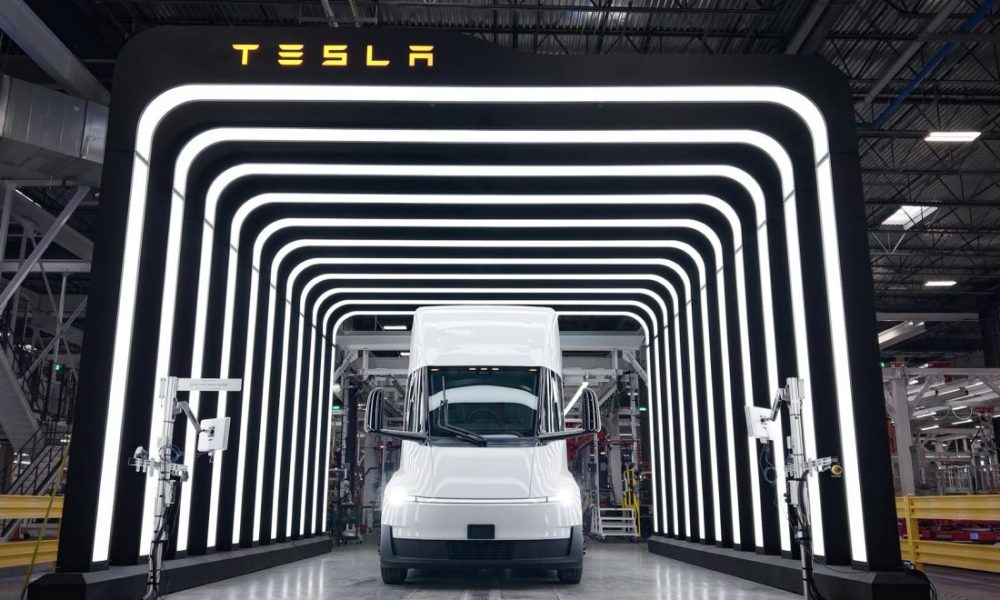
The timeline emerged during Tesla’s Q2 2026 earnings call, where Musk explained that the Semi’s autonomous functionality is slated to be “working” by early 2027. Teslarati reports that Musk qualified the statement as internal validation rather than a public, unsupervised rollout. The distinction matters because the Semi’s hardware is already being equipped for autonomy: analyst Nic Cruz Patane posted video of a production‑ready Semi with ten AI4 exterior cameras integrated directly into the truck’s body, rather than added later as an aftermarket kit.
Beyond the camera suite, the Semi has been seen on public roads with a full validation rig — the same rooftop sensor array Tesla mounts on vehicles ahead of an FSD milestone. Sightings in Sunnyvale and later near Fremont showed the truck sporting the rig and a matching camera array, suggesting that hardware validation is already underway.
However, Musk emphasized that the software team’s attention is currently focused on the Model 3, Model Y, and the upcoming Cybercab, which together dominate Tesla’s fleet. He described the Semi’s autonomy development as “
taking a bit of a backseat for the next six months or so,” and framed the decision as a matter of priority rather than capability. The rationale is tied to what Musk called “the march of nines of safety,” a phrase that underscores Tesla’s emphasis on achieving incremental safety improvements across its highest‑volume vehicles before scaling the same rigor to lower‑volume trucks.
Compounding the software bandwidth issue is the near‑term constraint of 4680 battery‑cell output. Musk pointed to the cell production rate as the primary limiter for both the Semi and the Cybercab, indicating that even if the software were ready, the hardware supply chain could throttle volume ramp‑up. The Q2 shareholder letter, also referenced by Teslarati, promised that the Semi would reach volume production in 2026, but the same source notes that the battery bottleneck could push high‑volume autonomous rollout into the following year.
From a market perspective, the driver shortage — highlighted by Musk’s comment that “
There is a really serious shortage of truckers,” — creates strong demand for any technology that can offset labor gaps. Yet regulators are still shaping the rules for autonomous trucks on U.S. highways, and Tesla’s approach of incremental safety validation may be a way to navigate an uncertain regulatory landscape while preserving brand credibility.
Audit & Contradictions
The Teslarati report is the sole source for every specific claim about the Semi’s FSD timeline, hardware configuration, and production constraints. Fact‑check data confirms that the timeline (“early 2027”), the software team’s focus shift, the ten‑camera exterior suite, the validation‑rig sightings, and the volume‑production promise are all single‑source assertions. No independent outlet in the provided corroborating set repeats these details, and the audit found no contradictions. Consequently, each point is presented with hedging language such as “Musk said” or “According to Teslarati.”
What the announcement does not address is the regulatory clearance pathway for driverless trucks, the exact scale of 4680 cell production shortfall, or any contingency plan if the software validation timeline slips. The lack of external verification leaves investors and industry watchers without a benchmark for assessing risk beyond Tesla’s internal projections.
Future Outlook
If Tesla’s Semi does achieve functional autonomy by early 2027, it could give the company a decisive edge over rivals like Nikola, BYD, and traditional OEMs that are still piloting autonomous truck prototypes. However, the reliance on limited 4680 cell capacity means that any delay in battery ramp‑up could push the Semi’s high‑volume, driverless rollout further out, opening a window for competitors to capture market share with alternative powertrains or partnerships with existing logistics firms.
Regulators may also respond to Tesla’s incremental safety narrative by tightening requirements for low‑volume autonomous vehicles, potentially forcing Tesla to demonstrate safety metrics on a larger fleet before granting full driverless permissions. Conversely, a successful validation could set a new industry benchmark, accelerating policy adoption and encouraging other manufacturers to adopt similar safety‑first software rollouts.
For shippers, the timeline signals that a tangible autonomous trucking solution is still a few years away, underscoring the need to continue investing in driver recruitment, retention, and short‑term automation aids such as advanced driver‑assistance systems. As Tesla balances battery production, software resources, and safety validation, the Semi’s path to driverless operation will likely serve as a barometer for how quickly the broader freight sector can transition to autonomous, electric haulage.