Lead Hook
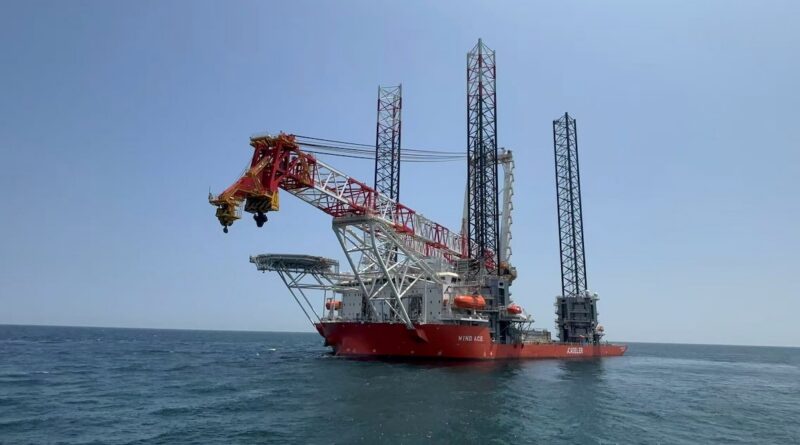
When a Chinese shipyard finishes building a high‑tech offshore wind installation vessel, the ripple goes far beyond the North Sea. The new Wind Ace, completed at COSCO’s Qidong yard, is being readied for a UK wind farm while the United States grapples with political resistance to offshore wind. The vessel’s hybrid capabilities and its timing—just as offshore wind LCOE is slipping into the $40‑50/MWh range—hint at a broader shift: China’s growing foothold in a market that could undercut former coal strongholds and challenge Western shipbuilding dominance.
Deep Dive
According to a CleanTechnica report, the Wind Ace is the second new A‑class vessel in Cadeler’s fleet, purpose‑built for installing XXL turbines. Cadeler, a Danish offshore wind specialist that claims to own the world’s largest fleet of jack‑up vessels, says the ship’s hybrid design “provides the flexibility to efficiently perform both foundation and wind turbine installation scopes, supporting the increasing scale and complexity of offshore wind developments,” and adds, “As turbines and foundations grow larger and projects become more complex, our clients need full‑scope installation partners with the capabilities to deliver safely and reliably.”
The vessel is slated to mobilise for ScottishPower Renewables’ East Anglia TWO project in the United Kingdom, where it will transport and install 64 turbines and their foundations. Cadeler notes, “Following mobilisation, Wind Ace will prepare for deployment on ScottishPower Renewables’ East Anglia TWO offshore wind farm in the UK.”
Why does the ship matter beyond its immediate contract? The cost trajectory of offshore wind provides part of the answer. Energy Solutions Intelligence (ESI) declared that in 2026 new offshore wind projects are achieving $40‑50/MWh LCOE—competitive with natural gas and cheaper than new coal. That threshold, if sustained, could make offshore wind the default choice for new baseload capacity.
Further cost pressure comes from the U.S. Department of Energy’s open‑source “FORCE” model. The model estimates that the average LCOE for fixed‑bottom offshore wind could fall from $75/MWh in 2021 to $53/MWh by 2035, while floating wind could drop from $207/MWh to $64/MWh over the same period. These projections are drawn directly from DOE‑reported figures.
Operations and maintenance (O&M) remain a sizable share of offshore wind’s per‑kWh cost—about 33% according to the source. Labor and transport dominate that O&M bill, accounting for up to 80‑90% of O&M costs, a finding from the UK’s HOME consortium. The consortium’s work on advanced sensors, machine learning, and robotics aims to slash those expenses, but the immediate impact of a vessel like Wind Ace is to reduce installation time and crew requirements, directly touching the labor component of O&M.
Beyond economics, the vessel’s Chinese origin carries geopolitical weight. While the United States has, in recent years, attempted to stifle offshore wind development through policy friction, the Chinese shipyard’s ability to deliver a state‑of‑the‑art installation vessel demonstrates that the global supply chain can bypass U.S. constraints. European shipyards, traditionally the backbone of offshore wind construction, now face competition from Chinese yards that can produce comparable or even more cost‑effective platforms at scale.
In short, the Wind Ace embodies three converging trends: larger turbines demanding specialized vessels, falling LCOE making offshore wind a credible competitor to fossil fuels, and a shifting supply chain that places Chinese manufacturing at the center of a market once dominated by Europe and the United States.
Audit & Contradictions
The CleanTechnica article is the sole source for every concrete claim examined. Fact‑check data confirms that statements about the vessel’s completion, its designation as the second A‑class ship, its upcoming deployment on East Anglia TWO, the $40‑50/MWh LCOE benchmark, the FORCE model projections, and the O&M cost breakdown are all single‑source. No independent corroboration from other outlets was identified, and the audit found no contradictions, assigning a “Low” contradiction level.
Because these points rest on a single publication, they should be read with appropriate caution. The report’s language—e.g., “according to Energy Solutions Intelligence” and “the FORCE model estimates”—indicates reliance on third‑party analyses, but the underlying data have not been independently verified within the scope of this investigation.
Future Outlook
If the Wind Ace and similar vessels enter service as scheduled, the immediate effect will be faster, cheaper installation of the next generation of 18‑MW turbines. That could accelerate the pace at which offshore wind reaches cost parity, prompting utilities and developers to favor wind over new coal or gas projects. In the United States, where offshore wind policy has been contentious, the availability of Chinese‑built installation assets may pressure policymakers to streamline permitting and support domestic supply chains to retain market share.
European shipyards may respond by consolidating, investing in automation, or seeking strategic partnerships with Asian builders to stay competitive. Meanwhile, the HOME consortium’s robotics push could dovetail with the hybrid capabilities of vessels like Wind Ace, further eroding the labor‑intensive O&M cost component.
Geopolitically, the scenario underscores a broader shift: China’s industrial capacity now extends into the critical infrastructure of the renewable energy transition. As offshore wind projects multiply—particularly in deep‑water sites that rely on floating turbines—the reliance on Chinese manufacturing could become a strategic consideration for governments weighing energy security against trade policy.
In a market where cost is the primary driver, the Wind Ace may be a harbinger of an era where offshore wind not only outcompetes fossil fuels on price but also reshapes the global industrial landscape that supports it.