Lead Hook
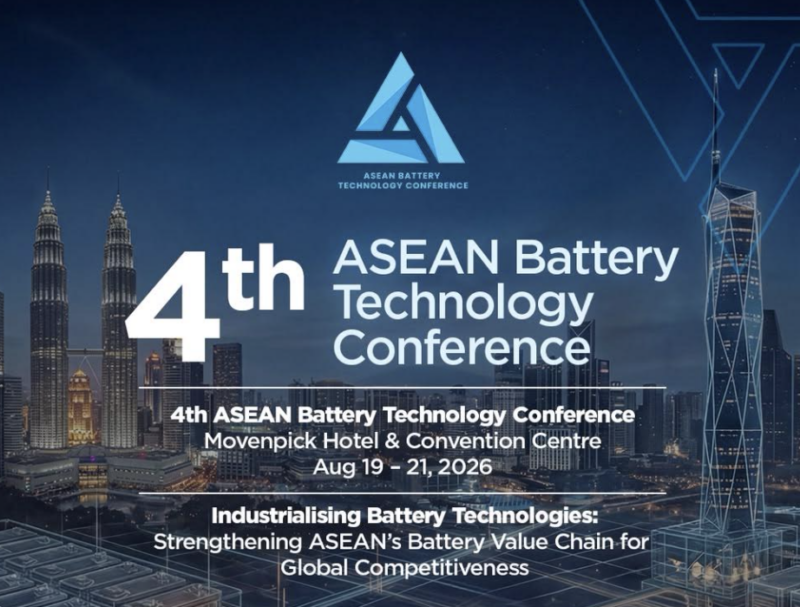
While headlines celebrate Southeast Asia's accelerating electric-vehicle (EV) rollout, a deeper story is unfolding in the region's boardrooms and labs. The 4th ASEAN Battery Technology Conference, slated for August 19-21 in Sepang, Malaysia, is not just a networking event; it is the first public sign that ASEAN is moving from policy-by-paper to a hard-wired, locally-produced battery ecosystem.
Deep Dive
According to CleanTechnica, the conference theme – "Industrialising Battery Technologies: Strengthening ASEAN's Battery Value Chain for Global Competitiveness" – frames the technical agenda. Organisers are zeroing in on three engineering pillars that have been glossed over in policy-centric discussions: thermal management, cell-level chemistry suited to tropical climates, and end-to-end safety standards.
High ambient temperatures and humidity accelerate lithium-ion degradation, a problem that has pushed regional designers toward lithium-iron-phosphate (LFP) chemistry. LFP's inherent thermal stability makes it a "regional favorite," but its lower energy density still requires breakthroughs in cathode coating uniformity, electrolyte additives, and separator materials to meet the range expectations of two- and three-wheelers that dominate urban traffic.
Manufacturing readiness is being addressed through a formal technology-transfer partnership between NanoMalaysia Berhad and the Institution of Engineers, Malaysia. The collaboration aims to bridge academic electrochemical research with shop-floor scaling – a bottleneck that has stalled battery innovation in the past.
Safety protocols are also moving from theory to practice. The ASEAN Battery Safety Network, launched at the previous Phuket conference, will use "real-world deployment data, destructive testing analytics, and advanced battery-management-system engineering." This focus reflects a pragmatic shift: rather than relying on cell-level stability alone, stakeholders are pushing for pack-level innovations that can predict voltage imbalances and pre-empt thermal runaway.
"We are honored to host ABTC 2026 at a critical point in ASEAN's battery journey," said Prof. (Adj.) Dr. Rezal Khairi Ahmad, chief executive officer of NanoMalaysia Berhad Group.
Beyond the technical details, the conference signals a strategic pivot that aligns with broader regional narratives. Independent outlets – the Manila Times and BusinessToday Malaysia – have reported that ASEAN is deliberately shifting its focus from policy frameworks to tangible battery manufacturing, EV adoption, and grid integration.
Future Outlook
If ASEAN can translate the conference's technical road-map into scalable production, the region could reduce its dependence on imported battery cells – a dependency that currently ties Southeast Asian EV growth to external supply shocks and geopolitical tensions. Successful localization of LFP technology would also give manufacturers a thermally robust chemistry that aligns with the climate realities of the tropics, potentially lowering warranty costs and extending vehicle lifespans.
Competitors in China and South Korea will likely monitor these developments closely. A home-grown ASEAN battery value chain could attract foreign direct investment, especially from automakers seeking diversified sourcing. Regulators, meanwhile, may need to codify the safety standards discussed at the conference into binding regional codes, a step that would cement ASEAN's credibility in the global battery market.