Lead Hook
When Tesla rolled the Cybercab into the National Federation of the Blind’s annual convention on July 3, 2026, the headline was its Braille‑labeled controls and extra room for guide dogs. Yet the subtext carries a different weight: a manufacturing shift that could reshape how the auto industry meets tightening environmental rules on volatile organic compounds (VOCs) and supply‑chain carbon footprints.
Deep Dive
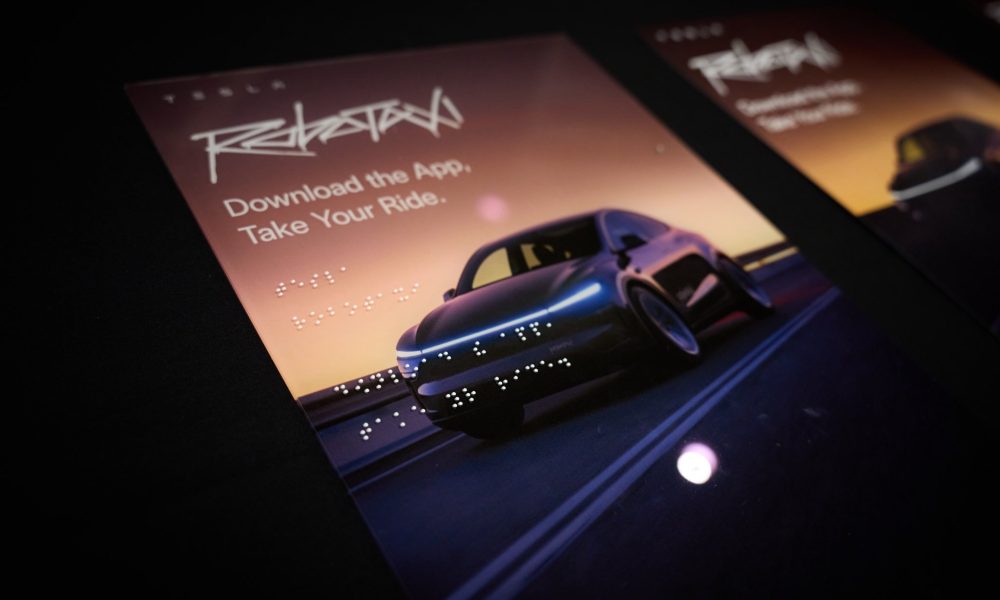
At the Austin event, attendees—many navigating with white canes or service dogs—were invited to sit in a steering‑wheel‑free robotaxi and test features that Tesla says are built “for blind and visually impaired users.” According to Teslarati, the Cybercab includes Braille lettering on door releases, emergency buttons and other physical controls, a cabin sized to accommodate service animals, and seats positioned at wheelchair height to ease transfers. Photos from the convention showed participants confidently approaching the vehicle, pets settled on the floor, and hands feeling the raised Braille markers.
Beyond accessibility, Tesla used the same platform to announce a new reaction injection molding (RIM) process that eliminates a traditional paint shop step. The company claims the pigment is mixed directly into the polymer feedstock, so panels emerge from the mold already colored. As Tesla put it:
Our new reaction injection molding (RIM) process shrinks Cybercab paint cycles from hours to minutes. This cuts those parts’ manufacturing and supply chain emissions by 35% and eliminating 100% of paint volatile organic compounds (VOCs) emitted in traditional paint methods.
While RIM technology has existed since the 1960s, its application to exterior body panels at scale is unusual. Conventional automotive painting requires large, energy‑intensive booths, solvent‑based coatings, and extensive curing time. By embedding color in the polymer, Tesla claims to slash the paint cycle from “hours to minutes,” a reduction that could translate into lower factory floor space, reduced energy use, and fewer hazardous emissions.
Regulators in California and the European Union have been tightening limits on VOCs and overall manufacturing emissions. If Tesla’s figures hold, a 35% cut in panel‑related emissions could provide a measurable compliance buffer, especially as the company expands its robotaxi fleet. The claim also dovetails with broader industry trends toward “paint‑free” or “color‑integrated” composites, which promise lighter weight and fewer supply‑chain bottlenecks.
However, the environmental benefit rests on a single‑source claim. The source article is the only place the 35% reduction and 100% VOC elimination are quantified. No third‑party life‑cycle analysis or regulator‑issued data currently corroborates these numbers.
In parallel, Tesla highlighted a market‑size figure: roughly 2.2 million visually impaired Americans could gain mobility independence from autonomous vehicles. The same source notes a new app update (version 4.58.5) that adds a live “Self‑Driving” indicator, showing when Full Self‑Driving (FSD) is active. Both points are presented without external verification, leaving analysts to treat them as company‑generated estimates.
Audit & Contradictions
The core demonstration—Cybercab at the NFB convention and its Braille, animal‑space, and wheelchair‑height features—is corroborated by an independent Teslarati report, confirming the event took place and the accessibility details are accurate.
All other notable claims are single‑source and therefore hedged:
- The RIM process’s 35% emissions cut and total VOC elimination are reported only by Tesla. The statement is quoted verbatim above.
- The estimate of 2.2 million visually impaired Americans who could benefit from robotaxis appears solely in the source article.
- The app update (version 4.58.5) that adds a live “Self‑Driving” indicator is also a single‑source claim.
The fact‑check audit notes a “Low” contradiction level, meaning no direct conflicts were found among the sources, but the lack of external corroboration means readers should treat those figures as company‑provided projections.
Future Outlook
If Tesla’s RIM approach proves scalable, it could pressure rivals—Rivian, Lucid and traditional OEMs—to explore paint‑free panel solutions, especially as emissions standards tighten worldwide. A successful VOC‑free process would also reduce reliance on solvent‑based paints, potentially lowering raw‑material costs and simplifying supply chains.
From an accessibility standpoint, the Cybercab’s design may set a new benchmark for inclusive autonomous vehicles. Competitors that ignore such features risk regulatory scrutiny in markets that increasingly mandate universal design standards for public transport and shared‑mobility services.
Regulators could also leverage Tesla’s announcement when drafting future legislation on vehicle manufacturing emissions. By quantifying a specific emissions reduction, the company creates a data point that policymakers might reference when establishing baseline requirements for paint‑related VOCs.
Finally, the app indicator, if rolled out broadly, could improve user trust in FSD by providing real‑time status, a subtle but potentially market‑shifting feature for consumers wary of “black‑box” autonomy.
In sum, the public demo of the Cybercab underscores Tesla’s dual narrative: a socially inclusive robotaxi and a manufacturing innovation that could reshape emissions accounting. Whether the environmental claims survive independent verification will determine if the move is a genuine leap forward or a strategic headline.