Lead Hook
When Walmart announced that its EV fast‑charging network now exceeds 600 stalls in 17 U.S. states, the headline sounded like another retailer cashing in on the electric‑vehicle boom. Yet the deeper story is a gamble on ultra‑high‑power hardware, dual‑connector standards and a pricing model that could reshape how non‑automakers invest in the charging ecosystem. In a market where EV adoption forecasts have been repeatedly revised downward, Walmart’s $0.46 per kilowatt‑hour price tag and exclusive use of 400‑kilowatt chargers raise questions about supply‑chain resilience and the capital efficiency of such an aggressive rollout.
Deep Dive
According to InsideEVs, Walmart’s network now spans 73 locations and offers 612 individual connectors – a figure that surpasses the Department of Energy’s Alternative Fuels Data Center, which still lists 66 locations and 528 ports. The discrepancy highlights how quickly Walmart is adding stalls: the retailer launched its EV fast‑charging business in April 2025, and within roughly two months it doubled its port count from about 300 at 50 stores to the current 600‑plus.
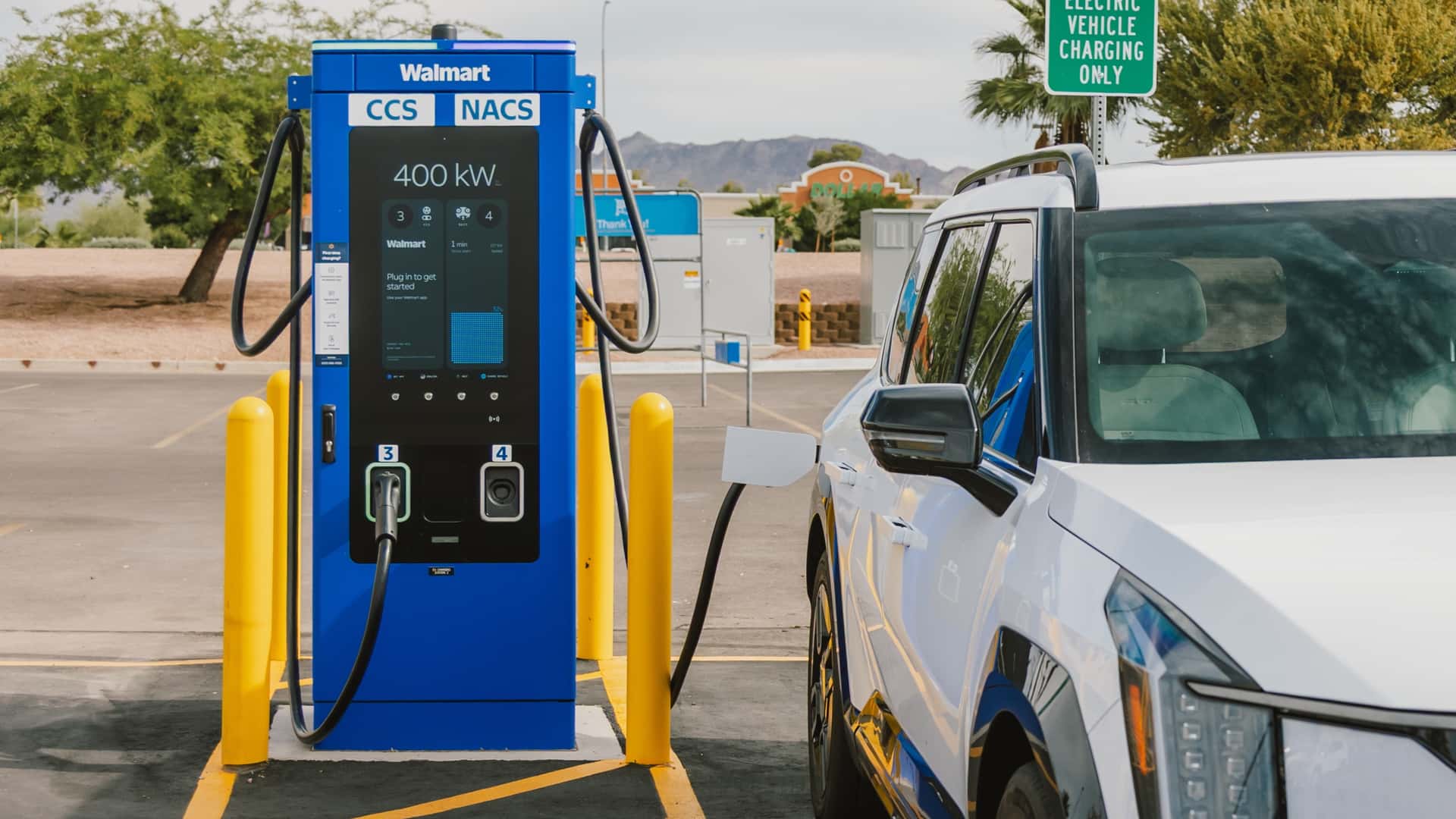
The company’s hardware strategy is singularly focused on 400‑kilowatt DC fast chargers supplied by ABB or Alpitronic. Each stall carries two cables – one with a CCS (Combined Charging System) connector and another with the newer NACS (North American Charging Standard) plug – allowing drivers of both legacy and upcoming EVs to plug in. This dual‑connector approach sidesteps the industry debate over a single standard, but it also doubles the hardware per stall, inflating upfront costs.
Pricing is another standout element. Walmart charges an average of $0.46 per kilowatt‑hour, with off‑peak rates that can shave as much as $0.20/kWh when combined with a 10% discount for Walmart Plus members who use the retailer’s smartphone app. Credit‑card payments, however, do not qualify for the membership discount, a detail that suggests the company is nudging users toward its own digital ecosystem.
From a supply‑chain perspective, the exclusive reliance on two OEMs for 400‑kW units could become a bottleneck. High‑power chargers require advanced power electronics, robust cooling, and substantial grid connections. If ABB or Alpitronic face component shortages – a risk that has already impacted other high‑power charger rollouts globally – Walmart’s expansion schedule could be delayed, forcing the retailer to either stockpile equipment or seek alternative suppliers, both of which would affect margins.
Capital efficiency is equally critical. Deploying 400‑kW chargers costs significantly more per stall than the 150‑250 kW units common at many public networks. While higher power translates to faster charging times, the utilization rate of such chargers is still uncertain. If EV owners in many of the 17 states still favor slower Level‑2 home charging or if vehicle ranges improve enough to reduce frequent fast‑charging stops, Walmart may end up with under‑used high‑cost assets. The $0.46/kWh price is competitive with many public DC fast‑charging operators, but the added capital outlay could pressure the retailer’s return on investment, especially if the anticipated “thousands of fast chargers” never materialize.
Regulatory and grid considerations also loom. Installing 400‑kW chargers often requires upgrades to local distribution infrastructure, and utilities may impose demand‑charge fees or require energy storage to smooth peaks. Walmart’s rapid expansion – noted by CleanTechnica as planning new chargers in up to 19 states – will inevitably intersect with municipal permitting processes and utility planning, potentially slowing rollout despite the company’s aggressive timeline.
Audit & Contradictions
The announcement paints a picture of unstoppable growth, yet several key details appear only in the primary source and lack independent verification. The claim that every stall uses 400‑kW chargers from ABB or Alpitronic, that each stall offers both CCS and NACS connectors, and that the average cost is $0.46/kWh—all come solely from the InsideEVs article. As per the fact‑check audit, these points are “single‑source” and should be treated as the company’s own reporting rather than independently corroborated data.
Similarly, the timeline – a launch in April 2025 and a doubling of ports within two months – is reported only by the source. No external database or third‑party tracker currently confirms that rapid growth rate. The payment model, including the exclusive app‑based discount and trial of card‑reader chargers, also lacks independent confirmation.
Importantly, the audit found no contradictions between the primary source and the secondary outlets. The independent interview on EVChargingStations.com backs the network’s presence in 17 states, and CleanTechnica’s coverage aligns with the reported plans to expand into roughly 19 states. Thus, while the core network size and expansion intent are corroborated, the technical specifications and pricing details remain single‑source claims.
Future Outlook
Walmart’s strategy could force other non‑automaker players to reconsider their charging architectures. If the retailer proves that a uniform 400‑kW, dual‑connector model can be deployed profitably, we may see a shift away from mixed‑power, single‑connector sites that dominate today’s public networks. Conversely, if utilization remains low and supply‑chain constraints emerge, Walmart could become a cautionary tale about over‑investing in high‑power hardware before market demand solidifies.
Competitors such as ChargePoint, EVgo, and regional utilities will be watching Walmart’s pricing and discount mechanisms closely. A $0.46/kWh rate that undercuts many private operators might pressure the broader market to lower prices, but it could also trigger a race to the bottom that squeezes margins across the sector.
Regulators may also take note. The dual‑connector approach sidesteps the ongoing standard‑setting debate, but it raises the question of whether future federal or state policies will mandate a single standard to simplify infrastructure investments. Should such mandates arise, Walmart’s mixed‑connector stalls could either become a competitive advantage (by catering to all EVs) or a liability (if one connector becomes obsolete).
Finally, the capital intensity of 400‑kW stations means that Walmart’s expansion will likely hinge on strategic partnerships with utilities and possibly on securing renewable‑energy or storage contracts to manage grid impact. The retailer’s ability to navigate these technical and regulatory hurdles will determine whether its fast‑charging network becomes a cornerstone of the U.S. EV ecosystem or a costly side project that stalls as adoption rates moderate.
In short, Walmart’s headline‑grabbing 600‑plus stalls are just the tip of an intricate investment in high‑power hardware, dual‑connector flexibility, and a pricing model designed to lock in customers. Whether this gamble pays off will depend on supply‑chain resilience, grid cooperation, and the pace at which drivers actually need 400‑kW charging across the 17 states the retailer now serves.