Lead Hook
Lucid Motors’ latest restructuring is more than a headline‑grabbing layoff list; it signals a cash‑flow emergency that could dictate whether the company ever reaches mass‑market scale with its upcoming Cosmos sedan. The stakes extend beyond the factory floor, touching Saudi Arabia’s Vision 2030 ambitions, volatile Middle‑East shipping lanes, and the broader EV market’s appetite for a new premium player.
Deep Dive
On June 1, 2026, Silvio Napoli—an industrial veteran from the Schindler Group—assumed the chief executive role at Lucid Motors, according to CleanTechnica. Within weeks, Napoli announced a restructuring that trimmed roughly 1,500 jobs, about 18 % of the workforce, on top of a prior 12 % cut earlier in the year. The move eliminated a second production shift at the AMP‑1 plant in Casa Grande, Arizona, and dissolved the chief operating officer role, consolidating operational authority under Napoli.
The layoffs are framed by an internal source as “the most serious reset since the company was founded.” The source also quoted Napoli saying, "the era of building capacity ahead of demand is over. Everything is being recalibrated to survive until Cosmos launches." This language underscores a shift from growth‑first thinking to a cash‑preservation mode.
"the era of building capacity ahead of demand is over. Everything is being recalibrated to survive until Cosmos launches." – Lucid insider, cited by CleanTechnica
Financially, Lucid’s first‑quarter 2026 results illustrate the pressure point. Revenue rose 20 % year‑over‑year to $282.5 million, yet the company posted a net loss of roughly $1 billion, per the same source. Production hit 5,500 vehicles, but deliveries lagged at 3,093, creating a sizable inventory gap that ties up capital. A February supplier defect halted Gravity deliveries for nearly a month, and an April recall of 4,500 Gravity SUVs added further strain.
Liquidity remains a concern. Lucid reported $3.2 billion in cash on hand, which would increase to a pro‑forma $4.7 billion after a recent capital raise. Nevertheless, management has signaled that additional funding will be required before the company can achieve profitability. In late June, Saudi Arabia’s Public Investment Fund (PIF) injected an extra $750 million, according to CleanTechnica. The PIF already owns more than half of Lucid’s equity and has invested over $9 billion since 2018.
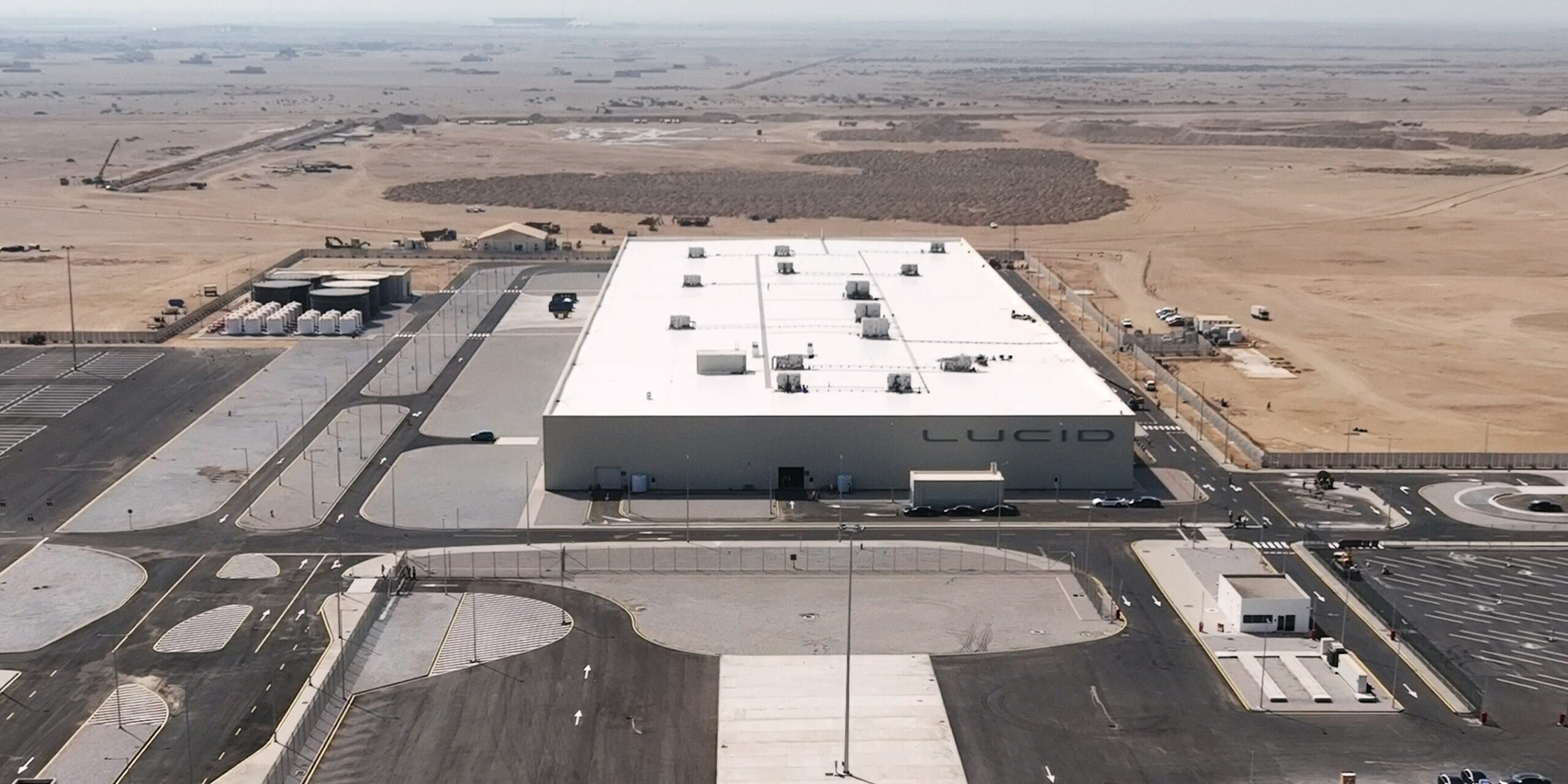
The restructuring also reshapes Lucid’s manufacturing geography. The Advanced Manufacturing Plant 2 (AMP‑2) in Saudi Arabia’s King Abdullah Economic City is fully operational and is slated to reach a capacity of 155,000 vehicles per year by 2029. The Saudi government has committed to purchasing up to 100,000 Lucid vehicles over a decade, with 50,000 already contracted. Crucially, AMP‑2 is expected to become the launch site for the Cosmos midsize EV—priced below $50,000—potentially beginning production six to twelve months before the Arizona facility. This reversal of the original US‑first strategy ties Lucid’s scale‑up directly to the stability of Saudi‑backed capital and the region’s geopolitical climate.
Geopolitical risk is not abstract. Escalating tensions involving Iran, Israel, and the United States have disrupted commercial shipping through the Strait of Hormuz, a critical artery for components and semi‑knockdown kits that feed AMP‑2. Lucid has acknowledged in recent filings that conflict in the Middle East could affect operations at the Saudi plant. While higher oil prices could improve the economics of EVs, the same tensions also threaten the supply chain that Lucid needs to build the Cosmos at scale.
Amid these challenges, Lucid retains notable strengths. The Lucid Gravity was named the 2026 World Luxury Car of the Year, a claim corroborated by an independent Saudi automotive outlet (CleanTechnica). The Gravity’s over‑the‑air updates and DreamDrive 2 Pro hands‑free driving features keep the model competitive in the premium segment, while a partnership with Uber envisions at least 35,000 vehicles on the platform.
Audit & Contradictions
The announcement leaves several critical data points unverified outside the CleanTechnica report. The CEO appointment, the 1,500‑employee layoff, the Q1 financial figures, and the $750 million PIF injection are all single‑source claims. Fact‑checkers note that only the Gravity’s award has independent confirmation; all other headline figures appear solely in the CleanTechnica article. The fact‑check summary rates the overall contradiction level as low, indicating no direct conflicts but a reliance on a single source for most quantitative claims.
Analysts have already reacted to the disclosed numbers, cutting price targets from $14 to $8 per share, and LCID stock is down roughly 38 % year‑to‑date, sitting about 99 % below its early‑2021 peak. However, without independent verification, investors must treat these figures as provisional until corroborated by filings, earnings calls, or third‑party reporting.
Future Outlook
Lucid’s path forward hinges on three intertwined variables: cash availability, supply‑chain resilience, and the market’s reception of Cosmos. If the PIF’s $750 million infusion proves sufficient to bridge the cash‑burn gap, the company may avoid a deeper liquidity crisis and keep the Cosmos timeline intact. Conversely, any disruption to the semi‑knockdown kit flow from Arizona to Saudi Arabia—whether from shipping delays, component shortages, or regional conflict—could push back production, eroding the very cost advantage the Saudi plant promises.
Competitors watching Lucid’s restructuring will note the trade‑off between sovereign backing and operational autonomy. While the Saudi partnership supplies deep pockets, it also ties Lucid’s growth to political and economic stability in the Gulf. For the broader EV market, Lucid’s struggle underscores the difficulty of scaling a premium brand to mass‑market volumes without a robust, diversified supply chain and consistent cash flow.
Regulators in the United States and Saudi Arabia may also play a role. U.S. trade policy could affect tariff treatment of kits shipped to AMP‑2, while Saudi industrial policy under Vision 2030 may impose production quotas or local‑content requirements that shape Lucid’s cost structure. The company’s ability to navigate these policy layers will be a decisive factor in whether Cosmos becomes a genuine mass‑market contender or remains a promise stalled by financial and geopolitical headwinds.
In short, Lucid’s latest cuts are a symptom of a broader cash‑flow dilemma amplified by geopolitical risk. The success of Cosmos—and Lucid’s survival as a viable EV manufacturer—will depend on how quickly the company can convert sovereign capital into a resilient, cost‑effective production system that can weather both market cycles and regional instability.