Lead Hook
When Future Proof Shipping’s two hydrogen‑fuel‑cell barges slipped into bankruptcy, the headline sounded like a technical failure. In reality, the collapse signals a deeper market fault line: hydrogen cargo shipping has cleared the engineering hurdle but stumbled over the economic and supply‑chain infrastructure needed to turn a working vessel into a sustainable business. As regulators and investors chase low‑carbon freight, the missing links in fuel production, transport, and pricing could decide whether hydrogen ever sails beyond isolated pilots.
Deep Dive
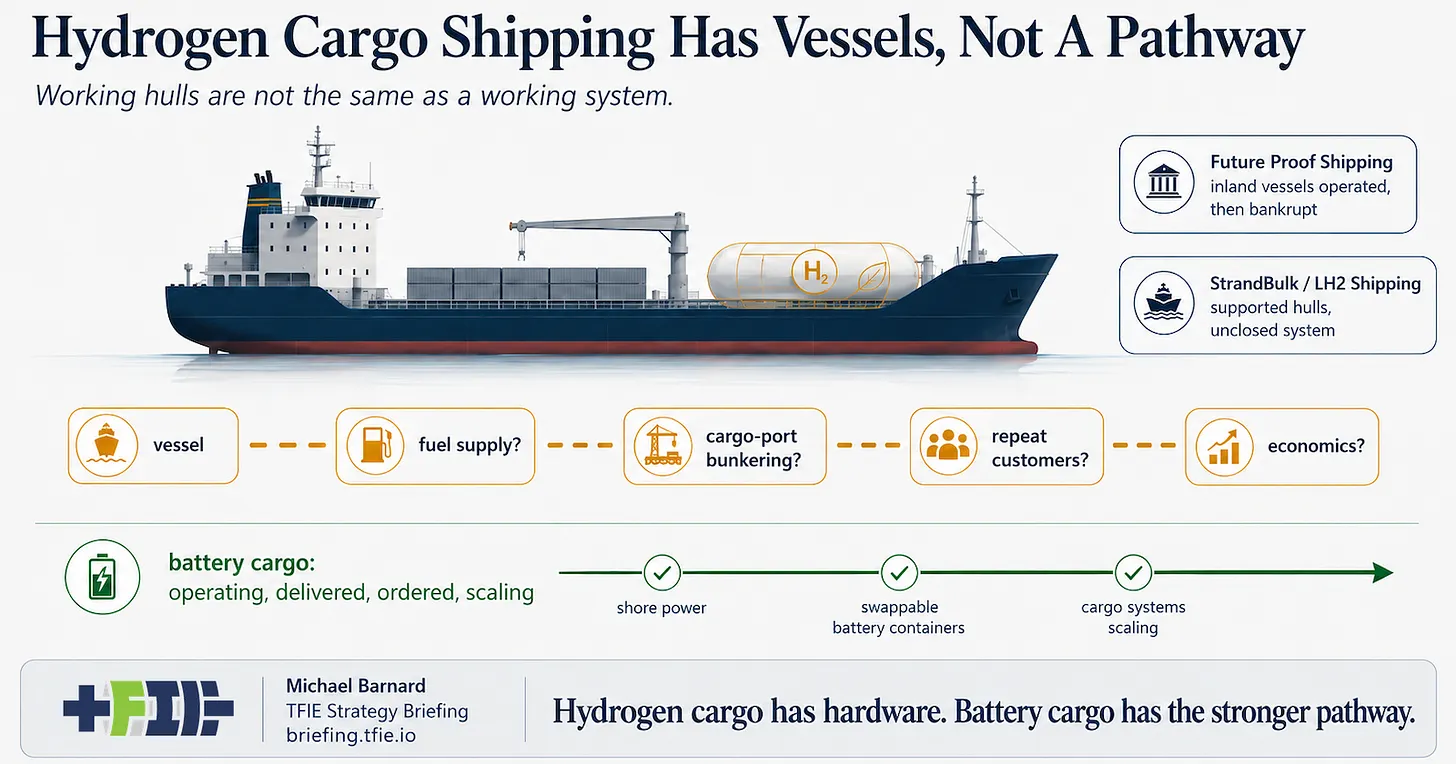
According to CleanTechnica, Future Proof Shipping converted two inland cargo vessels—dubbed H2 Barge 1 and H2 Barge 2—into hydrogen fuel‑cell‑powered ships and placed them in regular freight service on northern Europe’s inland waterways. The article emphasizes that these were not concept models but fully approved, customer‑carrying vessels, marking a rare instance where hydrogen propulsion moved past the design stage.
Despite proving that a fuel‑cell can move cargo, the company could not assemble a repeatable commercial model. The source notes that the barges did not secure a competitive hydrogen price, sufficient utilization, or a steady stream of customers, and that the business relied on “continued public risk absorption.” In short, the technology worked, but the surrounding economics did not.
The same article outlines Norway’s StrandBulk programme as the only other current hydrogen cargo effort with tangible backing. StrandBulk has obtained support for two additional hulls beyond an initial four‑vessel plan. Each vessel would combine liquid‑hydrogen storage, PEM fuel cells, a battery, shore‑power capability, and fallback diesel or biodiesel engines. However, the programme’s fuel supply chain remains unconfirmed: the intended hydrogen would come from a production facility roughly 1,000 km up the Norwegian coast that has yet to secure a final investment decision. The article stresses that without a commissioned production and liquefaction plant, reliable bunkering ports, and price‑stable deliveries, the vessels remain “more concrete than the usual hydrogen shipping proposal” but still lack a closed, commercial loop.
Compounding the supply‑chain challenge is the competitive landscape. CleanTechnica lists several battery‑electric and hybrid cargo solutions already operating at scale: ZES’s inland container service in the Netherlands using swappable battery containers, AtoB@C’s Green Coaster twelve‑vessel plug‑in hybrid series for Baltic and North Sea routes, and Chinese battery‑powered river, coastal, and bulk vessels. These alternatives provide direct electricity where possible, hybridize where batteries fall short, and rely on shore power or swappable packs—technologies that have moved beyond pilots into repeat orders and scaling production.
From a regulatory standpoint, the article points out that hydrogen cargo ships must meet a suite of safety, port‑interface, and insurance requirements that are still being defined across Europe. The lack of standardized bunkering protocols and price certainty for green hydrogen adds a layer of risk that traditional diesel or even battery‑electric operators do not face. Consequently, investors and governments are hesitant to pour capital into a model that still depends on an undefined fuel supply network.
Audit & Contradictions
The CleanTechnica piece is the sole source for all of the concrete facts discussed above. The fact‑check audit flags each of the following statements as single‑source claims: the operation and bankruptcy of Future Proof Shipping’s two barges; the technical success yet commercial shortfall of those vessels; StrandBulk’s secured backing for two extra hulls and its detailed vessel architecture; the still‑unfunded 1,000 km‑away hydrogen production facility; and the competitive pressure from existing battery‑electric and hybrid cargo fleets. The audit notes a “low” contradiction level, meaning no other outlet in the provided corroboration set confirms these points. As a result, each claim is hedged with language such as “according to CleanTechnica” or “the article reports.” No contradictory evidence appears in the source material.
Future Outlook
If hydrogen cargo shipping is to move from isolated pilots to a viable market segment, the industry must solve three interlocking problems:
- Fuel‑chain integration. A reliable, cost‑competitive source of green hydrogen, coupled with liquefaction, transport, and standardized bunkering infrastructure, is essential. Without a locked‑down supply chain, vessel operators will continue to face price volatility and logistical uncertainty.
- Capital efficiency. Building fuel‑cell vessels and the associated fuel infrastructure demands heavy upfront investment. Investors will likely demand a clear path to revenue, which means securing long‑term freight contracts and demonstrating utilization rates that can cover both vessel and fuel costs.
- Regulatory certainty. Harmonized safety standards, port‑side procedures, and insurance frameworks across European waterways would lower the non‑technical barriers that currently deter commercial scaling.
In the meantime, battery‑electric and hybrid operators are consolidating market share, benefitting from lower capital costs, existing electric grids, and clearer regulatory pathways. For hydrogen to regain traction, it may need to focus on niche routes where battery energy density is insufficient and where a robust, regional hydrogen hub can be built—perhaps in heavy‑industry corridors with abundant renewable electricity. Until then, the story of Future Proof Shipping serves as a cautionary tale: proving a vessel works is only the first step; building the entire ecosystem around it is the real test of future‑proofing.