Lead Hook
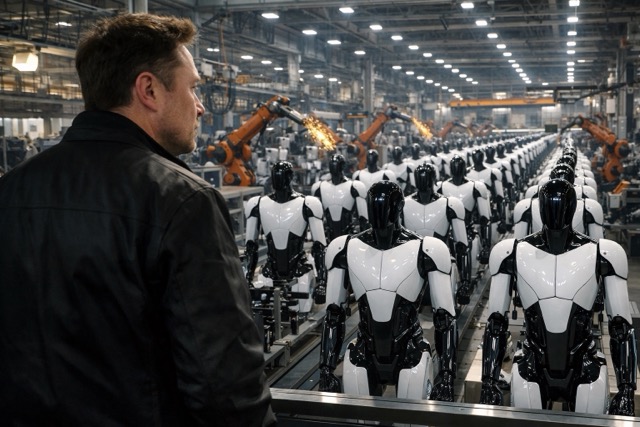
When Elon Musk posted a photo of himself on a newly‑minted production line at Tesla’s Fremont plant, the image did more than signal a shift of floor space—it underscored a strategic gamble. While the headline‑grabbing quote, “
No, Optimus production will be extremely slow at first, as everything is new. This is not like making a car.”teslarati, makes clear that the robot’s rollout will be deliberately paced, the underlying implications for Tesla’s supply chain, capital efficiency, and engineering talent pool remain largely unspoken. The company is converting the former Model S/X assembly area into a humanoid‑robot line, with limited production earmarked for late July or August 2026. If the venture succeeds, Tesla could add a new high‑margin product line; if it stalls, the capital outlay may strain a firm already navigating automotive scaling challenges.
Deep Dive
According to the same teslarati report, the Fremont conversion marks the first time Tesla has repurposed a dedicated car‑assembly bay for a robot. The former Model S/X line, which over its run produced roughly 610,000 units, is being retrofitted with tooling for a machine that reportedly contains “roughly 10,000 unique parts.” This part count is dramatically higher than a typical vehicle, where component families are standardized across thousands of cars. Each new part forces Tesla to either develop in‑house suppliers or negotiate with niche manufacturers, creating a supply‑chain risk profile that differs from the mature automotive ecosystem.
Beyond parts, the manufacturing process itself must be reinvented. Traditional automotive assembly relies on repeatable, high‑speed robotics that move large panels. Optimus, by contrast, demands precision actuation for dexterous hands, balanced locomotion, and real‑time AI integration. The source notes that early output rates are “literally impossible to predict,” suggesting that even basic throughput metrics are still being defined. Engineers must therefore design novel end‑of‑line testing rigs, develop new quality‑control algorithms, and secure a steady flow of high‑torque actuators—components that are not currently mass‑produced for consumer products.
From a capital perspective, the Fremont line’s eventual capacity is cited as “1 million units per year,” a figure that would put the robot on a scale comparable to Tesla’s Model 3/Y output. However, this capacity claim appears only in the primary Teslarati article and lacks corroboration from other outlets. If accurate, achieving such volume would require a massive investment in automation that rivals the company’s automotive fabs, raising questions about return on investment given the still‑unclear market for humanoid robots. A second, larger factory at Giga Texas is under construction, with a projected “higher‑volume production around summer 2027” and a “long‑term annual capacity potentially reaching millions of units.” Again, the precise capacity number is single‑source, and the timeline leaves ample room for engineering setbacks.
Financial analysts have long warned that the robot market’s economics differ sharply from automotive sales. A robot’s price point, service lifecycle, and regulatory approval path are all less certain. Tesla’s decision to allocate prime Fremont floor space—historically a high‑margin asset—signals confidence but also exposes the firm to opportunity cost: any delay or under‑utilization could dilute the plant’s overall productivity.
Finally, the human factor cannot be ignored. Scaling a novel humanoid platform demands not only new hardware but also software pipelines capable of continuous learning and safety validation. Tesla’s existing AI stack, built for autonomous driving, will need substantial adaptation to meet the diverse task set envisioned for Optimus, from factory assistance to potential consumer use. The article notes that early units are expected to handle “simple factory tasks before expanding to more complex roles,” a phased approach that mirrors software rollouts but adds layers of mechanical risk.
Audit & Contradictions
The announcement leaves several key details unaddressed. First, the capacity figures—1 million units per year for Fremont and up to 10 million units per year for Giga Texas—are reported only by Teslarati and have not been independently verified. According to the fact‑check audit, these remain single‑source claims and should be treated with caution. Second, the statement about “10,000 unique parts” and the associated prediction that early output rates are “literally impossible to predict” also originates solely from the primary article, lacking external confirmation.
Beyond numbers, the source does not disclose the sourcing strategy for critical components such as high‑precision actuators, sensors, or AI chips, nor does it outline any regulatory roadmap for a consumer‑facing humanoid. No contradictions were identified across the corroborating outlets (Crypto Briefing, Forbes, inc.com), resulting in a “Low” contradiction level. However, the silence on supply‑chain mitigation, quality‑control protocols, and certification pathways suggests that investors and observers will need to watch for future disclosures.
Future Outlook
If Tesla can navigate the engineering and supply‑chain hurdles, Optimus could reshape labor markets and open a new revenue stream that rivals its automotive division. Competitors such as Boston Dynamics and Hyundai’s robotics arm will be watching closely; their own products are already limited to niche industrial applications, and a successful mass‑production model from Tesla could set a new benchmark.
For investors, the key risk lies in capital allocation. The Fremont plant’s repurposing represents a sizable sunk cost that must be justified by future throughput. Should the robot’s market adoption lag, the financial impact could echo past over‑optimistic projections in Tesla’s battery‑technology roadmap.
Regulators may also enter the conversation as humanoid robots move beyond factory floors into public spaces. Safety standards, liability frameworks, and data‑privacy rules will likely evolve, adding another layer of compliance cost that the announcement does not address.
In the short term, the July‑August 2026 start date provides a concrete milestone for stakeholders to monitor. The next quarterly earnings call will be the first public forum where Tesla can report actual unit counts, yield rates, and any supply‑chain adjustments. Until then, the Optimus story remains a mix of bold vision and untested manufacturing reality.