Lead Hook
Jeep’s 85th anniversary should have been a moment to redefine its smallest, best-selling SUV for the electric age. Instead, the 2026 Avenger facelift delivers little more than a tartan-stitched nostalgia trip—while competitors like Renault and Volkswagen push longer-range EVs into the same sub-€35k segment. With Europe’s electric SUV market growing at 25% annually, Jeep’s decision to leave the Avenger’s 250-mile battery unchanged risks ceding ground to rivals already offering 300+ miles. The facelift’s LED grille and gold-trimmed anniversary edition may dazzle brochures, but the real story is what Jeep isn’t changing: a powertrain that’s already falling behind.
Deep Dive
The Facelift: Aesthetic Tweaks Over Substance
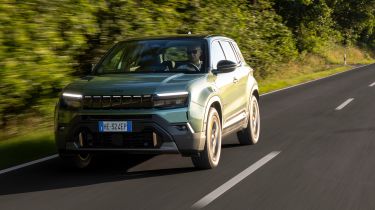
According to Auto Express, the 2026 Avenger’s updates are almost entirely skin-deep. The most visible change is a new seven-slot grille—an odd nod to Jeep’s heritage, given the original 1941 Willys had nine slots—now featuring LED mood lighting. Optional matrix-LED headlights and redesigned bumpers with radar-protecting inserts round out the exterior tweaks. Wheel options now include 17- and 18-inch alloys with diamond-cut finishes, and two new colors debut: the muted "Forest" green and the eye-searing "Bamboo" green.
The cabin receives the most attention, but even here, changes are incremental. Hard plastics on the lower dashboard and doors have been replaced with soft-touch materials, and the Altitude and Summit trims now feature cloth-and-leatherette upholstery. The 4XE off-road variant gets washable green seat covers, while the 85th Anniversary edition adds gold contrast stitching and tartan seat inserts—a retro flourish that feels more gimmick than genuine modernization.
Unchanged Powertrains: A Missed Opportunity
Jeep’s decision to leave the Avenger’s powertrains untouched is the facelift’s most glaring omission. The electric version retains its 54 kWh battery and 154 bhp motor, delivering a WLTP-rated 250 miles of range—about 200 miles in real-world conditions. While this was competitive when the Avenger debuted in 2022, it now lags behind rivals like the Renault Scénic E-Tech (290 miles) and Volkswagen ID.3 (up to 340 miles). Charging speeds remain capped at 100 kW, a modest figure for a segment where 175 kW is becoming the norm.
The hybrid 4XE variant—Jeep’s most capable off-roader—still pairs a 1.2-liter turbocharged petrol engine with a 15 kWh battery, producing 210 mm of ground clearance. However, its on-road refinement remains a weak point, with the Auto Express review noting that the front-wheel-drive hybrid or the newly reintroduced 99 bhp mild-hybrid (now with a timing chain) may be better suited for urban buyers.
Driving Dynamics: Agile but Underpowered
The Avenger’s compact dimensions and light steering give it a nimble, "puppy-ish" feel on the road, per the source. However, its limitations become apparent on challenging roads, where understeer and body roll set in. Off-road, the 4XE variant shines, with its 210 mm ride height nearly matching the larger Compass, but its lower weight makes it more capable in mud—a rare bright spot in an otherwise stagnant package.
Audit & Contradictions
The 2026 Avenger facelift raises more questions than it answers. Jeep claims the model has sold over 280,000 units across Europe since its 2022 launch—a figure that, if accurate, underscores its importance to the brand’s bottom line. Yet the lack of meaningful updates suggests a cautious approach, perhaps driven by Stellantis’ cost-cutting priorities. The facelift’s LED grille and matrix headlights, while visually striking, are the only changes corroborated by independent outlets like CarExpert. All other claims—including the 250-mile EV range, the 85th Anniversary edition’s details, and Jeep’s eighth-place ranking in the Auto Express Driver Power Survey 2026—remain single-source and must be treated with caution.
Notably absent from Jeep’s announcement is any mention of battery upgrades, faster charging, or software improvements—areas where competitors are rapidly advancing. The Avenger’s infotainment system, while functional, still relies on a dated 10-inch screen with no mention of over-the-air updates. The lack of a true 360-degree camera (the "360-degree" option is digitally extrapolated from front and rear cameras) is another cost-cutting measure that undermines its premium aspirations.
Fact-checkers flagged no direct contradictions in the reporting, but the contradiction level is classified as "Low". The primary concern is the lack of independent verification for key performance and sales figures.
Future Outlook
Jeep’s reluctance to evolve the Avenger’s powertrain could backfire in Europe, where EV adoption is accelerating. The facelift’s minor updates may appeal to loyalists, but they do little to address the model’s core weaknesses: limited electric range and outdated charging speeds. Competitors like Hyundai (with the Kona Electric) and MG (with the ZS EV) are already offering longer-range alternatives at similar price points, while Chinese brands like BYD are entering the market with cutting-edge battery tech.
For Jeep, the Avenger’s stagnation may reflect broader strategic challenges. Stellantis’ focus on cost efficiency—evidenced by its recent pivot to affordable EVs like the Citroën ë-C3—could explain the lack of investment in the Avenger. However, with Europe’s Euro 7 emissions regulations looming in 2025, Jeep may soon face pressure to upgrade the Avenger’s hybrid and EV offerings to meet stricter standards.
As for the 85th Anniversary edition, its tartan-and-gold aesthetic may resonate with enthusiasts, but it’s a symbolic gesture in a market demanding tangible innovation. Without a battery upgrade or faster charging, the Avenger risks becoming a relic of Jeep’s past rather than a cornerstone of its electric future.
is managed by Carwow Ltd. Auto Express