Lead Hook
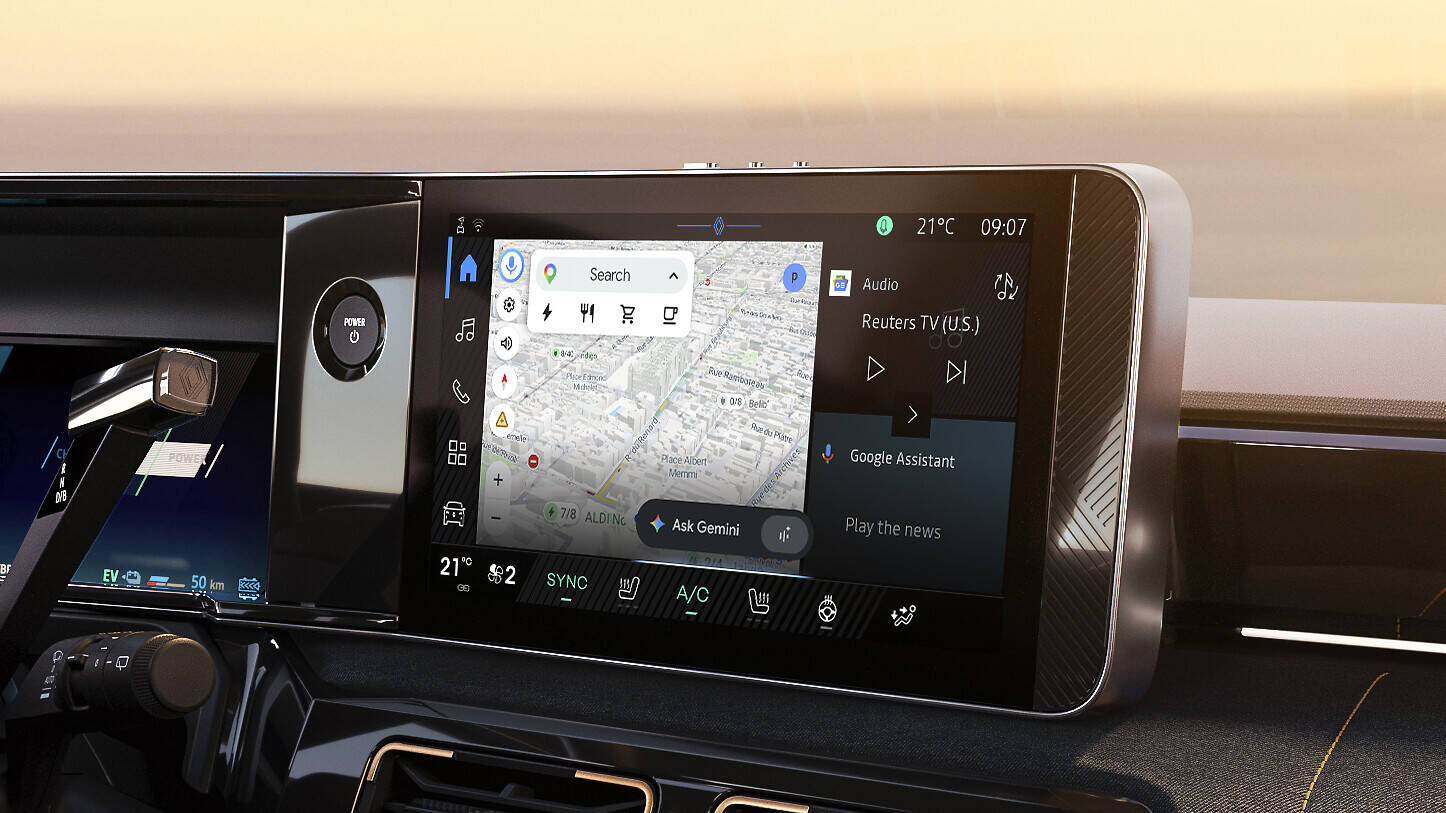
Renault’s latest over‑the‑air (OTA) push places Google’s Gemini generative‑AI directly inside the vehicle’s infotainment system, promising a more natural voice experience. While the headline‑grabbing feature sounds like a convenience upgrade, the move also embeds a powerful cloud‑based assistant into the core of the car’s controls – a step that could force regulators and privacy advocates to revisit how much personal data European drivers are willing to share with tech giants.
Deep Dive
According to electrive.com, the free OTA update began rolling out in mid‑June and reaches every Renault model fitted with the OpenR Link infotainment system, from the compact Twingo E‑Tech Electric to the flagship Rafale, as well as other models slated for international markets. The update does not require a workshop visit, and Renault says it does not affect the validity of existing connectivity services.
Gemini replaces the long‑standing Google Assistant, which has been part of the OpenR Link suite since the platform’s debut in 2022 on the Mégane E‑Tech Electric. The new AI is marketed as capable of “understanding conversational context, processing more complex requests and executing multiple commands in sequence.”† In practice, Renault claims drivers can now adjust climate settings, set navigation destinations, tune the radio and modify vehicle configurations using natural language, with the assistant drawing on real‑time vehicle data such as remaining battery range to optimise route planning.
Unlike the Gemini version available through Android Auto, Renault’s integration is embedded directly into the vehicle’s electronic architecture. This deeper link means the assistant can issue commands to the car’s HVAC system, navigation module and other subsystems without the driver needing to invoke a separate app. Activation requires the driver to log in with a Google account and opt‑in to the service, a step Renault says is left to the customer’s discretion.Independent outlets, including the Indian Autos Blog, have confirmed the rollout and the basic premise of replacing Google Assistant with Gemini. However, the finer details of the AI’s capabilities – such as multi‑command execution and contextual understanding – appear only in Renault’s own communications, and have not been independently verified.
From a technical standpoint, the integration raises several engineering questions. First, the real‑time exchange of vehicle telemetry (battery state‑of‑charge, climate settings, location) with a cloud‑based AI demands robust, low‑latency connectivity. Renault’s OpenR Link already supports Google Maps and the Play Store, but adding generative AI could increase data throughput and place additional strain on the vehicle’s embedded modem. Second, the OTA mechanism itself must be hardened against cyber‑threats; a compromised update could theoretically grant malicious actors control over critical vehicle functions.
Regulatory implications are perhaps even more consequential. The European Union’s General Data Protection Regulation (GDPR) imposes strict rules on the collection, processing and sharing of personal data. By linking a driver’s Google account to vehicle operations, Renault is creating a data pipeline that merges automotive telemetry with a user’s broader online profile. The company notes that data processing depends on the user’s account settings and granted permissions, but it does not detail how consent is obtained, how data is stored, or whether Renault or Google act as joint data controllers.
Such ambiguities could attract scrutiny from national data‑protection authorities, especially as other OEMs – from Volkswagen to Stellantis – explore similar AI‑driven cockpit experiences. The European Commission has already signalled intent to tighten rules around in‑car data sharing, proposing that manufacturers provide clear, granular opt‑in mechanisms and limit the use of personal data for non‑essential functions.
Renault also hinted at a future feature called “Gemini Live,” slated for a later software update. This enhancement is described as a conversational mode that would allow users to issue multiple commands without repeating the activation phrase. While the promise of a seamless dialogue sounds appealing, it further deepens the reliance on continuous cloud processing, potentially expanding the scope of data captured during each drive.
Audit & Contradictions
The announcement leaves several key points unaddressed. First, the claim that Gemini can “process more complex requests” and “execute multiple commands in sequence” is sourced solely from Renault’s own statements and therefore must be hedged as a single‑source claim. Second, the description of direct vehicle‑function integration – adjusting interior temperature, incorporating battery range into navigation, and controlling radio settings – also rests on Renault’s narrative alone.
Renault’s opt‑in model for the AI assistant, as well as the upcoming Gemini Live feature, are similarly presented without independent verification. The fact‑check audit notes that these points are single‑source and should be reported with qualifiers such as “according to Renault” or “the company says.”
Importantly, the audit found no contradictions between the primary source and the independent outlets that covered the story; the overall contradiction level is low. Nonetheless, the lack of third‑party testing or regulatory commentary means the public cannot yet gauge the true performance or privacy impact of the system.
Future Outlook
Renault’s Gemini rollout signals that generative AI is becoming a standard expectation for next‑generation infotainment, pushing competitors to accelerate their own AI roadmaps. If the integration proves technically reliable, it could set a new benchmark for voice‑first vehicle control, nudging the market toward more hands‑free interfaces.
However, the data‑privacy dimension may become the decisive factor. Should regulators deem the current consent model insufficient, Renault could be forced to redesign the onboarding flow, introduce stricter data‑minimisation measures, or even limit the AI’s access to certain vehicle functions. Such constraints could dampen the competitive advantage that early adopters seek.
For consumers, the real test will be whether the promised conversational ease outweighs concerns about data sharing with a tech giant. As more OEMs embed AI deeper into the chassis, the balance between convenience and privacy will likely shape the next wave of automotive software strategy across Europe and beyond.