Lead Hook
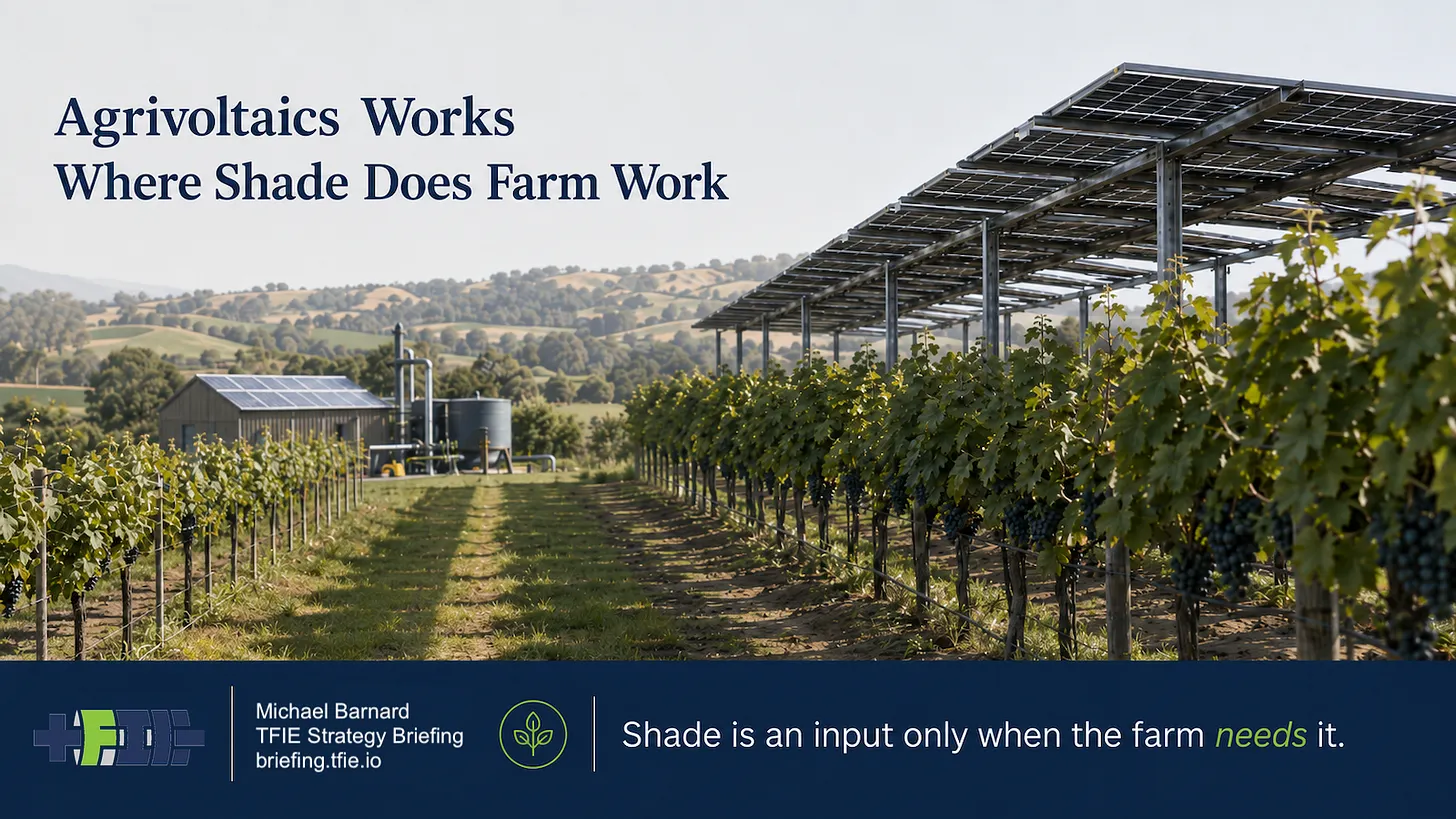
Agrivoltaics is sold as a land-use miracle: solar panels and farming coexisting, squaring the circle between food and energy. But the real test isn’t whether panels and crops can share the same dirt—it’s whether the solar structure earns its keep as a farm tool, not just an electricity generator. According to CleanTechnica, the projects that scale ask the panels to do something the farm already needs: shade sheep, protect berries, or replace trellising. The ones that stumble treat the farm as a stage prop, where the electricity project needed a narrative more than the farm needed the shade.
This distinction isn’t academic. As rural America sees a solar boom (WBUR reports), the capital efficiency of agrivoltaics is under scrutiny. Ground-mounted solar arrays, barn roofs, and grid electricity offer cheaper electrons than steel towers above soybeans. If agrivoltaics can’t justify its cost through real agricultural work, it risks becoming a subsidy-dependent sideshow—photogenic but not scalable.
Deep Dive
1. Grazing Under Panels: The Scalable Baseline
Sheep grazing beneath standard solar arrays is the cleanest scaling case, CleanTechnica reports. The panels don’t need to become agricultural architecture; they’re already low enough for sheep to fit underneath. Vegetation management becomes a revenue stream, mowing costs fall, and graziers earn income without redesigning their operations. This model is less photogenic than a vineyard under dynamic glass, but it’s also less demanding—both technologically and financially.
Southern Alliance for Clean Energy corroborates this, noting that grazing projects have seen repeat adoption because the solar structure doesn’t disrupt farm machinery or crop cycles. The electricity is a byproduct of a vegetation management solution, not the other way around.
2. Protected Crops: Shade as a Service
For high-value crops like berries, vineyards, and orchards, shade isn’t a novelty—it’s infrastructure. These systems already deal with sunburn, hail, and rain damage, and often invest in trellising, shade cloth, and irrigation. If photovoltaic structures can replace or supplement these existing protections, the economics become plausible. CleanTechnica highlights that in these cases, the electricity isn’t just an add-on; it’s part of a farm-protection system that also produces power.
Water-stressed horticulture adds another layer. In hot climates, full sun can become too much sun, reducing crop quality. Partial shade can reduce plant stress and preserve marketable output, especially where irrigation or cooling loads align with daytime electricity demand. NREL’s research (nlr.gov) supports this, showing that agrivoltaics in arid regions can improve water efficiency by reducing evapotranspiration.
3. Broadacre Crops: The Niche Problem
The caution zone is tall overhead structures above broadacre annual crops like corn or soybeans. While technically feasible, CleanTechnica warns that the business case is weak. Commodity crops have lower value per hectare, many need high light, and large machinery requires expensive, elevated structures. Steel costs and crop yield risks make these projects niche, not scalable.
WBUR’s reporting echoes this, noting that while demonstration projects exist, the economic argument hasn’t been made convincingly outside of climate-stressed regions. The steel and engineering required often outweigh the benefits, especially when cheaper alternatives like ground-mounted solar or barn roofs are available.
4. Land Equivalent Ratio: The Misleading Metric
The Land Equivalent Ratio (LER) is often cited as proof of agrivoltaics’ success, measuring combined land productivity. However, CleanTechnica points out that LER doesn’t answer the crop-yield question. A project can show strong combined land-use results while still reducing crop output. This metric can mask trade-offs, such as lower yields or higher costs, unless the agricultural value is explicitly accounted for.
The realistic comparator isn’t a diesel-dependent farm without solar—it’s an electrifying farm with access to roofs, sheds, and ordinary ground-mounted PV. If the same electricity can be produced more cheaply elsewhere, the agrivoltaic system must justify itself through additional agricultural value, not just combined land use.
Audit & Contradictions
The primary source’s core assertions—that agrivoltaics can merge solar power with farming, that grazing under panels is scalable, and that shade benefits high-value crops—are widely corroborated by WBUR, Southern Alliance for Clean Energy, and NREL. However, two critical claims are single-source and must be hedged:
- Land Equivalent Ratio (LER) limitations: The critique that LER can mask reductions in crop output is only found in CleanTechnica. The source states, "A project can show a strong combined land-use result while still reducing crop output materially." This claim isn’t contradicted, but it also isn’t independently verified in the provided corroboration.
- Niche status of tall overhead structures: The assertion that tall overhead structures above broadacre crops remain a niche solution due to high steel costs and limited business case is also single-source. CleanTechnica reports, "The problem is the business case. Commodity crops often have lower value per hectare, many need high light, and large machinery pushes structures higher and more expensive."
The fact-check audit confirms no direct contradictions, labeling the contradiction level as "Low." However, the lack of independent verification for these two claims means they should be framed as the source’s analysis, not established consensus.
Future Outlook
Agrivoltaics isn’t a monolith—it’s a spectrum of solutions, each with its own capital efficiency and agricultural value. The projects that will scale are those where the solar structure performs a job the farm already pays for, whether that’s vegetation management, crop protection, or water preservation. The ones that struggle will be those where the farm is treated as a prop for an electricity project.
As farm electrification accelerates—with pumps, irrigation, refrigeration, and eventually equipment charging increasing electricity demand—the case for agrivoltaics may strengthen in specific niches. However, the economics will remain brutal. Steel costs, crop yield risks, and machinery access constraints mean that tall overhead structures over broadacre crops will likely remain a niche, not a norm.
Regulators and investors should focus on the agricultural value first, not the land-use optics. Subsidies or incentives tied to agrivoltaics must demand explicit farm benefits, not just combined land-use metrics. Otherwise, the risk is creating a fleet of projects that look good in press releases but fail to deliver either reliable electricity or sustainable farming.
"The strongest cases start where the solar structure either stays cheap or does something the farm already needs."
That’s the test: Does the solar structure earn its place on the farm, or is it just a guest that overstayed its welcome?