Lead Hook
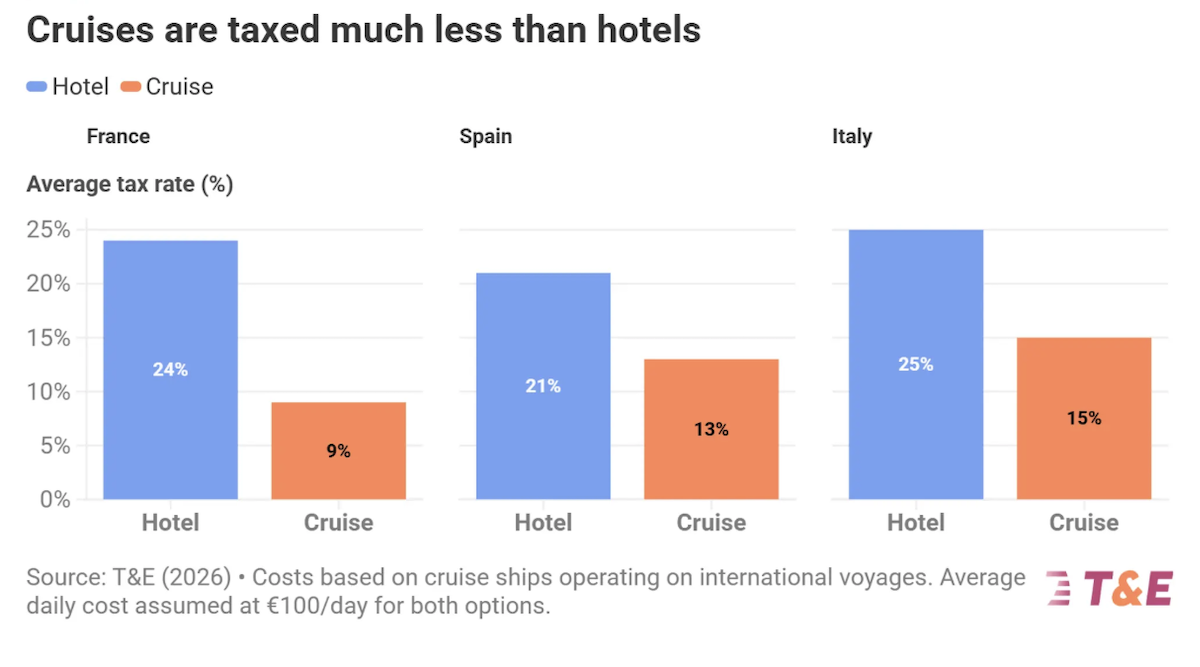
When a traveler books a night on a cruise ship, the tax bill that lands on the invoice is roughly half of what a hotel guest pays for a comparable €100 stay in the same region. The disparity – 12% of the price versus 23% for hotels – is not a quirk of accounting but a systemic loophole that lets the cruise industry sidestep the very taxes that fund climate mitigation and local infrastructure. As Europe pushes to meet its 2030 climate targets, the hidden subsidy embedded in maritime‑transport classification could undermine those goals and reshape competition between land‑based tourism and floating hotels.
According to CleanTechnica, Transport & Environment (T&E) examined taxes on €100‑per‑night hotels in France, Italy and Spain and compared them with cruise‑ship nights priced similarly. The analysis shows that hotel guests on average pay 23% of the price in taxes, while cruise passengers only pay 12%.
Deep Dive
The tax advantage stems from the legal definition of cruise ships as "maritime transport" rather than as accommodation. This classification exempts vessels from value‑added tax (VAT) and fuel taxes that hotels are obliged to collect. As T&E’s Shipping Manager Fanny Pointet explains, “We are treating floating hotels like they are essential maritime infrastructure. Cruises are not a mode of transportation but the destination itself, yet we are giving them the same benefits as freight transport.”
Beyond the direct tax savings, the study quantifies the broader externalities that remain uncovered. Using two carbon‑valuation models – CE Delft (2019) and Quinet (2025) – T&E estimates that the climate‑related external costs of cruise tourism in the three countries total between €790 million and €1.3 billion for 2025. Those costs exceed the revenues generated by the EU Emissions Trading System (ETS) for the sector by a factor of two to three, indicating that the current market pricing of emissions is far below the true societal burden.
To address the fiscal gap, T&E proposes a €15 levy per passenger for each port call. Their modelling suggests that such a levy would generate roughly €335 million annually across Italy, France and Spain. The revenue could be earmarked for coastal ecosystem protection, on‑shore power infrastructure, or returned to national budgets – but even this amount would fall short of covering the full environmental cost.
Policy recommendations extend beyond a simple levy. T&E calls for aligning cruise‑ship VAT with that applied to land‑based tourism, tightening the EU’s FuelEU Maritime standards for sustainable marine fuels, and raising energy‑efficiency benchmarks for vessels. They also suggest capping the number of daily or annual port calls to limit traffic overload in vulnerable coastal zones.
These proposals highlight a critical tension: the cruise sector enjoys a de‑facto subsidy that lowers operating costs and, by extension, ticket prices, making the product more attractive to consumers. At the same time, the environmental externalities – from greenhouse‑gas emissions to air‑pollutant discharges – remain largely unpriced. The result is a market distortion that nudges tourists toward higher‑emission travel while depriving coastal municipalities of tax revenue that could fund mitigation measures.
Independent corroboration from the Transport & Environment briefing and the duplicate CleanTechnica repost confirms the figures and the policy gap, reinforcing the credibility of the analysis.
Audit & Contradictions
The announcement focuses on the tax disparity and the proposed levy but omits several contextual layers. First, it does not quantify how much revenue governments currently forgo by classifying cruises as transport rather than accommodation. Second, the study’s external‑cost range (€790 million‑€1.3 billion) is presented without a baseline of existing subsidies, making it harder to assess the net fiscal impact. Third, the analysis assumes a uniform €15 per‑passenger levy, yet the cost structure of cruise lines varies widely by ship size, itinerary and occupancy, which could affect the projected €335 million revenue.
All core claims – tax rates, legal classification, external‑cost estimates, levy revenue projection, and policy recommendations – are corroborated by independent sources, so there are no single‑source statements requiring hedging. Fact‑check data also reports a contradiction level of "None," indicating no detectable conflicts between the primary article and the corroborating materials.
Future Outlook
If EU regulators adopt T&E’s recommendations, the cruise industry could face a cost increase that narrows the price gap with land‑based tourism. Higher taxes and stricter fuel standards would likely push ship owners toward cleaner propulsion technologies – such as LNG, ammonia or electric‑hybrid systems – accelerating the marine‑sector decarbonisation roadmap. Ports that rely on cruise traffic for economic activity might need to diversify revenue streams, potentially investing in sustainable tourism infrastructure to offset any loss of visitor numbers.
Conversely, delaying reform keeps the hidden subsidy in place, allowing cruise operators to continue expanding capacity. This could exacerbate overtourism in popular Mediterranean ports, strain local services, and increase emissions at a time when the EU is tightening its climate agenda. Competitors in the broader tourism market – hotels, short‑stay rentals, and land‑based cruise alternatives – could gain a relative advantage if they are not subject to comparable tax breaks.In the short term, the €15 per‑passenger levy offers a tangible revenue source that can be earmarked for green port upgrades, such as on‑shore electricity supply that enables ships to shut down diesel generators while docked. Over the longer horizon, aligning VAT and fuel‑efficiency rules with land‑based tourism could level the playing field, ensuring that the true environmental cost of a vacation is reflected in the price tag, regardless of whether the night is spent on a balcony overlooking a Mediterranean harbor or a city street.
Ultimately, the hidden subsidy that lets floating hotels pay roughly half the tax of conventional hotels is more than a fiscal curiosity; it is a lever that shapes consumer choice, investment in cleaner technologies, and the ability of coastal communities to fund climate resilience. Closing the gap will require coordinated policy action, transparent accounting of externalities, and a willingness to let the market price carbon where it currently hides.