Lead Hook
When the UK government announced a rollout of AI‑powered road‑safety cameras, the headline promised smarter enforcement of seat‑belt use, tax compliance and insurance checks. But the real story lies in what the plan sidesteps: a decade‑long plateau in traffic‑fatality reductions and a patchwork of privacy concerns already surfacing abroad. For motorists, regulators and civil‑rights groups, the stakes are not just about catching speeders – they are about whether a high‑tech solution can deliver safety gains that traditional cameras have failed to achieve.
Deep Dive
The proposal, as outlined in Autocar, envisions AI‑enabled cameras that would expand the reach of fixed‑penalty points beyond speed‑related offences to cover seat‑belt wearing, vehicle tax and insurance compliance. The same source notes that the government also plans to extend penalty points to enforce these broader rules.
At the heart of the argument is a perceived shortfall in the current speed‑centred camera system. According to the article, “the current speed‑centred system hasn't significantly reduced mortality for the past 15 years.” No comparative data are offered, but the claim sets the tone for a policy shift that looks to technology rather than stricter speed limits or infrastructure changes.
Personal experience is used to illustrate the system's impact. The author, Autocar’s chief car tester Matt Saunders, recounts receiving three penalty points for travelling 59 mph on an A‑road that was formerly under the national speed limit. He describes the penalty as a “fair cop” that prompted him to monitor his speed more closely. This anecdote serves as a micro‑example of how expanded point‑allocation could affect everyday drivers.
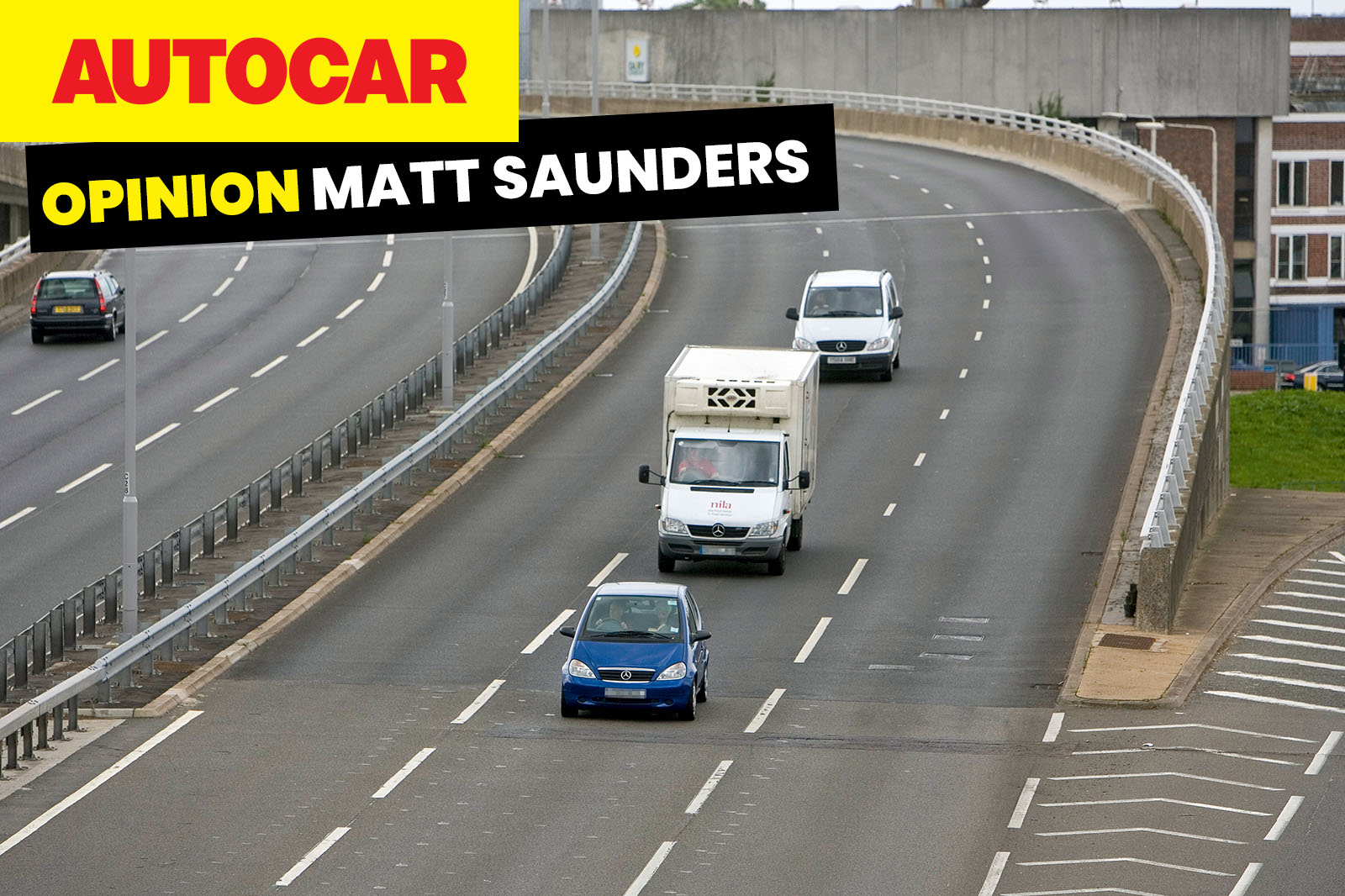
Beyond enforcement of speed, the article sketches an ambitious re‑ordering of lane discipline on dual‑carriageways. It proposes that lorries and coaches be confined to the innermost lane, smaller commercial vehicles to the two left‑most lanes, and cars and motorbikes be permitted up to 80 mph with exclusive use of the outer lane. The piece also suggests that AI cameras could enforce a minimum following distance for heavy vehicles, a measure the author believes could be “enforced by camera quite easily.” All of these proposals are presented as author‑driven ideas, not as government policy.
What the article does not address is the practical pathway to such a regulatory overhaul. Implementing lane‑specific AI enforcement would require new legal definitions of lane usage, standards for AI detection accuracy, and a framework for contesting automated penalties. Moreover, the piece acknowledges uncertainty about AI’s ability to police “middle‑lane hogging,” leaving that enforcement to human patrol officers.
Internationally, the same technology is being trialled in very different contexts. Independent reports cite AI traffic cameras in Houston, USA, and a pilot in Cyprus, both of which have sparked privacy debates. While these cases are not directly linked to the UK plan, they highlight the broader regulatory and civil‑liberty questions that any large‑scale AI surveillance system must confront.
Audit & Contradictions
The article makes several claims that are not corroborated by external sources and therefore must be treated as single‑source statements. These include:
- The UK government’s intention to use AI‑powered cameras and expand penalty points to seat‑belt, tax and insurance enforcement.
- The assertion that road‑mortality rates have not significantly improved in the past 15 years.
- The personal anecdote of three penalty points for a 59 mph breach on an A‑road.
- The suggestion that AI cameras could enforce lane discipline and minimum following distances for heavy vehicles.
- The proposal that cars and motorbikes travel up to 80 mph with exclusive outer‑lane usage.
Fact‑check data label all of these as single‑source claims, with no direct contradictions identified in the listed independent corroboration. The overall contradiction level is assessed as “Low,” meaning the piece does not present outright falsehoods but leans heavily on unverified statements.
Future Outlook
If the UK proceeds with AI‑driven enforcement, the market for automotive‑grade computer‑vision systems could see a surge in demand, attracting both domestic tech firms and international players already active in the US and Cyprus pilots. However, the lack of proven mortality impact and the looming privacy scrutiny may slow adoption, prompting regulators to demand robust audit trails and transparent algorithmic standards.
Competitors—ranging from traditional camera manufacturers to AI start‑ups—will need to demonstrate not just detection accuracy but also compliance with emerging data‑protection frameworks. For the automotive industry, a shift toward higher speed limits and lane‑specific rules could influence vehicle design, especially in terms of driver‑assistance systems that must respect AI‑enforced lane allocations.
Regulators, meanwhile, will be tasked with balancing the promise of reduced congestion and targeted enforcement against the risk of over‑surveillance. The UK’s approach may set a precedent that other European nations watch closely; success could catalyse a continent‑wide rollout, while failure—or a high‑profile privacy backlash—could reinforce calls for more modest, human‑led enforcement strategies.
In the end, the AI camera initiative raises a fundamental question: can technology fill the gap left by a stagnating safety record, or will it simply add another layer of monitoring without delivering measurable lives saved? The answer will hinge not on the hardware itself, but on the policy scaffolding that determines how, when and why cameras intervene on Britain’s roads.