Lead Hook
Reaching 10 million cumulative vehicle sales would place Tesla alongside legacy automakers that have built decades of market share. Yet the milestone, which CleanTechnica reports, is being driven almost entirely by two models – the Model Y and Model 3. The concentration raises a deeper question: can Tesla sustain this velocity when its production network, battery supply chain, and competitive landscape are all tightening?
Deep Dive
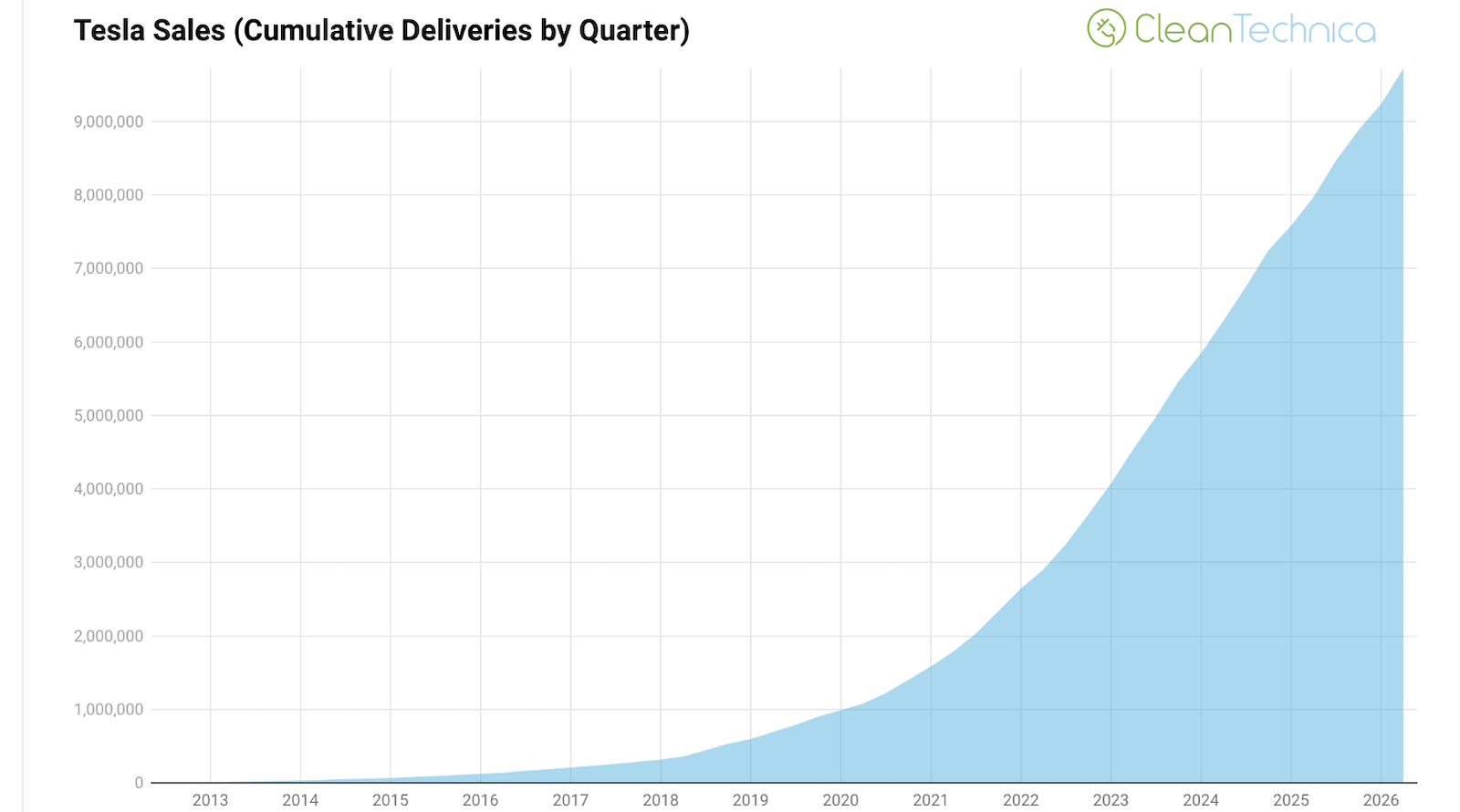
According to the source, Tesla’s cumulative vehicle sales stood at 9,721,070 units at the end of Q2 2026 and the company delivered 480,126 vehicles in that quarter. Simple arithmetic suggests that the remaining 278,930 sales needed to breach the 10 million mark could be achieved within the next three months, assuming Q2’s delivery rate holds.
That delivery rate is not a product of a broad portfolio. The article notes that the Model 3 has accumulated 3,502,363 sales while the Model Y has reached 5,385,508 sales. The Model Y is also described as “the highest‑selling electric vehicle of all time.” In effect, more than 90% of Tesla’s cumulative volume comes from these two platforms.
From a production standpoint, sustaining a half‑million‑unit quarterly output hinges on several interlocking factors:
- Battery supply constraints. Tesla’s Gigafactories in Nevada, Texas, and Berlin are currently the primary sources of its 4680‑type cells. Any disruption – whether from raw‑material shortages, geopolitical tensions, or factory ramp‑up delays – would directly curtail the number of vehicles that can be assembled.
- Manufacturing capacity. The Model Y and Model 3 share a common platform and many production lines. While this commonality enables rapid scaling, it also creates a single‑point bottleneck: a slowdown in one plant reverberates across both models.
- Software and AI integration. The source’s unrelated note about Tesla achieving an AI5 chip tape‑out hints at the company’s broader push to embed advanced compute in its vehicles. Integrating new silicon into production lines can temporarily reduce throughput, even as it promises future revenue streams from robotaxi services.
Financially, the sales surge strengthens Tesla’s cash flow, which it can redeploy into expanding its battery supply chain or accelerating new model development. However, the reliance on two models also leaves the company vulnerable to market shifts. If consumer preferences pivot toward larger SUVs or lower‑price entry‑level EVs that Tesla does not currently offer, its growth could plateau.
Regulatory incentives further complicate the picture. Many jurisdictions award credits based on cumulative sales milestones, which can translate into tax breaks or zero‑emission vehicle (ZEV) credits. Achieving 10 million units may unlock additional benefits, but those incentives are being phased out in key markets such as the EU and California as the EV market matures. The timing of the milestone therefore coincides with a narrowing window for policy‑driven upside.
Competitors are also closing the gap. Legacy manufacturers like Volkswagen and General Motors have announced multi‑model EV lineups that collectively aim to outpace Tesla’s Model Y‑only dominance in specific segments. The concentration risk becomes stark when a rival launches a similarly priced compact SUV that can erode the Model Y’s market share.
Audit & Contradictions
The CleanTechnica article is the sole source for every quantitative claim in this story. The fact‑check audit notes that the following statements are single‑source and therefore hedged:
- Tesla will reach 10 million cumulative vehicle sales in Q3 2026.
- Tesla’s cumulative vehicle sales were 9,721,070 at the end of Q2 2026.
- Tesla delivered 480,126 vehicles in Q2 2026.
- Model 3 cumulative sales are 3,502,363 units.
- Model Y cumulative sales are 5,385,508 units.
- The Model Y is the highest‑selling electric vehicle of all time.
No independent outlet corroborates these numbers, and the audit reports a “Low” contradiction level, meaning no direct conflicts were found. Readers should therefore treat the figures as Tesla‑reported estimates rather than independently verified data.
Future Outlook
If Tesla does breach the 10 million mark as projected, the headline will reinforce its brand narrative of market leadership. Yet the underlying dynamics suggest a crossroads:
- Product diversification. Introducing a lower‑cost model or a new body style could dilute the concentration risk and capture consumers who currently gravitate toward competing brands.
- Supply‑chain investments. Securing additional lithium‑ion cell capacity—through partnerships or in‑house gigafactories—will be crucial to keep pace with any future acceleration beyond the current quarterly average.
- Regulatory navigation. As ZEV credit programs evolve, Tesla may need to lean more on software revenue (Full Self‑Driving, robotaxi) to offset diminishing policy subsidies.
- Competitive pressure. The next wave of EVs from legacy OEMs will likely target the same price‑performance sweet spot occupied by the Model Y. Tesla’s ability to sustain its delivery cadence will be tested by how quickly rivals can scale their own production.
In sum, the 10 million milestone is as much a celebration of past growth as it is a signal that Tesla’s future will depend on expanding its manufacturing flexibility, broadening its model range, and navigating a rapidly shifting policy and competitive environment.