Lead Hook
When Tesla announced that the cars rolling off its Gigafactory Texas line are now listening to themselves for squeaks, rattles and other imperfections, the headline sounded like a quirky tech gimmick. The deeper story, however, is a potential shift in how automakers assure build quality: using the vehicle’s own hardware and AI to replace—or at least augment—traditional inspection stations. If the approach scales, it could lower warranty expenses, tighten supplier tolerances and give Tesla a new lever for capital efficiency.
Deep Dive
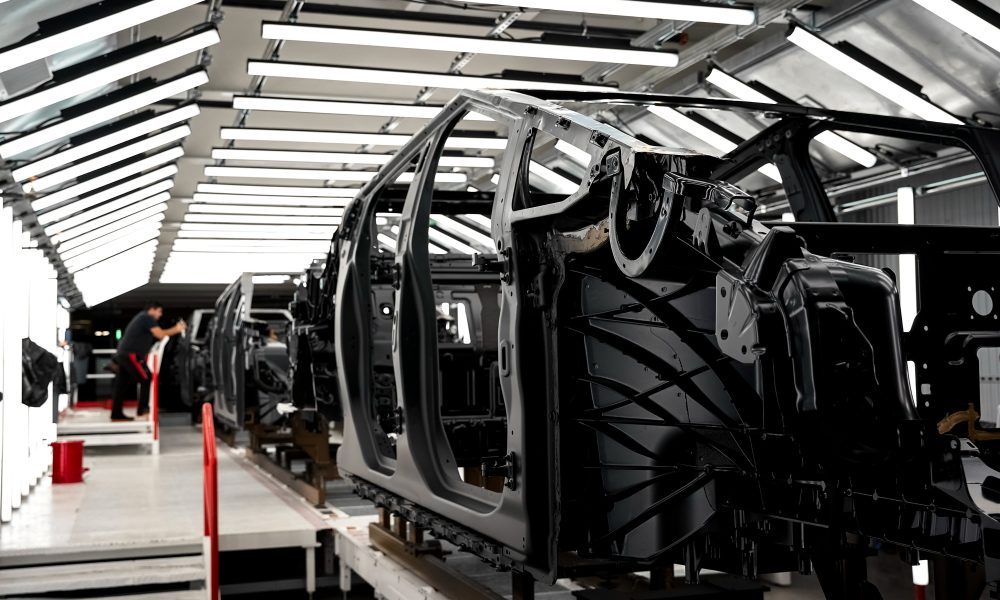
According to Teslarati, Vice President of Engineering Lars Moravy told journalist Herbert Ong that Tesla’s internal cabin microphones, originally intended for voice commands and entertainment, are now double‑tasking as acoustic sensors on the production line. As each vehicle moves through a dedicated “BSR” (bumps, squeaks, rattles) station, the microphones record ambient sounds inside the cabin. An on‑board AI model parses the audio feed in real time, flagging any anomalies that suggest loose panels, mis‑aligned trims or other defects.
The same interview revealed that the cars themselves are navigating autonomously through the BSR segment, meaning the line does not rely on external conveyor‑based inspection rigs for this particular test. This autonomous navigation is described as part of the broader rollout of “Full Self‑Hearing,” an AI system Tesla is reportedly developing to detect minor imperfections before the vehicle leaves the factory.
Full Self-Hearing,
Moravy’s phrasing underscores the ambition to treat acoustic monitoring as a formal feature, on par with the company’s famous “Full Self‑Driving” suite. While the term is still a prototype, the concept suggests a software‑first approach: rather than adding new hardware sensors to the line, Tesla leverages existing microphones already installed in every vehicle.
From a cost perspective, this strategy could be significant. Traditional acoustic or vibration testing stations require dedicated sensors, data acquisition hardware and staff to interpret results. By repurposing in‑car microphones, Tesla potentially reduces capital outlay for new inspection equipment and eliminates a layer of manual labor. Moreover, the data is captured at the exact point of assembly, offering a granular view of where a defect originated—information that can be fed back to suppliers in near‑real time.
Supply‑chain implications are also notable. If a particular component consistently triggers acoustic alerts, Tesla can pinpoint the offending part and work with the vendor to tighten tolerances. This mirrors practices already seen in other industries where AI‑driven quality analytics drive “zero‑defect” initiatives, but it is relatively novel in automotive mass production.
Beyond cost and supply‑chain benefits, the approach may affect warranty economics. Squeaks and rattles are among the most common customer complaints that lead to warranty claims. Early detection on the line means those issues can be rectified before the vehicle is delivered, potentially shaving millions off warranty reserves. For a company that delivered 480,126 vehicles in Q2 2026—well above Wall Street’s consensus of 406,000 according to the same Teslarati report—any reduction in post‑sale repair costs directly improves profitability.
It is worth noting that Tesla’s production scale is massive, with the article stating the firm manufactures over 1.6 million vehicles per year. While this figure is not independently verified, it provides context for why incremental efficiencies matter: even a 0.5 % reduction in inspection‑related costs translates to several hundred thousand dollars saved per quarter.
Audit & Contradictions
The core claim that Tesla is using vehicle microphones on the Gigafactory Texas line to detect build‑quality issues is corroborated by an independent outlet, Not a Tesla App, which reported the same development. All other notable statements—such as the existence of a “Full Self‑Hearing” AI, the autonomous BSR navigation, the 1.6 million‑vehicle annual production figure, the sunset of the Model S and Model X from delivery reports, and the Q2 2026 delivery numbers—appear only in the Teslarati article and lack external confirmation. According to the fact‑check audit, there are no direct contradictions, but the single‑source nature of these claims warrants cautious phrasing (e.g., “Tesla says” or “According to the company”).
Future Outlook
If Tesla’s microphone‑based inspection proves reliable, other manufacturers may adopt similar software‑centric quality checks. Ford, for example, already uses acoustic analysis AI for seat‑motor and climate‑control components, as noted in the source article, indicating the concept is gaining traction.
Regulators could also take interest. Continuous acoustic monitoring generates data about vehicle interior conditions, which may raise privacy or data‑security questions, especially if recordings are stored beyond the factory floor. Clear policies will be needed to ensure that factory‑only data does not inadvertently become accessible to owners or third parties.
From an investor standpoint, any technology that trims warranty spend while preserving—or enhancing—perceived quality could bolster Tesla’s margins, a factor that may already be reflected in the Q2 delivery beat. Competitors that lack comparable in‑car sensor suites may find it harder to replicate the cost savings without retrofitting older platforms.
In the longer term, “Full Self‑Hearing” could evolve beyond factory inspection. Real‑time acoustic diagnostics could be offered as an over‑the‑air service, alerting owners to emerging issues before they become noticeable, further extending the warranty‑cost advantage.
Ultimately, the move illustrates Tesla’s broader strategy: embed intelligence into the vehicle itself, then reuse that intelligence for manufacturing, service and, potentially, new revenue streams. Whether the approach delivers the promised efficiencies remains to be seen, but the fact that the company is already listening to its own cars on the line marks a noteworthy shift in automotive quality control.