Lead Hook
The May 2026 sales snapshot looks like a routine leaderboard, but beneath the numbers lies a market being reshaped by policy volatility and a rapid consolidation around battery‑electric vehicles (BEVs). The data shows Tesla’s Model Y still commanding the global stage with 93,571 units sold, while BEVs now make up 71% of all plug‑in registrations. At the same time, plug‑in hybrids (PHEVs) are slipping into the red for a fifth straight month. These trends suggest that the end of major subsidies in the United States and the gradual phase‑out of incentives in China are not just short‑term blips—they are accelerating a structural pivot toward pure electrics and concentrating sales among a handful of models.
Deep Dive
According to CleanTechnica, global plugin‑vehicle registrations rose 4% year‑over‑year (YoY) in May, ending the month at roughly 1.7 million units. The headline‑grabbing figure masks a stark divergence: BEVs surged 15% YoY, while PHEVs fell 15% YoY. This is the first time since 2019 that PHEVs have posted five consecutive months of decline.
When the two segments are recombined, the overall plugin market is barely positive (+2% YoY), a number that is entirely driven by the BEV surge (+9% YoY). In concrete terms, BEVs accounted for 71% of all plugin sales in May—about 1.2 million units—making it one of the strongest monthly performances in recent years. The share of BEVs in the total plugin mix has now touched the upper ceiling of the past 12 years, where the range has historically hovered between 50% and 70%.
Geographically, the story becomes even more telling. The United States and China together represent the two largest EV markets, but both are experiencing incentive roll‑backs: the U.S. ended its federal EV tax credit in October 2025, and China plans a partial removal of subsidies by the end of 2025. When these two markets are stripped from the global tally, EV registrations jumped a staggering 39% YoY in May, with BEVs alone climbing 47% YoY. Even PHEVs, which have been lagging, only managed a 20% growth rate in the same excluded‑market view—the weakest for the technology in over a year.
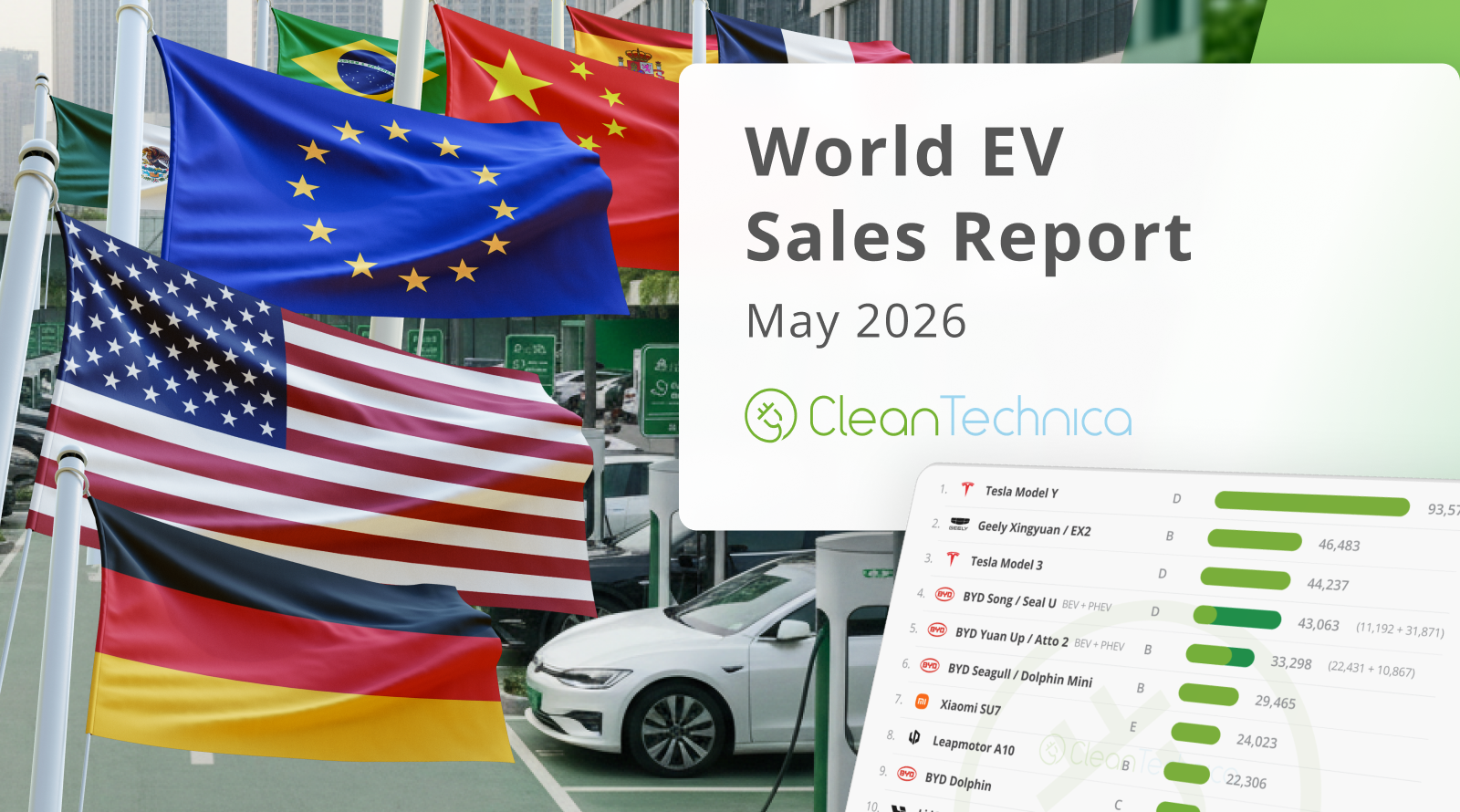
The concentration of sales among a few models amplifies the market’s fragility. Tesla’s Model Y led with 93,571 units, up 16% YoY, while the Model 3 posted 44,237 units, up 28% YoY, securing the third‑place slot. Chinese‑origin models such as Geely’s Xingyuan (EX2) and BYD’s Song and Yuan Up/Atto 2 filled the next spots, but each of these models is either relying on refreshed designs or export‑driven growth to stay competitive. Leapmotor’s A10, a newcomer, recorded 22,000 registrations in just its third month, landing it in eighth place—a remarkable debut that signals a potential shift in the Chinese small‑crossover segment.
Beyond the top‑ten, legacy OEMs are barely making a dent. Toyota’s BZ4X emerged as the best‑selling legacy model with 11,119 units, followed closely by the BMW iX1/X1 PHEV twins (10,746 units) and Hyundai’s IONIQ 5 (10,478 units). These figures underscore how the market’s momentum is now dominated by pure‑electric offerings and a handful of high‑volume players, leaving traditional brands to chase niche sales.
The policy‑driven dynamics have several downstream effects. First, manufacturers that have heavily invested in hybrid powertrains now face a shrinking addressable market, prompting a reallocation of R&D budgets toward BEV platforms. Second, supply‑chain constraints—particularly for battery cells and semiconductor components—are becoming more acute as a smaller set of models absorb a larger share of global demand. Finally, the concentration of sales intensifies competitive pressures on pricing and after‑sales support, especially in regions where subsidies have vanished and consumers are price‑sensitive.
Audit & Contradictions
The CleanTechnica report is the sole source for the headline figures cited above. Fact‑check data confirms that the claims about Tesla’s Model Y (93,571 units, +16% YoY), the Model 3 (44,237 units, +28% YoY), the 71% BEV share of plugin sales (≈1.2 million units), the 39% YoY global EV surge when China and the U.S. are excluded, and Leapmotor’s A10 debut (22,000 registrations) are all single‑source statements with no corroboration from the listed independent outlets. The audit notes a “Low” contradiction level, meaning no conflicting data were identified, but the lack of independent verification means these numbers should be treated as preliminary until confirmed by additional sources.
What the announcement does not address is the potential lag in reporting from emerging markets, the impact of regional regulatory changes that may not yet be reflected in the May data, and the long‑term sustainability of the current BEV growth rate once the incentive vacuum widens further. Moreover, the report offers no insight into the profitability of the high‑volume models or the capacity constraints that could temper future sales spikes.
Future Outlook
If the policy trajectory continues—U.S. federal incentives remaining absent and China scaling back subsidies—the BEV share of global plug‑in sales is likely to climb further, potentially breaching the 75% threshold by year‑end. This would compress the market for PHEVs, nudging manufacturers to accelerate BEV‑only line‑ups or to seek alternative incentives, such as state‑level rebates or corporate fleet commitments.
For Tesla, the continued dominance of the Model Y and Model 3 creates both an advantage and a risk. While high volume secures economies of scale, it also makes the company vulnerable to supply‑chain shocks, especially in battery cell shortages. Competitors like BYD, Geely, and Leapmotor are leveraging aggressive pricing and export strategies to chip away at Tesla’s lead, but their success will depend on scaling production without the cushion of subsidies.
Chinese manufacturers that have found a resurgence in export markets—evident in Geely’s 47,000‑unit surge and BYD’s refreshed Song—may see renewed growth if they can navigate tariff barriers and meet safety standards in Europe and North America. Conversely, legacy OEMs that rely on hybrid technology will need to pivot quickly, potentially accelerating the rollout of dedicated BEV platforms to stay relevant.
Regulators, meanwhile, face a balancing act. Removing subsidies can accelerate market maturation, but abrupt policy shifts risk creating a sales cliff that could leave manufacturers with excess inventory and underutilized factories. A phased approach—combining targeted incentives for lower‑cost BEVs, investments in charging infrastructure, and clear timelines for hybrid phase‑out—could smooth the transition while preserving the momentum observed in May’s data.
In sum, the May 2026 figures are more than a leaderboard; they are a barometer of a market in flux, driven by policy, concentration, and the relentless march of BEV technology. Stakeholders that anticipate these undercurrents will be better positioned to navigate the next wave of electric mobility.