Lead Hook
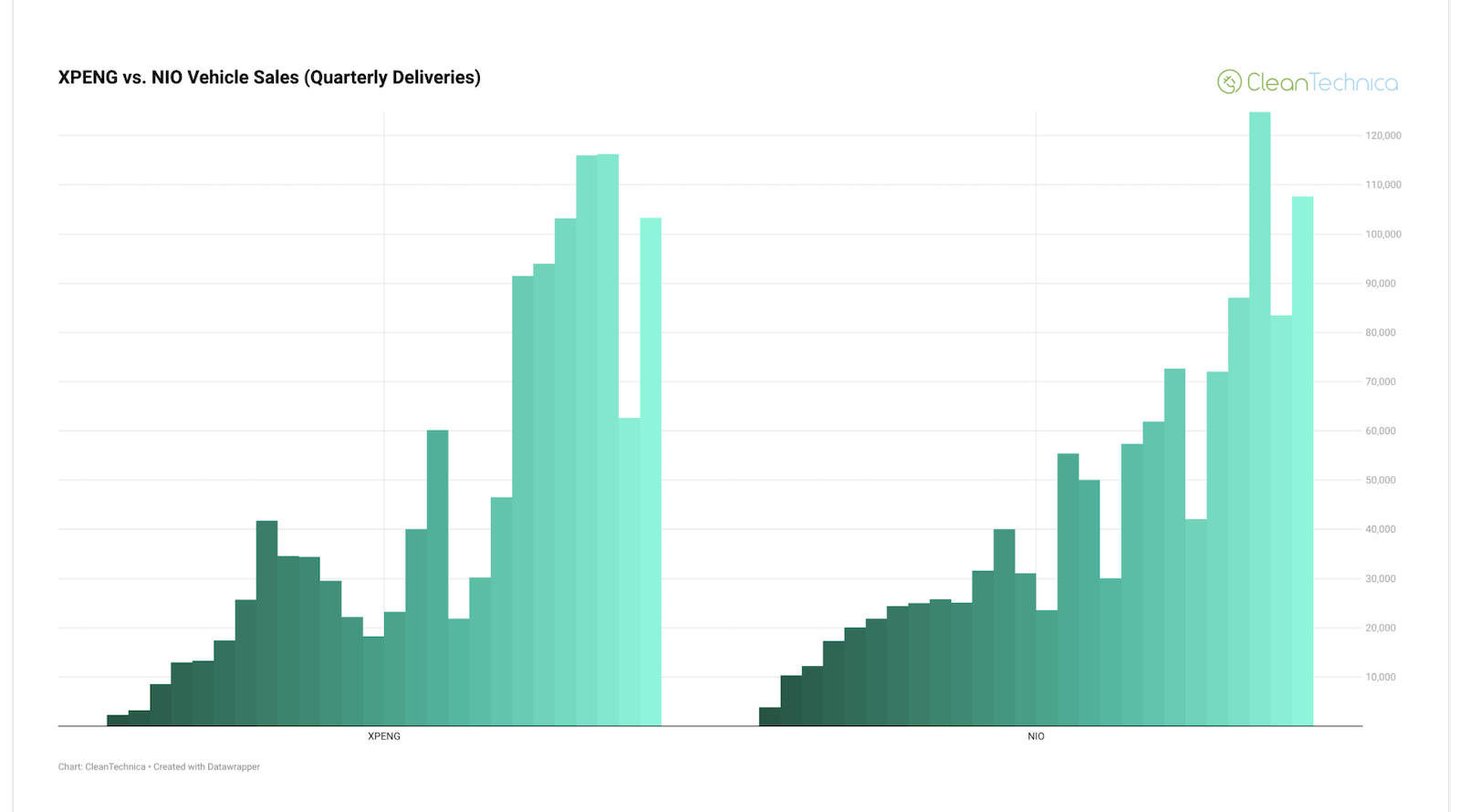
When two of China’s biggest electric‑vehicle makers post monthly sales that differ by less than a hundred units, the headline reads like a sports score. Yet the stakes run far deeper than a headline‑level rivalry. The June 2026 numbers—XPENG’s 40,126 deliveries versus NIO’s 40,597—signal a turning point in how each company is betting on the next generation of charging infrastructure, capital allocation, and ultimately, financial survivability in a market that can swing on a single digit of demand.
Deep Dive
The CleanTechnica piece notes that the June sales gap is roughly 1%, a margin that has narrowed dramatically after a period of back‑and‑forth dominance. Earlier, XPENG had surged ahead at the end of 2025, only for NIO to reclaim the lead in December 2025. This seesaw pattern underscores how volatile the Chinese EV market remains, where brand loyalty, model refresh cycles, and government incentives can shift momentum within weeks.
Beyond raw units, the article highlights divergent strategic pathways. NIO has “brought two more brands to market in order to achieve its sales growth.” While the piece does not detail the brands, the move suggests a diversification strategy aimed at capturing niche segments or price points that XPENG may be targeting with its own model pipeline. Both firms, according to the source, continue to roll out new models while pursuing “financial sustainability” in a “hyper‑competitive Chinese EV market.” This dual focus on product cadence and the bottom line reflects a broader industry pressure: investors are demanding profitability faster than many legacy automakers have ever required.
Perhaps the most consequential contrast lies in the approach to energy delivery. NIO’s long‑standing battery‑swap network is described as “getting a bit questionable in the face of ‘Flash Charging.’” The article includes a bare quote of the term, hinting at a technology that promises ultra‑rapid power transfer without the mechanical complexity of swapping stations. While the piece does not quantify the speed or cost differences, the implication is clear: if flash‑charging infrastructure scales quickly, the capital‑intensive swap stations could become a stranded asset, pressuring NIO’s balance sheet.
Flash Charging.
By contrast, XPENG has historically leaned on fast‑charging solutions that align with existing grid upgrades, positioning itself to benefit from a charging ecosystem that may be less capital‑heavy. If flash‑charging does become the de‑facto standard, the company that has already invested in compatible hardware could gain a decisive edge in both consumer perception and operational economics.
Capital efficiency also surfaces indirectly. The article’s emphasis on “financial sustainability” suggests that both firms are feeling the squeeze of cash burn, a common theme among Chinese EV startups that have relied heavily on state‑backed financing and aggressive expansion. The narrow sales gap means that any misstep—whether a delayed model launch, a supply‑chain hiccup, or a regulatory shift—could tip the balance. In a market where subsidies are being phased out and competition from domestic giants intensifies, the ability to fund new model development without overleveraging becomes a decisive factor.
Audit & Contradictions
The CleanTechnica article is the sole source for the concrete figures and strategic claims cited above. The fact‑check audit notes that independent outlets listed—such as Gasgoo, ArenaEV, and TradingView—do not corroborate the June 2026 sales numbers, the end‑2025 peak shift, the introduction of two new NIO brands, or the comparative assessment of battery swapping versus flash charging. Consequently, each of these points must be presented as single‑source statements, hedged accordingly.
Specifically, the audit flags the following as single‑source claims: XPENG’s 40,126 June 2026 sales, NIO’s 40,597 June 2026 sales, the end‑2025 sales peak dynamics, NIO’s two‑brand expansion, and the potential vulnerability of NIO’s battery‑swap model to flash‑charging technology. No contradictions were identified among the sources, and the overall contradiction level is reported as “Low.”
Future Outlook
Looking ahead to the second half of 2026, the razor‑thin sales margin suggests that the rivalry will be decided less by headline numbers and more by how each company allocates capital toward charging infrastructure and model diversification. If flash‑charging standards coalesce quickly, NIO may face pressure to retrofit its fleet or accelerate a shift away from swapping, potentially stretching its cash reserves. XPENG, meanwhile, could leverage its existing fast‑charging partnerships to capture market share among consumers who prioritize convenience over the novelty of swapping.
Regulators could also play an indirect role. Chinese authorities have signaled a desire to standardize charging protocols to avoid a fragmented ecosystem. A policy that favors ultra‑fast charging could inadvertently privilege firms that have already invested in compatible hardware, while a policy that continues to subsidize swapping stations could preserve NIO’s current advantage.
For competitors outside China, the unfolding battle offers a case study in how charging‑technology bets intersect with financial discipline. International EV makers watching the Chinese market may adjust their own roadmap timelines, ensuring that their charging solutions are flexible enough to adapt to whichever standard—swap or flash—gains regulatory and consumer favor.
In sum, the June 2026 sales parity is a surface reading of a deeper strategic contest. While the numbers are almost even, the underlying capital commitments, technology bets, and regulatory environment could soon create a decisive gap. Stakeholders—from investors to policymakers—should watch not just the sales charts, but the infrastructure blueprints that each company is drafting today.