Lead Hook
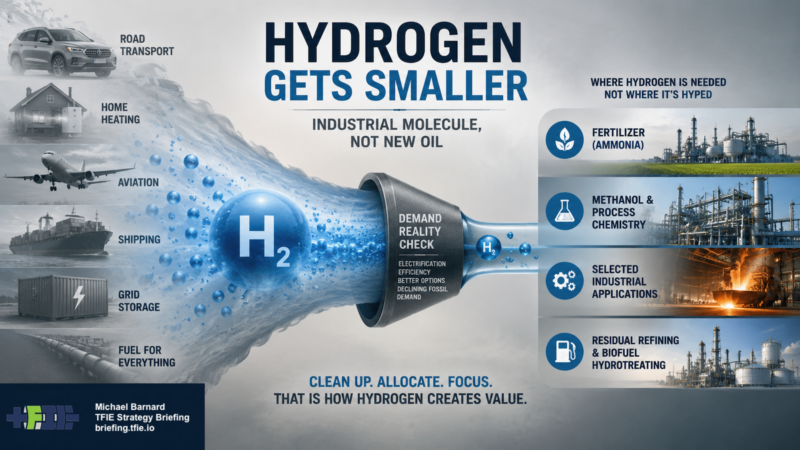
Hydrogen has been sold as the Swiss Army knife of the energy transition—a fuel that could decarbonize everything from trucks to steel mills to home heating. But what if the hydrogen economy isn’t expanding? What if it’s actually shrinking?
According to a new analysis published by CleanTechnica, the global hydrogen market is poised for contraction, not growth, when measured correctly. The problem? Most hydrogen demand today is tied to fossil fuels—refining, ammonia production, and methanol—and as the world shifts away from oil and gas, that demand evaporates. Meanwhile, where hydrogen *could* play a role—like transport or grid storage—electrification, batteries, and alternative fuels are already winning. The result is a market that may shrink by 2100, not explode.
This isn’t just an academic debate. Governments and corporations have poured billions into hydrogen infrastructure, betting on it as a climate solution. If demand is overestimated, those investments could become stranded assets—expensive, underutilized pipelines, refueling stations, and production facilities that never pay off. The stakes are high: misjudging hydrogen’s role could slow the energy transition by diverting resources from cheaper, more scalable solutions.
Deep Dive
1. Today’s Hydrogen Market: A Fossil-Fuel Subsidy in Disguise
Hydrogen isn’t a fuel most consumers encounter. According to CleanTechnica, it’s almost entirely an industrial feedstock: 80% of global demand comes from oil refining (for desulfurization and upgrading heavy hydrocarbons), ammonia production (for fertilizers), and methanol synthesis. The catch? Nearly all of this hydrogen is produced from fossil fuels—primarily natural gas and coal—making it a major source of CO₂ emissions. The International Energy Agency (IEA) estimates that hydrogen production accounts for roughly 900 million tons of CO₂ annually, equivalent to the emissions of the entire aviation sector.
The climate challenge isn’t just cleaning up existing hydrogen production—it’s whether that demand will even exist in a decarbonized world. The largest single use, oil refining, is directly tied to gasoline and diesel consumption. As electric vehicles (EVs) replace internal combustion engines, global oil demand is projected to decline. The IEA’s Net Zero by 2050 scenario sees oil demand falling by 75% by 2050. Fewer barrels refined means less need for hydrogen in refineries. The source reports that "hydrogen used to make fossil fuels cleaner at the point of combustion does not survive unchanged in a world using fewer fossil fuels." This isn’t a niche trend—it’s a structural decline.
2. Ammonia and Fertilizer: Necessary but Not Expanding
Ammonia, the second-largest hydrogen market, is critical for global food security. The world will still need nitrogen fertilizers, but CleanTechnica argues that demand won’t grow unchecked. Precision agriculture, better application techniques, and shifts in diet (such as reduced meat consumption) could moderate nitrogen demand. The source notes that "better application, precision agriculture, reduced losses, manure management, nitrification inhibitors, crop rotation, biological nitrogen fixation and shifts in diet can all moderate nitrogen demand."
The task for decarbonization isn’t to justify hydrogen as a fuel but to clean up the existing ammonia supply. Green hydrogen—produced via electrolysis powered by renewables—can replace fossil-based hydrogen in fertilizer production, but this doesn’t create new demand. It’s a substitution, not an expansion.
3. Transport: Why Hydrogen Is Losing the Race
Hydrogen has long been touted as a solution for hard-to-decarbonize transport sectors like trucks, shipping, and aviation. The reality? Battery-electric vehicles (BEVs) are winning in nearly every segment. For light-duty vehicles, BEVs dominate. For buses, CleanTechnica reports that "electric buses are winning against hydrogen buses on cost, reliability and infrastructure." Even in trucking, where hydrogen was once seen as the frontrunner for long-haul freight, BEVs are making inroads. Tesla’s Semi, Freightliner’s eCascadia, and Volvo’s FH Electric are proving that battery-electric trucks can handle regional and return-to-base routes—exactly the markets where hydrogen infrastructure would be easiest to deploy.
Hydrogen’s problem in transport isn’t just competition—it’s inefficiency. The source explains that hydrogen vehicles require "a parallel fuel system with production, compression or liquefaction, distribution, storage, dispensing, maintenance and utilization high enough to pay for all of it." For every unit of renewable electricity used to produce hydrogen, 60-70% of the energy is lost in conversion, compression, and transport. By comparison, BEVs retain 80-90% of the original electricity’s energy. The math doesn’t add up.
4. Steel, Shipping, and Aviation: Niche Markets, Not Silver Bullets
Steel production is often cited as a major future market for hydrogen, specifically for direct reduced iron (DRI) processes that replace coal. But CleanTechnica argues that this market is more limited than the hype suggests. Scrap-based electric arc furnaces (EAFs) are expanding as steel recycling grows. The source notes that "direct electrochemical ironmaking and other emerging pathways compete for new iron production." Hydrogen DRI may make sense in regions with abundant renewable energy and high-grade iron ore, but it’s not a universal solution.
Shipping and aviation face similar constraints. While hydrogen-derived fuels like ammonia and synthetic kerosene are being tested, they remain expensive and energy-intensive. The source reports that "shipping fuel demand falls as fossil cargoes decline, batteries take inland and short-sea routes, efficiency improves and residual liquid fuels are allocated carefully." For aviation, biomass-derived sustainable aviation fuels (SAFs) are a more likely solution than hydrogen, which introduces challenges like storage, volume, and airport logistics.
Audit & Contradictions
The central claim—that hydrogen demand will shrink when measured correctly—is corroborated by two independent CleanTechnica reports. However, nearly all the sector-specific assertions are single-source claims and must be treated with caution:
- Refining demand decline: The source states that hydrogen demand in refining will fall as oil demand declines. This is plausible given EV adoption trends, but the exact rate of decline depends on factors like petrochemical demand and biofuel blending mandates, which are not addressed in the analysis.
- Ammonia demand moderation: The claim that nitrogen fertilizer demand will moderate due to agricultural innovations is speculative. While precision farming and dietary shifts could reduce demand, population growth and food security concerns may offset these gains.
- Hydrogen buses losing to BEVs: The source asserts that electric buses are outperforming hydrogen buses on cost and reliability. While this aligns with trends in China and Europe, some regions (e.g., parts of the U.S. and Australia) are still investing in hydrogen bus fleets, suggesting local variations.
- Limited role in steel, shipping, and aviation: The argument that hydrogen will play a niche role in these sectors is not universally accepted. For example, the European Commission’s REPowerEU plan targets 10 million tons of domestic renewable hydrogen production by 2030, with a significant portion earmarked for steel and aviation. The source’s projection conflicts with these policy ambitions.
- Grid storage: The source dismisses hydrogen’s role in grid storage, emphasizing batteries for short-duration needs. However, some energy analysts argue that hydrogen could play a role in seasonal storage, particularly in regions with high renewable penetration.
The fact-check audit confirms that the article’s headline claim is well-supported, but its sector-specific forecasts are single-source and lack independent corroboration. The contradiction level is rated as "Low," meaning no major contradictions were found, but the nuances of hydrogen’s role in steel, shipping, and aviation remain debated.
Future Outlook
If hydrogen demand is set to shrink, what does that mean for the billions already invested in the sector? The implications are profound:
- Stranded assets: Hydrogen production facilities, pipelines, and refueling stations could become underutilized if demand fails to materialize. For example, the EU’s hydrogen strategy includes plans for 40 GW of electrolyzer capacity by 2030. If demand is overestimated, these projects may struggle to achieve economies of scale.
- Policy misalignment: Governments are subsidizing hydrogen projects based on the assumption of growing demand. If the market contracts, these subsidies could be seen as misallocated funds, potentially slowing the energy transition by diverting resources from more scalable solutions like grid upgrades and battery storage.
- Corporate pivots: Companies like Plug Power, ITM Power, and Nel Hydrogen have bet heavily on hydrogen as a growth market. If demand shrinks, they may need to pivot to niche applications (e.g., green steel, ammonia) or face financial strain. Ballard Power, a leader in hydrogen fuel cells, is already seeing stronger demand for battery-electric buses than hydrogen buses, according to Kalkine Media.
- Geopolitical shifts: Countries like Australia, Chile, and Saudi Arabia are investing in hydrogen exports, banking on future demand. If that demand doesn’t materialize, these projects could become economic liabilities, leaving stranded workers and communities.
The hydrogen economy isn’t disappearing, but it may be far smaller than its proponents claim. The real winners of the energy transition may not be hydrogen producers but the companies and technologies that can outcompete it—battery manufacturers, grid operators, and innovators in direct electrification.
As CleanTechnica concludes, "The better test is narrower: where is hydrogen already used, which of those uses survive decarbonization, and which new uses can beat direct electrification or better molecules?" The answer, it seems, is far fewer than we’ve been led to believe.