Lead Hook
When BMW rolls out a futuristic façade of illuminated trees that can juice an electric car at up to 400 kW, the spectacle grabs headlines. Yet the real story lies in why a luxury automaker is betting on a handful of ultra‑fast chargers in a public space, while quietly relying on a much larger underground network of modest 22 kW points. The design dazzles, but the economics and grid implications tell a more nuanced tale about the future of public EV charging.
Deep Dive
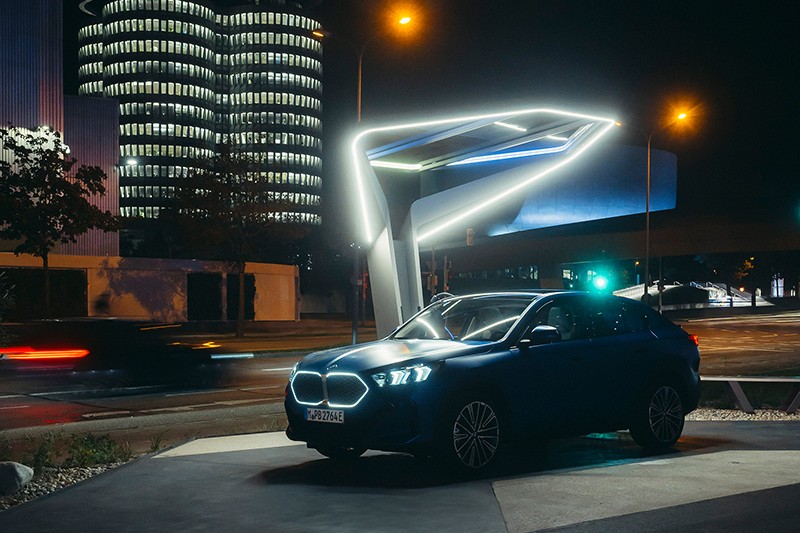
According to electrive, Designworks – the BMW Group’s innovation studio – installed a new charging park in front of the BMW Welt in Munich. The park features eight public charging stations, each capable of delivering up to 400 kW, and the units are styled as “Charging Trees” that light up with LED displays during the charging process.
The stations were developed in collaboration with Designworks and are equipped with sensors that detect approaching vehicles, enabling a seamless user experience. BMW describes the aesthetic as “a touch of tech magic” and markets the hardware as a blend of “futuristic design with high‑performance charging technology.”
"futuristic design with high-performance charging technology"
Beyond the visual impact, the technical choice of 400 kW is significant. At that power level, a compatible EV can add roughly 200 km of range in under ten minutes, according to industry benchmarks. However, such high‑power chargers require substantial electrical infrastructure, often involving three‑phase 800 V connections and dedicated transformers. Deploying eight of these units in a public plaza suggests a considerable capital outlay, especially when contrasted with the roughly 100 additional underground points that BMW notes, each offering up to 22 kW for longer stays.
The tiered approach – a small number of ultra‑fast chargers complemented by a larger fleet of slower, longer‑duration points – hints at a strategic segmentation. Premium customers, or visitors to the BMW Welt exhibition, can experience rapid top‑up while the broader public can rely on the underground chargers for overnight or extended parking. This mirrors a broader industry pattern where automakers prioritize flagship locations to showcase technology, rather than rolling out dense networks of high‑power stations across city streets.From a grid perspective, the cumulative demand of eight 400 kW chargers could peak at 3.2 MW if all units operate simultaneously at full capacity. While the site’s existing power supply may accommodate such spikes, scaling this model to multiple urban locations would require coordinated upgrades with local utilities, potentially slowing broader adoption of ultra‑fast public charging.
Access to the Charging Trees is 24/7, with payment options limited to credit cards or NFC, according to the source. The narrow one‑way street leading to the chargers also means that traffic flow and parking logistics become part of the user experience, an aspect rarely highlighted in press releases.
Audit & Contradictions
The announcement provides a vivid picture but leaves several key details opaque. All principal claims – the installation of eight 400 kW trees, the involvement of Designworks, the sensor‑based vehicle detection, 24/7 accessibility, and the existence of ~100 underground 22 kW points – are reported solely by the electrive article. No independent outlet has corroborated these specifics, making each point a single‑source claim that must be hedged as “according to the source.”
The fact‑check audit notes a low contradiction level, indicating no overt conflicts within the source itself, but the reliance on a single report underscores the need for independent verification, especially regarding the actual grid impact and the cost structure of the high‑power installations.
Future Outlook
If BMW’s Munich showcase proves popular, competitors may follow suit, deploying eye‑catching ultra‑fast chargers in high‑visibility locations. However, the economic calculus suggests that such installations serve more as brand statements than as scalable solutions for mass EV adoption. Regulators and city planners will likely scrutinize the energy demand of multiple 400 kW sites, potentially prompting new guidelines on grid integration and permitting.
For the broader market, the mixed‑speed strategy could become a template: a limited number of premium fast chargers to attract high‑end users, backed by a dense network of slower, cost‑effective points for everyday charging. The success of this model will hinge on whether the visual allure of “Charging Trees” translates into measurable usage and whether utilities can accommodate the associated power spikes without compromising grid stability.
In the meantime, BMW’s Munich installation stands as a striking illustration of how design, technology, and branding intersect in the evolving EV charging landscape – a reminder that the most dazzling headlines may mask a more modest, incremental approach to building a truly ubiquitous fast‑charging infrastructure.