Lead Hook
When a climate‑tech startup touts a breakthrough—whether it’s a novel carbon‑capture material or a next‑generation hydrogen fuel cell—the headline often reads like a promise to solve a piece of the decarbonisation puzzle. What rarely makes the front page is the modest, low‑cost test that could determine whether the claim ever sees a bank‑rolled pilot. As CleanTechnica notes, a simple “red‑flag” screen can separate the ideas worth a deep‑dive from the glossy proposals that would waste public and private capital.
Deep Dive
According to the source, climate‑tech claims usually bundle two elements: a technical promise and a request for funding, policy support, or market preference. The promise can range from a new reactor to a storage system, while the request may be for grants, procurement contracts, or regulatory carve‑outs. The article argues that treating every claim with the same level of due diligence is inefficient; instead, a quick arithmetic and systems check can reveal whether the claim is even on the right scale.
The first screen is the “denominator.” A technology that works in a lab or a single pilot may not matter at the scale implied. Direct air capture (DAC) is used as an illustration. While DAC can indeed pull CO₂ from the atmosphere, the source stresses that its relevance hinges on three variables: the amount captured, the cost per tonne, and the energy and infrastructure required to run it. Without clear numbers on these variables, a DAC project cannot be compared meaningfully to alternatives such as electrified heat or process redesign.
Hydrogen follows a similar pattern. The source points out that hydrogen can be produced, stored, transported and used, yet when the full chain—production, compression, distribution, station upkeep, and utilisation rates—is accounted for, it often fails to beat direct electrification on cost or efficiency. This is not a statement about the chemistry of hydrogen; it is a systems‑level observation that the “full‑chain” economics matter more than the isolated capability of any single component.
Storage technologies receive the same scrutiny. Many can demonstrate physical feasibility, but the article warns that commercial viability evaporates if the solution depends on rare geology, low‑cost electricity, high utilisation, or extensive subsidies. In other words, a battery that only works in a salt‑cave or a pumped‑hydro plant that needs cheap night‑time power may never scale without a confluence of favourable conditions.
Beyond the technical math, the source highlights an institutional screen. Heavy‑weight assets—ships, ports, steel mills, pipelines—have lifespans measured in decades. Introducing a new technology that requires a parallel rollout of new infrastructure can be a non‑starter unless the timeline aligns with the existing asset turnover. As the article observes, many promising ideas may only become viable “eventually,” once the surrounding ecosystem catches up.
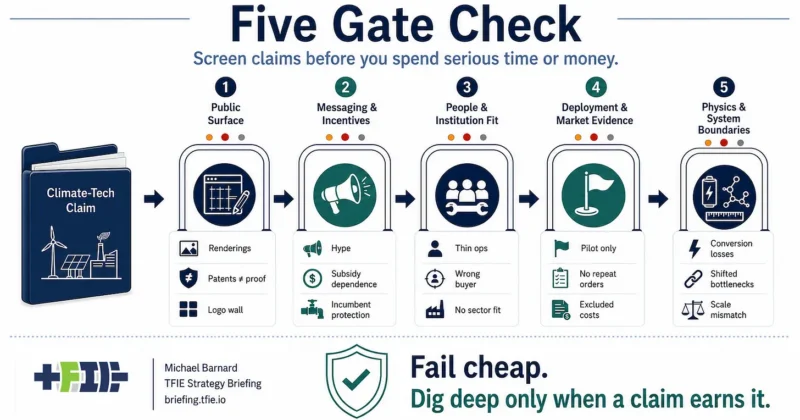
All these observations converge on a single recommendation: employ a cheap, early‑stage red‑flag assessment to decide whether to allocate deeper resources. The screening asks basic questions—what is the scale, what is the evidence (performance vs. activity), where are the boundaries, what are the alternatives, and does the institutional context support adoption? If the answer to any of these is weak, the claim should be paused, refined, or discarded before large sums of money are committed.
Audit & Contradictions
The CleanTechnica piece provides a clear analytical framework but does not present external corroboration for its assertions. According to the fact‑check audit, every key point—such as the pairing of technical promises with funding requests, the utility of a cheap red‑flag screen, the cost‑and‑energy sensitivity of DAC, the comparative weakness of hydrogen versus electrification, and the commercial fragility of many storage concepts—appears only in this single source. As a result, each claim must be hedged with language like “according to the source” or “the article suggests.” No contradictions were identified in the independent outlets listed, so the overall contradiction level is low.
Future Outlook
If investors, governments, and corporations adopt the red‑flag methodology as an informal gatekeeper, the climate‑tech funding landscape could shift dramatically. Projects that already sit on existing infrastructure—such as battery storage paired with a grid that already has low‑cost renewable energy—may clear the screen more easily than novel concepts that require new pipelines or hydrogen stations. This could concentrate capital into incremental improvements rather than disruptive breakthroughs, potentially slowing the emergence of high‑risk, high‑reward technologies.
Regulators may also take note. By embedding the red‑flag criteria into grant eligibility or procurement guidelines, public agencies could create a de‑facto filter that aligns funding with systemic efficiency rather than headline‑grabbing promises. However, policymakers must balance this efficiency with the need to nurture early‑stage innovation that may not yet meet all screening thresholds but could become viable with targeted support.
For venture capital firms, the article’s framework offers a low‑cost triage tool. Instead of spending months on deep technical due diligence for every pitch, firms can apply the red‑flag checklist to quickly weed out proposals that lack a clear denominator, robust performance data, or realistic institutional pathways. Those that pass could then receive the more intensive analysis required for larger investments.
In sum, the red‑flag approach does not promise to solve the climate‑tech funding dilemma, but it does offer a pragmatic first filter. By forcing claimants to articulate scale, evidence, boundaries, alternatives, and institutional fit, the method could prevent misallocation of capital while still leaving room for truly transformative solutions to emerge—provided the gatekeepers remain vigilant about not letting the screen become a barrier to breakthrough innovation.
Key Takeaways
- A quick “red‑flag” screen can identify low‑value climate‑tech claims before large sums are committed.
- The screen focuses on scale, hard performance data, system‑level economics, and institutional compatibility.
- Adopting the methodology could steer public and private capital toward projects that are ready for deployment, while still preserving pathways for high‑risk breakthroughs.