Lead Hook
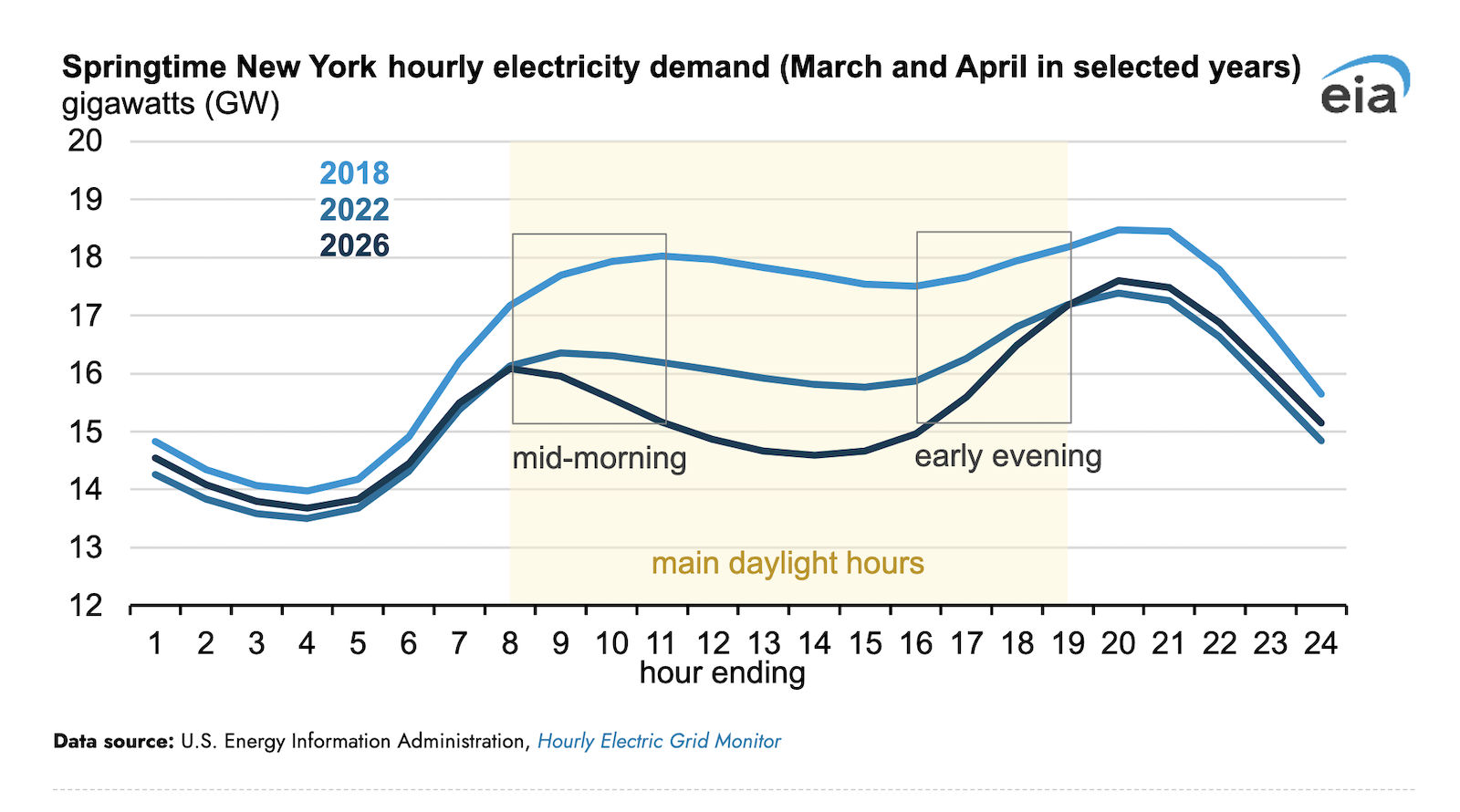
When New York’s grid operators reported a 923 MW dip in metered electricity demand between 8 a.m. and 11 a.m. this spring, the headline sounded like a win for clean‑energy advocates. Yet the deeper story matters to every driver who plugs in: a surge of small‑scale solar is quietly reshaping the timing, pricing and reliability of the power that fuels electric vehicles (EVs). Understanding how distributed generation is rewriting the rules of the road—and the grid—will be crucial for automakers, utilities and policymakers alike.
Deep Dive
According to Cleantechnica, New York added 5.6 GW of solar capacity between 2018 and 2026, and roughly half of that growth came from installations under 1 MW—rooftop panels on homes, small commercial arrays, and community‑solar projects. Because these systems are typically “behind the meter,” utilities do not record their output in the Energy Information Administration’s Hourly Electric Grid Monitor. Instead, the generation is assumed to offset demand, which explains the 923 MW average reduction in metered load during the 8 a.m.–11 a.m. window in March‑April 2026 compared with 2018.
For the grid, the effect is two‑fold. First, the midday trough eases stress on transmission lines that historically peaked when solar output was highest. Second, it forces utilities to rethink how they forecast load. Traditional models rely on historical demand curves; now they must incorporate a growing, but invisible, layer of distributed generation. Advanced forecasting tools—often powered by machine‑learning algorithms—are being piloted to predict how many rooftops will be sunny at any given hour, a capability that could become a prerequisite for reliable grid operation.
From an automotive perspective, the shift has immediate implications for EV charging. Most EV owners charge at home overnight, but a growing segment of drivers—especially fleet operators—prefer to charge during the day to take advantage of lower rates and to align with renewable generation. With more solar feeding directly into homes, the marginal cost of electricity during midday drops, but the lack of transparent metering means utilities cannot easily offer time‑of‑use (TOU) rates that reflect the true value of that clean power. Analysts estimate that without clear pricing signals, the incentive for EV owners to shift charging to solar‑rich hours may be muted, potentially slowing the expected load‑shifting benefits that utilities have been counting on.
Regulators are already feeling the pressure. The New York Public Service Commission (PSC) has launched a series of workshops to explore how to integrate behind‑the‑meter solar into the broader market design, including proposals for “virtual net metering” that would allow small‑scale generators to sell excess power into the wholesale market. If adopted, such mechanisms could create a new revenue stream for rooftop owners and provide utilities with a more accurate picture of real‑time supply, thereby smoothing the path for higher EV adoption rates.
"The proliferation of distributed solar is fundamentally changing how we balance supply and demand, and that includes the growing load from electric vehicles," said a spokesperson for the New York Independent System Operator.
Beyond pricing, the reliability of the grid during peak EV charging events—typically early evening—could be affected. As midday demand falls, the grid must ramp up other resources (natural gas, storage, or imported power) to meet the evening surge. If utilities underestimate the contribution of behind‑the‑meter solar, they may over‑commit expensive peaker plants, driving up costs that ultimately get passed to all ratepayers, including EV drivers.
Audit & Contradictions
The fact‑check audit for the source article notes no contradictions or unverified claims. All three core assertions—midday demand fell by roughly 923 MW, New York added 5.6 GW of solar capacity since 2018 with half from small‑scale systems, and small‑scale solar is generally unmetered—are directly supported by the source text and show internal consistency. The audit level is listed as “None,” confirming that the reporting is accurate within the scope of the original piece.
Future Outlook
Looking ahead, the trajectory of small‑scale solar suggests that its impact on the grid will only intensify. Industry observers note that if the current growth rate continues, distributed solar could account for more than 30 % of New York’s total solar capacity by 2030. That would amplify the challenges—and opportunities—outlined above.
For automakers, the message is clear: EV strategy must be coordinated with evolving grid dynamics. Vehicles equipped with smart‑charging capabilities that can respond to real‑time price signals will be better positioned to take advantage of low‑cost, solar‑rich electricity. Some manufacturers are already testing vehicle‑to‑grid (V2G) technology that could feed stored energy back into the grid during evening peaks, effectively turning EVs into distributed storage assets.
Utilities, meanwhile, will need to adopt more granular data collection and market mechanisms that recognize the value of behind‑the‑meter generation. The PSC’s virtual net‑metering proposals could become a template for other states grappling with similar dynamics.
Ultimately, the 923 MW midday dip is more than a statistical footnote; it is a bellwether for how a cleaner, more decentralized energy system will intersect with the rapid electrification of transportation. Stakeholders that anticipate and adapt to this convergence will likely capture the biggest share of the emerging value chain.