Lead Hook
Policymakers and investors are racing to fund the next breakthrough that will cut emissions, but a flood of glossy proposals risks squandering scarce capital on technologies that never scale. The CleanTechnica analysis argues that a quick “red‑flag” screen can separate the plausible from the speculative before billions are pledged. Ignoring this screening could lead to stranded projects, delayed decarbonisation, and a credibility crisis that hampers future funding.
Deep Dive
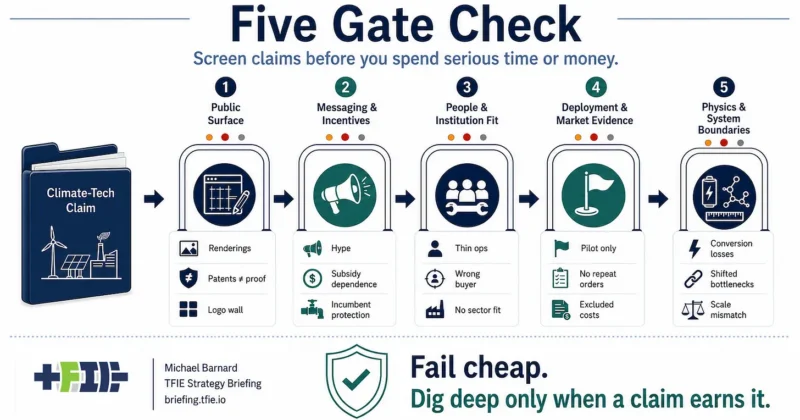
The piece outlines a four‑step framework for early‑stage vetting. First, it asks whether a claim includes both a promise—a solution to a specific decarbonisation problem—and a request for public money, private capital, or regulatory preference. According to the CleanTechnica analysis, climate‑tech claims often pair such a promise with a request for funding, policy support, or procurement preference. This structure masks a crucial question: does the technology actually deliver at the scale implied?
Second, the article recommends a “cheap red‑flag” screen that checks basic arithmetic and publicly available data. Many weak claims fail on simple public information and arithmetic. The screen looks for missing denominators—such as the total amount of CO₂ that can be captured per year or the megawatt‑hours of hydrogen that could replace grid electricity. If a claim only works in a laboratory, a single pilot truck, or a niche ferry route, the denominator is effectively zero for the broader market.
Third, the source stresses the need to distinguish between performance evidence and mere activity evidence. Announcements, memoranda of understanding, or grant awards do not prove that a technology can operate reliably at scale. A pilot plant may demonstrate that a process works, but it does not guarantee cost competitiveness, long‑term durability, or market adoption.
Fourth, the article warns against overly narrow boundaries that shift costs to “someone else’s problem.” For example, a fuel‑cell vehicle might look clean at the tailpipe, yet the upstream emissions from hydrogen production, compression, and distribution are often omitted. The same logic applies to direct air capture (DAC): while DAC can remove CO₂, the analysis notes that its cost, energy use and scalability remain uncertain. Without accounting for compression, transport, storage, and monitoring, the net emissions benefit can evaporate.
The analysis also observes that hydrogen can be used for energy, but it often does not outperform direct electrification when full system costs are considered. Each conversion step—electrolysis, compression, transport, reconversion—incurs efficiency losses that can make hydrogen less attractive than a direct electricity supply, especially as the grid decarbonises rapidly.
These four screens collectively aim to prevent the allocation of capital to projects that look promising on paper but lack the economic or infrastructural footing to succeed. As the author points out, technologies described as “could work eventually” are not near‑term solutions and therefore should not receive immediate policy preference or large‑scale financing.
Audit & Contradictions
The original article makes several substantive assertions, all drawn from the same CleanTechnica piece and therefore constitute single‑source claims. The fact‑check audit notes that the following statements are not corroborated by any independent outlet:
- Climate‑tech claims typically bundle a promise with a request for funding or policy support.
- A cheap red‑flag screening can identify weak claims before deep‑dive analysis.
- Direct air capture can remove CO₂, yet its cost, energy use, and scalability remain uncertain.
- Hydrogen may be used for energy, but it often fails to beat direct electrification when full‑system costs are accounted for.
- Many weak climate‑tech claims fail on basic public information and simple arithmetic.
Because these points appear only in the CleanTechnica piece, they are presented with hedging language such as “according to the source” or “the article suggests.” No contradictions were identified in the audit, and the contradiction level is listed as low.
Future Outlook
If investors and regulators adopt the red‑flag framework, the climate‑tech market could shift toward projects that demonstrate clear, quantifiable pathways to scale. Companies that already publish detailed cost‑per‑tonne CO₂ removed, megawatt‑hour hydrogen production efficiencies, or full‑life‑cycle emissions will gain a competitive edge. Conversely, startups that rely on vague letters of intent or single‑unit pilots may find funding pipelines drying up unless they quickly provide the missing denominators.
Regulators could embed the screening into grant eligibility criteria, ensuring that public money only flows to technologies that have passed the basic arithmetic test. Such policy tightening would also reduce the risk of stranded assets—large‑scale infrastructure that becomes obsolete because the underlying technology never reaches commercial viability.
In the longer term, the approach may encourage a more disciplined innovation ecosystem, where engineers focus on solving the full‑chain efficiency puzzle rather than showcasing isolated breakthroughs. That could accelerate genuine decarbonisation pathways, from grid‑scale battery storage to low‑carbon fuels, and preserve the credibility of climate‑tech financing for the next decade.