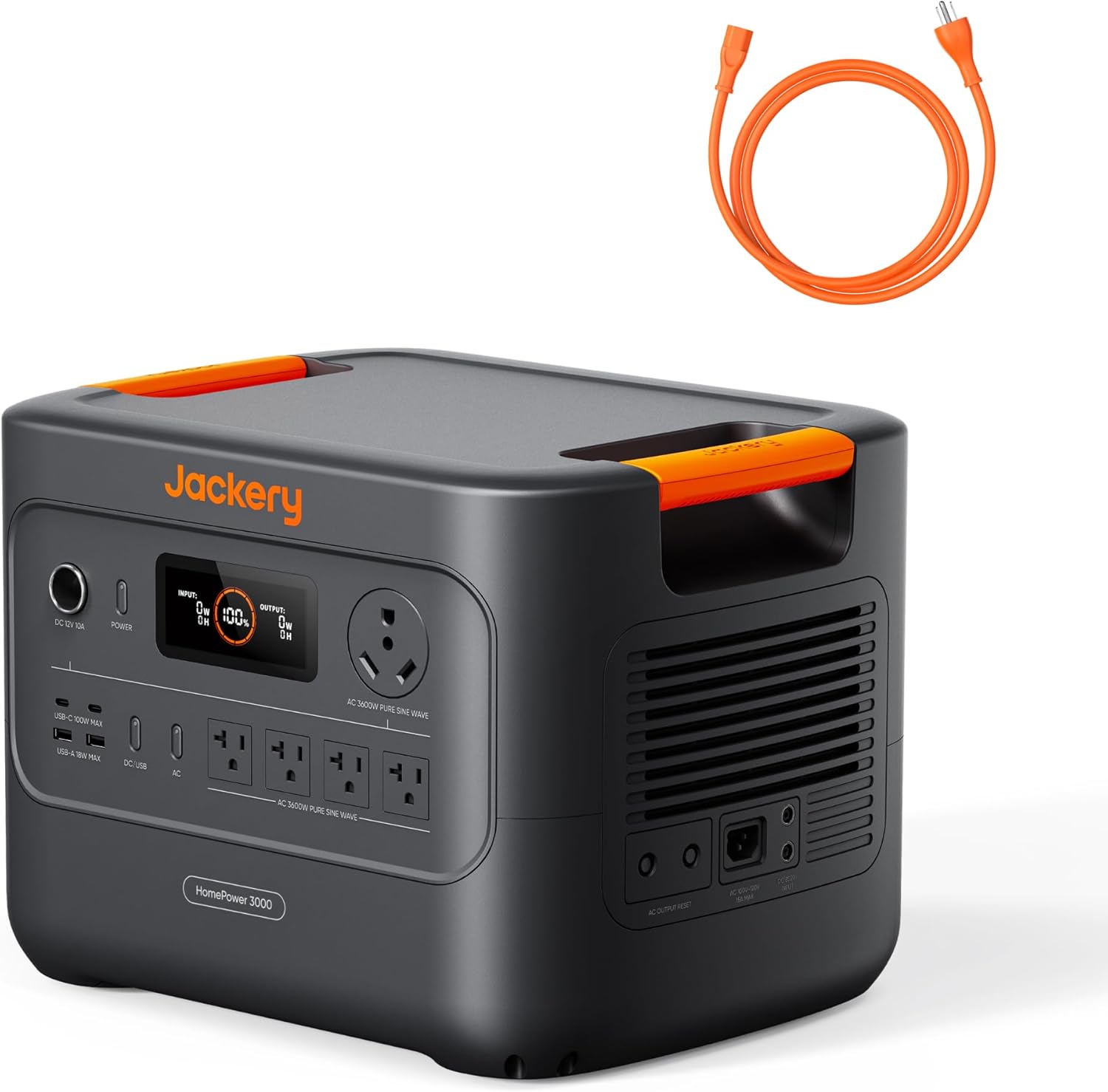
The HomePower Revolution: Jackery’s Bold Bet on Residential Energy Storage
Jackery’s launch of its latest HomePower battery lineup—including the HomePower 1000 v2, HomePower 2000 Plus v2, and the flagship HomePower 3600 Pro Max—arrives at a pivotal moment for the residential energy storage market. As blackouts, grid instability, and the push for energy independence intensify, Jackery is positioning itself as a one-stop solution for homeowners seeking resilience. But beneath the glossy marketing lies a labyrinth of technical claims, supply chain dependencies, and economic projections that demand scrutiny.
The timing couldn’t be better—or riskier. The global energy storage market is projected to grow at a compound annual rate of 20% through 2030, driven by solar-plus-storage adoption and government incentives. Yet, as Jackery rolls out its latest offerings, industry observers are raising questions about the veracity of its claims, the sustainability of its supply chain, and the long-term viability of its business model. What’s real, and what’s just cleverly packaged corporate hype?
The Technical Facade: What’s Under the Hood?
At first glance, Jackery’s new batteries appear to deliver on their promises. The HomePower 3600 Pro Max, for instance, boasts 3584Wh of storage capacity, scalable up to 43kWh with add-on batteries, and the ability to output both 240V and 120V simultaneously. These features are designed to appeal to homeowners looking to power everything from refrigerators to electric vehicles during outages. The use of LFP (lithium iron phosphate) cells, which the company claims offer over 6,000 cycles—translating to more than 16 years of daily use—further cements its appeal in a market where battery degradation is a persistent concern.
However, the devil is in the details. While Jackery’s claims about cycle life and scalability are technically plausible—LFP chemistry is indeed known for its longevity—the company’s projections about real-world performance remain unverified. Industry analysts note that cycle life estimates are often based on ideal conditions, such as controlled temperatures and low discharge rates, which rarely mirror the chaotic reality of residential use. “Cycle life is a lab metric, not a real-world one,” says an energy storage analyst at BloombergNEF. “Degradation accelerates with heat, depth of discharge, and inconsistent charging patterns.”
The HomePower 2000 Plus v2’s touted 34% weight reduction compared to its predecessor is another highlight, but the significance of this feature is context-dependent. While lighter batteries are easier to install and move, they often come at the cost of energy density—a critical factor for homeowners with limited space. Jackery does not disclose whether this weight reduction sacrifices capacity or longevity, leaving potential buyers in the dark.
Audit & Contradictions: Where Marketing Meets Reality
The Pricing Paradox: ‘Super Early Bird’ or Smoke and Mirrors?
Jackery’s announcement of a “super early bird” pricing promotion for its new batteries is ripe for skepticism. The article cites this promotion as a major selling point, but no verifiable details—such as expiration dates, terms, or retailer participation—are provided. This lack of transparency is a red flag in an industry where pricing transparency is increasingly expected, especially as federal and state incentives (e.g., the U.S. Inflation Reduction Act’s 30% tax credit for residential storage) complicate upfront costs.
Industry observers suggest that such promotions are often used to create artificial urgency, driving early sales while masking the true long-term cost of ownership. “Early bird pricing is a classic marketing tactic,” says a solar industry consultant. “It’s designed to make you act now, not necessarily to save you money.”
The $4,238 Savings Claim: A Fantasy or a Fact?
Perhaps the most eyebrow-raising claim is that the HomePower 3600 Pro Max can save homeowners up to $4,238 annually. This figure is presented without context, leaving critical questions unanswered: What utility rates are assumed? How much solar generation is required to offset grid dependence? What’s the baseline for comparison?
Per the U.S. Energy Information Administration, the average U.S. residential electricity price in 2025 was $0.17/kWh, but this varies wildly by state and time-of-use rates. Jackery’s savings claim likely hinges on high utility rates, net metering policies, and heavy solar integration—factors that are not universal. “This is a best-case scenario number,” notes an energy economist at MIT. “For most homeowners, the savings would be a fraction of that.”
The Generator Comparison: A Biased Benchmark?
Jackery’s comparison of the HomePower 3600 Pro Max to a Honda EU2000i portable generator is another area ripe for scrutiny. While the article highlights the battery’s silent operation and lack of emissions, it omits key trade-offs. Portable generators, for instance, can run indefinitely with refueling, whereas Jackery’s batteries are limited by capacity and recharge times. Noise, emissions, and fuel costs are real-world factors that the comparison glosses over.
According to the EPA, portable generators emit harmful pollutants like carbon monoxide and nitrogen oxides, which are absent in lithium-ion systems. However, the article frames the comparison as a straightforward win for Jackery without acknowledging the operational limitations of battery systems in prolonged outages. “This is a classic case of cherry-picking metrics,” says a clean energy advocate. “It’s not about what’s better, but what’s better for a specific use case.”
The Supply Chain Tightrope: Lithium’s Long Shadow
Jackery’s reliance on LFP chemistry places it squarely in the crosshairs of the lithium supply chain—a market fraught with geopolitical risks, price volatility, and ethical concerns. While LFP avoids the cobalt supply chain issues plaguing NMC batteries, it is not without its own challenges. The majority of LFP cathode material is produced in China, which controls roughly 80% of the global lithium processing capacity. This dependency exposes Jackery to tariffs, trade wars, and regulatory shifts—factors that could disrupt production or inflate costs.
Moreover, the environmental cost of lithium mining, even in LFP form, remains a contentious issue. While LFP batteries contain no cobalt, they still require significant lithium, nickel, and graphite inputs. According to a 2024 report by the International Energy Agency, lithium demand is projected to grow 40-fold by 2040, raising questions about the sustainability of Jackery’s long-term sourcing strategy.
Future Outlook: Can Jackery Sustain the Hype?
Jackery’s entry into the residential energy storage market is a high-stakes gamble. On one hand, the company’s focus on modularity, scalability, and LFP chemistry aligns with growing consumer demand for flexible, long-lasting solutions. On the other, its reliance on unverified claims, supply chain vulnerabilities, and aggressive marketing tactics risks eroding trust in a market that is increasingly savvy about greenwashing.
Competitors like Tesla, LG Energy Solution, and Enphase are not standing still. Tesla’s Powerwall 3, for instance, offers a sleeker design and deeper integration with solar, while Enphase’s IQ Battery boasts a modular architecture that competes directly with Jackery’s scalability pitch. Industry analysts suggest that Jackery’s success will hinge on three factors: (1) the real-world performance of its batteries, (2) the transparency of its pricing and incentives, and (3) its ability to navigate the lithium supply chain’s choppy waters.
For now, Jackery’s HomePower batteries remain a tantalizing but unproven proposition. The company’s bold claims—from cycle life to cost savings—are not inherently false, but they are not universally applicable either. As the residential energy storage market matures, consumers and regulators alike will demand more rigorous data, independent testing, and transparent pricing. Until then, Jackery’s latest launch is less a revolution and more a high-stakes experiment in market positioning.
Key Takeaways for Consumers:
- Do the math: Jackery’s savings claims are context-dependent. Calculate your own potential savings based on your utility rates, solar generation, and energy usage.
- Ask for proof: Demand independent testing data for cycle life and real-world performance. Lab conditions ≠ home conditions.
- Weigh the trade-offs: Lighter batteries may be easier to install, but they might sacrifice capacity or longevity. Compare specs carefully.
- Consider the bigger picture: Lithium supply chain risks and geopolitical factors could impact future pricing and availability. Diversify your energy strategy if possible.
Final Verdict: Innovation or Illusion?
Jackery’s HomePower batteries are a microcosm of the broader residential energy storage market: full of promise, but clouded by uncertainty. The company’s technical innovations—scalability, dual-voltage output, and LFP chemistry—are undeniably valuable, but their real-world benefits remain to be proven. As the market evolves, Jackery will need to move beyond marketing fluff and deliver on the hard data if it hopes to carve out a lasting niche.
For now, the HomePower lineup is a gamble—a bet that consumers will prioritize convenience and brand trust over rigorous scrutiny. Whether that bet pays off remains to be seen.