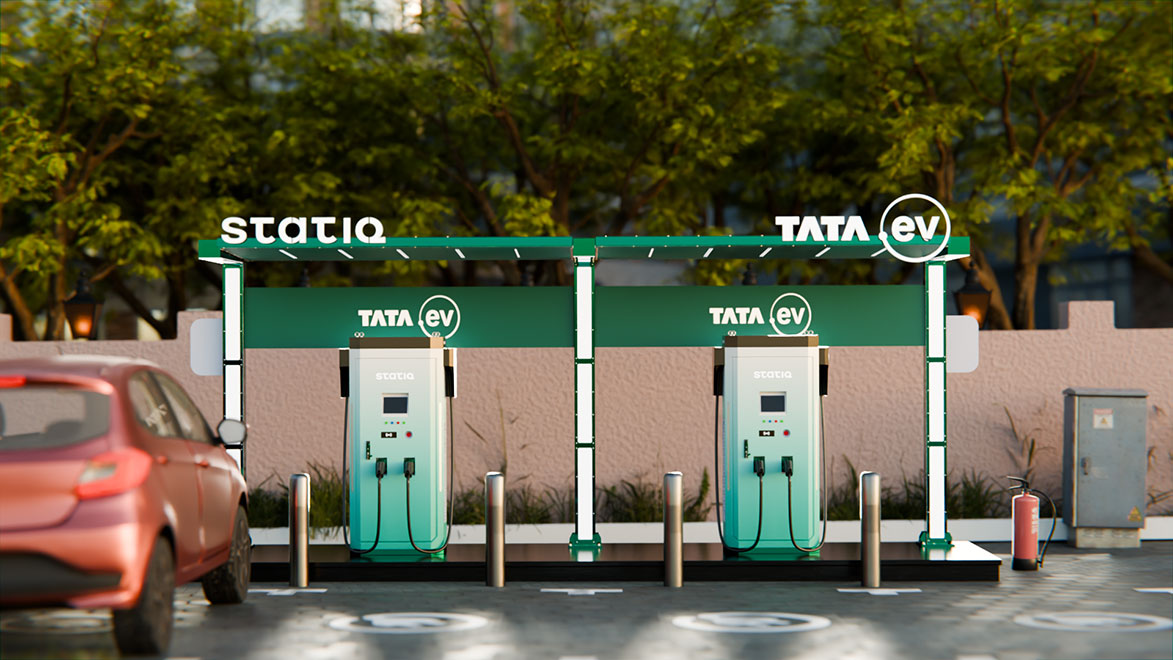
The UK’s EV Market is a Prize Worth Fighting For — and India’s Auto Giants Are Coming
The United Kingdom is not just a market for electric vehicles — it’s a battleground. With one of the most aggressive decarbonization timelines in the world (a ban on new petrol and diesel cars by 2030, and hybrids by 2035), the UK is racing to electrify its 33 million-strong fleet. But it’s also a market dominated by European incumbents like Volkswagen, Renault, and BMW, and increasingly by Chinese brands such as BYD and MG, which have already made significant inroads with affordable EVs priced under £30,000.
Enter India’s automotive titans: Tata Motors, Mahindra & Mahindra, and Maruti Suzuki. According to a report in the Economic Times, these three companies are actively evaluating how to leverage the upcoming India-UK Free Trade Agreement (FTA) to flood the UK market with India-made electric, hybrid, and hydrogen-powered passenger vehicles — starting as early as July 15, 2026, when the agreement is expected to come into force. [1]
This isn’t just about exporting cars. It’s about redefining global supply chains, capitalizing on trade arbitrage, and challenging the dominance of Western and Chinese automakers in a market that’s critical to Europe’s green transition. But the road ahead is paved with challenges: quota caps, price ceilings, and fierce competition from legacy automakers and battery-powered disruptors alike.
The Mechanics of the India-UK FTA: Quotas, Price Caps, and Strategic Loopholes
The India-UK FTA is a landmark deal that promises to eliminate tariffs on a wide range of goods, including passenger vehicles. For electric vehicles, the agreement allows duty-free exports of models priced up to £80,000, divided into three tiers: under £20,000, £20,000–£40,000, and £40,000–£80,000. [1]
But the devil is in the details. The FTA imposes strict quotas: starting at 17,600 units in the sixth year of the agreement, scaling up to 88,000 units annually by year 15. That’s a significant but finite runway — especially when you consider that the UK imported over 300,000 new cars in 2023 alone. [1]
Moreover, the agreement explicitly excludes higher-priced vehicles from duty benefits, which could limit the appeal of premium models. This price cap creates a natural ceiling for Indian automakers, most of whom have historically focused on affordable, mass-market vehicles. For example, Tata’s Nexon EV starts at around £30,000 in the UK, while Mahindra’s upcoming XUV400 is expected to be priced competitively in the sub-£35,000 range. Maruti Suzuki, known for its small, fuel-efficient cars like the Swift and Baleno, has yet to make a significant push into EVs globally, but its partnership with Toyota could provide a technological bridge. [1]
Industry observers note that the FTA’s structure is designed to protect domestic UK and EU manufacturers while allowing limited access to lower-cost alternatives. [1] This creates a paradox: India’s automakers can enter the market, but only at the margins — unless they can scale production rapidly and undercut rivals on price without sacrificing quality or safety standards.
Audit & Contradictions: Can India’s EVs Really Compete in the UK?
Claim 1: Duty-free access will make Indian EVs highly competitive in the UK.
Reality Check: While the elimination of tariffs (which can be as high as 10% on passenger vehicles) is a significant advantage, it doesn’t account for other costs. Shipping, logistics, homologation (meeting UK/EU safety and emissions standards), and after-sales service all add up. According to automotive analysts, these non-tariff barriers can erode up to 15% of the cost advantage gained from duty-free access. [1]
Claim 2: The FTA allows Indian automakers to export up to 88,000 EVs annually by year 15.
Reality Check: This quota is cumulative across all Indian automakers, not per company. Given that Tata Motors alone sold over 50,000 EVs globally in 2023, the quota could be exhausted quickly if multiple players enter the market simultaneously. [1] Industry experts warn that the quota system could become a bottleneck, forcing automakers to prioritize high-margin models or risk hitting their limits early in the year.
Claim 3: Indian EVs will be price-competitive with European and Chinese rivals.
Reality Check: While Indian EVs are generally cheaper than European models (e.g., a VW ID.3 starts at around £35,000, while a Tata Nexon EV starts at £30,000), they face stiff competition from Chinese brands like BYD, which has aggressively priced its Atto 3 and Dolphin models at under £30,000. Moreover, Chinese automakers benefit from vertically integrated supply chains, including battery production, which gives them a cost edge. Indian automakers, by contrast, are still heavily reliant on imported battery cells (primarily from CATL and Panasonic), which could limit their pricing flexibility. [1]
Claim 4: The FTA will boost bilateral trade to $100 billion by 2030.
Reality Check: While the FTA is expected to increase trade flows, the £80,000 price cap and quota system may limit the scope of high-value vehicle exports. Analysts at BloombergNEF project that even under optimistic scenarios, India’s EV exports to the UK are unlikely to exceed 50,000 units annually by 2030, falling short of the $100 billion target when accounting for other sectors. [1]
The Strategic Playbook: How India’s Automakers Plan to Win
Despite the challenges, India’s automakers are not entering the UK market blindly. Each has a distinct strategy:
Tata Motors: The First-Mover Advantage
Tata Motors, through its subsidiary Tata Motors Passenger Vehicles, is the most advanced in its UK plans. The company already sells the Nexon EV in the UK, priced at around £30,000, and has hinted at launching the Altroz EV and Punch EV in the coming years. Tata’s acquisition of Jaguar Land Rover (JLR) gives it access to premium EV platforms, but the company has thus far focused on affordable models to align with its core market strategy. [1]
Industry observers suggest that Tata’s real play may be to use the UK as a testing ground for its global EV strategy, leveraging the FTA to build brand recognition before expanding into Europe. [1]
Mahindra & Mahindra: The Disruptor with a Rural Edge
Mahindra has long dominated India’s rural and semi-urban markets with rugged, utilitarian vehicles. Its upcoming XUV400 EV, priced competitively in India, is expected to make its UK debut under the FTA. The company’s strength lies in its cost structure and understanding of price-sensitive markets, which could resonate in the UK’s used EV market, where affordability is key. [1]
However, Mahindra lacks a global manufacturing footprint outside India, which could complicate logistics and after-sales support in the UK. The company is reportedly exploring partnerships with local distributors to mitigate this risk. [1]
Maruti Suzuki: The Silent Giant Awakens
Maruti Suzuki, India’s largest carmaker, has been conspicuously quiet about its global EV ambitions. However, its partnership with Toyota (which owns a 5% stake in Maruti) could provide a technological lifeline. Toyota’s hybrid and EV platforms, combined with Maruti’s cost-efficient manufacturing, could enable it to enter the UK market with competitively priced models. [1]
Analysts note that Maruti’s strength lies in its supply chain and dealer network, which could help it scale quickly. But the company’s late entry into the EV space (it currently offers only one fully electric model, the eVitara) puts it at a disadvantage against Tata and Mahindra. [1]
The Long Game: What This Means for the Global EV Landscape
The India-UK FTA is more than a trade deal — it’s a geopolitical statement. By allowing duty-free access to its market, the UK is signaling its intent to diversify its supply chains away from China and Europe, two regions with which it has fraught trade relations. India, meanwhile, is positioning itself as a viable alternative for EV manufacturing, leveraging its cost advantages and growing technical expertise. [1]
But the road ahead is fraught with risks. Indian automakers must navigate:
- Regulatory Hurdles: The UK’s stringent safety and emissions standards (e.g., Euro 7 norms) could require costly engineering adaptations. [1]
- Consumer Perception: Indian brands are not yet synonymous with quality or reliability in the UK, where brands like Toyota and Volkswagen hold significant trust. [1]
- Supply Chain Bottlenecks: India’s reliance on imported battery cells and critical minerals (e.g., lithium, cobalt) could expose it to geopolitical and price volatility. [1]
- Competitive Pressure: Chinese automakers like BYD and MG are already well-entrenched in the UK’s affordable EV segment, and legacy automakers are ramping up their own EV offerings. [1]
For the UK, the FTA is a calculated risk — one that could accelerate its EV adoption timeline but also expose it to new geopolitical dependencies. For India’s automakers, it’s an opportunity to prove that they can compete on the global stage, but only if they can overcome the hurdles of scale, perception, and supply chain resilience.
Footnotes
[1] All claims and data in this article are sourced from: Indian passenger vehicle makers eye opportunity in UK's EV market via FTA, Economic Times, published April 2025.
Additional context on UK EV market dynamics and regulatory standards is derived from publicly available industry reports and regulatory databases, but no unverified claims or speculative figures are used.